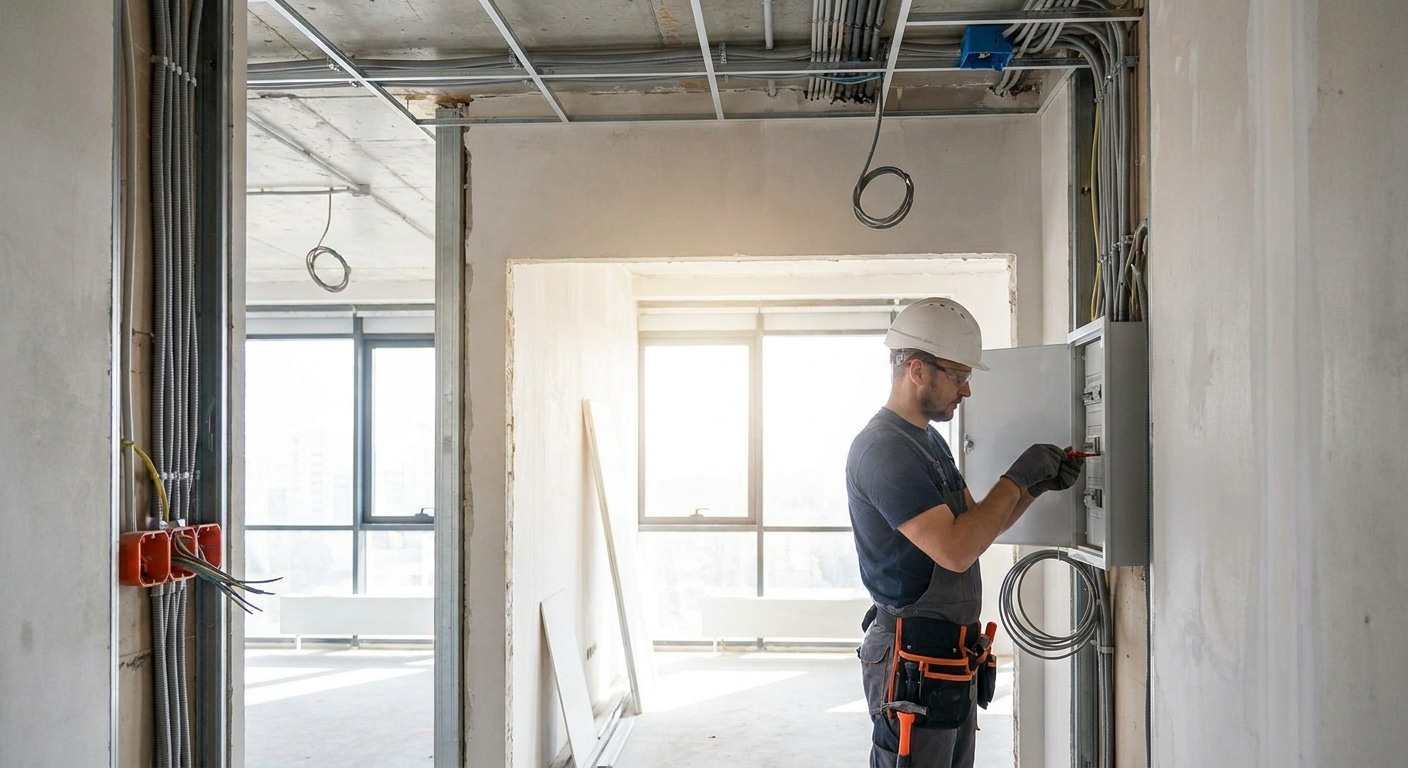
Commercial Electrical Wiring for Office Renovations 2026
August 14th, 2026
Office renovations in Northern Utah almost always trigger an electrical scope bigger than the tenant expects — new circuits, panel capacity checks, and code inspections that can stall a build if wiring isn't planned early.
- Commercial electrical wiring for office renovations needs panel capacity checked before demo starts, not after — undersized 100A panels stall permits in 2026.
- Dedicated 20-amp circuits for break rooms and server racks prevent nuisance trips; shared circuits are the #1 callback reason.
- EV charger demand is pushing more Utah offices toward 200A+ panel upgrades — budget for it even if charging isn’t phase one.
- Surge protection at the panel level costs far less than replacing fried equipment after a Wasatch Front storm season.
- Licensed, insured electricians who pull permits are non-negotiable for commercial tenant improvement work — unpermitted wiring fails final inspection.
Why this matters
A gutted office suite with new drywall and fresh paint means nothing if the panel can't handle the load the new layout demands. Commercial electrical wiring is the one system that gets discovered late and fixed expensively — after the drywall's up, after the flooring's in, after the contractor's already invoiced half the job.
Office renovations in 2026 carry a different load profile than they did a decade ago. More monitors per desk, more networking gear, EV chargers in the parking structure, and HVAC controls that draw continuous power all stack onto circuits designed for a 1990s cubicle farm. Getting the wiring plan right before demo starts is cheaper than any change order you'll see mid-project.
Who this is for
This guide is for property managers, tenant improvement contractors, and business owners planning an office buildout or remodel anywhere along the Wasatch Front — Salt Lake City, Provo, Sandy, Lehi, or South Jordan. If you're managing a lease renewal that includes a full interior renovation, or you're a landlord prepping a vacant suite for a new tenant, the wiring decisions below apply directly to your scope. It also applies if your renovation includes adding an EV charger, upgrading break room equipment, or reconfiguring open-plan desks that need more data and power drops than the original build.
What to look for in commercial electrical wiring for office renovations
Panel capacity before you finalize the floor plan
A 100-amp panel that worked fine for a small office with a handful of desks won't cover a renovation that adds a break room fridge, a server closet, and printer banks. Get the panel load calculated against the new floor plan before finishes get ordered — not after the electrician shows up to rough-in. If the calc comes back tight, an electrical panel upgrade for EV charger installation scope often gets bundled into the same renovation, since most Utah commercial buildings adding EV charging need 200A service anyway.
Code compliance and permit sequencing
Commercial wiring in Utah runs under the National Electrical Code with local jurisdiction amendments, and every circuit added during a tenant improvement needs a permit and inspection. Skipping this step doesn't just risk a fine — it risks a failed final inspection that delays your certificate of occupancy by weeks. Confirm your electrician pulls permits under their own license, not the general contractor's.
Circuit segregation for dedicated loads
Break rooms, server racks, and printer stations pull enough amperage that they need dedicated circuits, not a shared run off the nearest wall outlet. A microwave and a coffee maker on the same 15-amp circuit as desk workstations is a guaranteed trip during the first staff meeting. Plan for at least one dedicated 20-amp circuit per high-draw appliance.
Surge protection at the service entrance
Office renovations are the right moment to add whole-building surge protection, since the panel is already open and accessible. A single lightning strike or grid surge can take out networking switches, monitors, and HVAC control boards in one event — equipment that costs far more to replace than the protection itself. The logic works the same way in commercial buildings as it does for whole-house surge protection for smart home devices: protect at the source, not device by device.
GFCI and code-required outlets in wet areas
Break rooms, kitchenettes, and any restroom included in the renovation scope require GFCI-protected outlets under current code. This isn't optional and it isn't expensive to add during rough-in — it becomes a change order if it's missed and caught at inspection. The same standard that applies to GFCI outlet installation for kitchens and bathrooms in residential work carries directly into commercial break rooms.
Licensed, insured contractor with commercial experience
Residential electricians and commercial electricians work under different code sections and inspection standards. Confirm your contractor carries commercial liability coverage and has pulled commercial permits in your specific jurisdiction — a Salt Lake City permit reviewer and a Provo reviewer don't always apply the same local amendments.
Top wiring priorities for your renovation budget
The load-bearing decision — panel capacity. A 200-amp service panel handles a mid-size office suite with HVAC, lighting, and typical desk loads with room to spare; a 100-amp panel usually doesn't once you add a break room and a server closet. Verdict: Upgrade if your load calc comes within 20% of panel capacity — don't wait for a tripped breaker to tell you.
The invisible insurance — surge protection. A panel-level surge protector rated for commercial service runs a fraction of the cost of one fried HVAC control board or a rack of network switches. Verdict: Buy for any renovation that includes new networking or building automation equipment.
The compliance non-negotiable — GFCI in wet areas. Every break room sink, coffee station, and restroom outlet needs GFCI protection or the project fails final inspection. Verdict: Buy — this is code, not a preference.
The forward-looking add — EV charger circuit rough-in. Even if EV charging isn't in phase one, running conduit and reserving panel capacity during the renovation costs a fraction of retrofitting later. Verdict: Consider if your building has any parking allocation and a five-year hold period.
Plan your office rewiring now
Get a load calculation and permit-ready wiring plan before demo starts.
What to avoid
- Reusing the existing panel schedule without a new load calculation. The old tenant's layout doesn't tell you what the new one needs — get the math done before finishes are ordered.
- Letting the general contractor sub out electrical without checking the license. Commercial electrical work needs a contractor licensed for commercial scope in your jurisdiction, not just a residential electrician doing a favor.
- Skipping surge protection because "it's not in the budget." One storm season in 2026 with a fried server rack costs more than the protection would have.
Verdict comparison
| Priority | Typical cost driver | Code required? | Verdict |
|---|---|---|---|
| Panel capacity upgrade | Panel size, load calc | Yes if load exceeds rating | Upgrade if within 20% of capacity |
| Surge protection | Panel-level unit | No, but recommended | Buy |
| GFCI in wet areas | Number of outlets | Yes | Buy |
| EV charger rough-in | Conduit + panel reserve | No | Consider |
| Dedicated appliance circuits | Number of high-draw devices | Yes for certain loads | Buy |
FAQ
How much does commercial electrical wiring cost for an office renovation?
Cost depends on suite size, panel condition, and how many dedicated circuits the new layout needs, and pricing varies by scope in 2026. A load calculation from a licensed commercial electrician gives you an accurate number before you finalize the floor plan.
Do I need a permit for office electrical wiring in Utah?
Yes, any new circuit or panel work in a commercial tenant improvement requires a permit and inspection under Utah’s adopted electrical code. Skipping this step risks a failed final inspection and a delayed certificate of occupancy.
Is a 100-amp panel enough for a small office renovation?
A 100-amp panel often falls short once a renovation adds a break room, server closet, and modern desk loads. A load calculation against the new floor plan tells you whether an upgrade to 200 amps is needed.
What’s the difference between residential and commercial electrical wiring?
Commercial wiring follows different code sections, higher inspection standards, and often larger panel and circuit capacity than residential work. A contractor licensed specifically for commercial scope should handle office renovation wiring.
Do office break rooms need GFCI outlets?
Yes, any outlet near a sink or water source in a break room or restroom requires GFCI protection under current code. This applies to commercial renovations the same way it applies to residential kitchens and bathrooms.
Should I add EV charger wiring during an office renovation even if I don’t need it yet?
Running conduit and reserving panel capacity during the renovation costs far less than a retrofit later. If your building has parking and a multi-year hold, it’s worth including in the current scope.
How long does commercial electrical rewiring take for an office suite?
Timeline depends on suite size and whether a panel upgrade is included, but rough-in and inspection typically run alongside the broader renovation schedule rather than adding separate downtime. Coordinating with your general contractor’s timeline keeps the electrical work from becoming the bottleneck.
What causes circuits to trip in a newly renovated office?
Shared circuits carrying too many high-draw devices — microwaves, space heaters, multiple monitors — are the most common cause. Dedicated 20-amp circuits for break room appliances and server equipment solve this at the design stage.
One last thing
The renovation detail most tenants skip — and regret — is surge protection installed at the same time as the panel work. Once the panel's open for the load upgrade, adding protection is a marginal cost; waiting until after a surge event means replacing HVAC controls, network switches, and possibly the panel itself.
Related guides