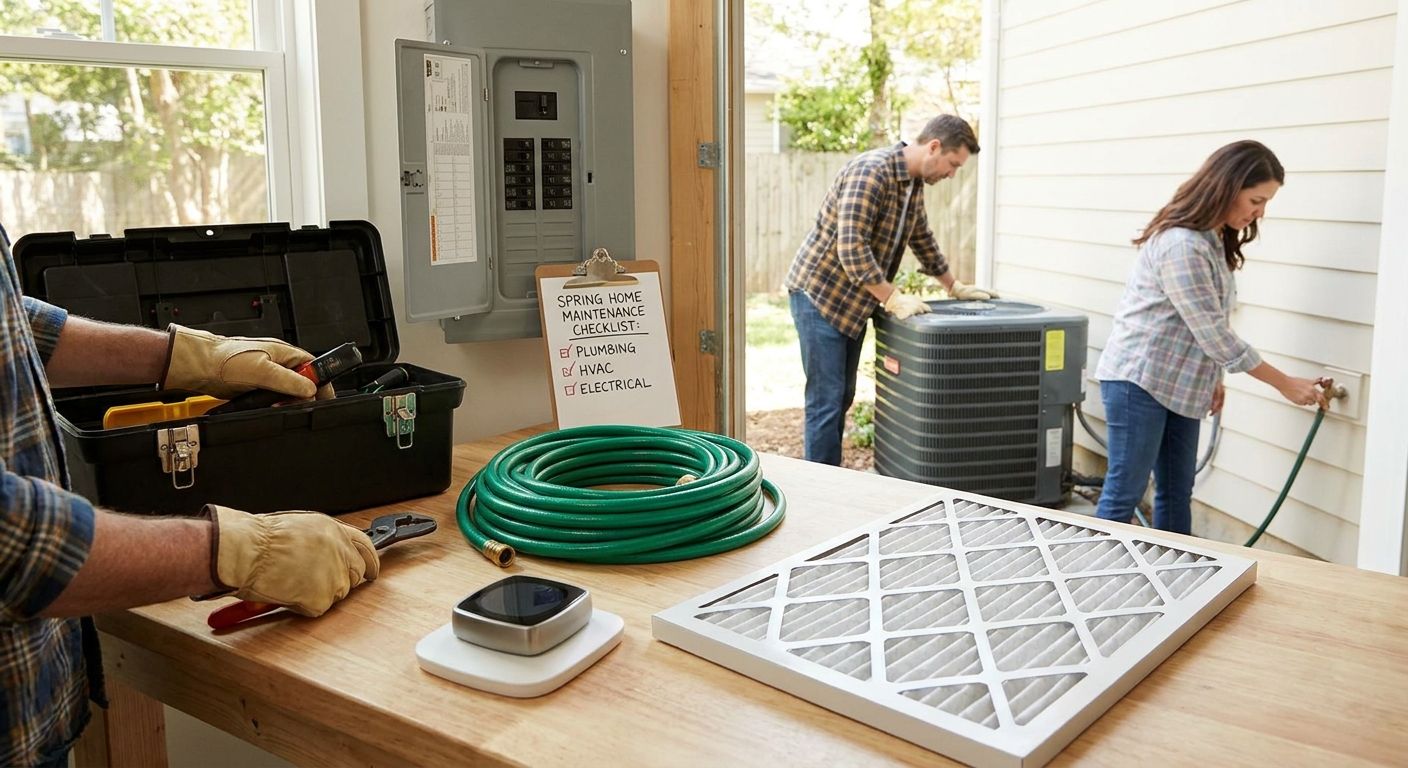
Spring Plumbing, HVAC, Electrical Checklist 2026
September 1st, 2026
Plumbing, HVAC, and electrical systems all take a beating over a Northern Utah winter, and spring is when that damage shows up as a burst spigot, a dead AC compressor, or a tripped breaker at the worst possible moment. A real spring home maintenance checklist for plumbing, HVAC, and electrical covers roughly 15 tasks across the three trades, and running them in the right order in 2026 keeps a slow leak from becoming a flooded crawlspace by June. Freeze-thaw cycles crack pipes you can't see, snowmelt overloads sump pumps, and the switch from furnace season to AC season exposes wiring and panels that sat untouched since October.
- A spring home maintenance checklist for plumbing, HVAC, and electrical covers about 15 tasks across three trades in 2026.
- Test the main water shut-off valve and sump pump before spring snowmelt hits Northern Utah crawlspaces.
- Water pressure above 80 psi and panels under 100 amps are the two most-missed spring red flags.
- Expert Services runs plumbing, HVAC, and electrical checks in one visit for Northern Utah homes.
Why this matters
Winter doesn't damage systems evenly. Plumbing takes the hit from freeze-thaw cycling in exposed pipe runs, HVAC takes the hit from six straight months of furnace runtime with no AC use, and electrical takes the hit from moisture intrusion at outdoor outlets and boxes. Before you turn the water back on outside or plug in a pool pump this spring, test the main water shut-off valve so it isn't seized when you actually need it.
Skip the checklist and the failures show up in the worst sequence possible: a cracked spigot floods a crawlspace during April snowmelt, an AC unit that sat idle all winter won't start on the first 85\u00b0F day of 2026, or a GFCI outlet that failed silently in January trips the moment you plug in a sprinkler timer. None of these are expensive to catch in March. All of them get expensive by July.
What's on a spring maintenance checklist for plumbing, HVAC, and electrical?
| System | Tasks | Timing |
|---|---|---|
| Plumbing | 6 tasks | Before outdoor spigots and irrigation go live |
| HVAC | 5 tasks | Before the first sustained 80\u00b0F day |
| Electrical | 4 tasks | Before outdoor equipment, pools, or added load |
Run plumbing first, HVAC second, electrical last \u2014 that's the order winter damage typically surfaces in, and it's the order that prevents one system's failure from masking another's.
Plumbing spring checklist: 6 tasks before you turn the water back on
- Reopen outdoor spigots and hose bibs slowly, checking for cracks or drips that indicate freeze damage from winter.
- Test the main shut-off valve. If it won't turn smoothly by hand, get it serviced before you need it in an actual emergency, not during one.
- Inspect exposed pipe in crawlspaces and basements for hairline cracks, corrosion, or slow leaks that only show up once water pressure is restored.
- Test the sump pump manually before spring snowmelt raises the water table \u2014 a pump that hasn't run since last fall can fail silently.
- Flush the water heater to clear winter sediment buildup and confirm the thermostat holds at 120\u00b0F, the standard safe setting for residential units.
- Check water pressure at an outdoor spigot. Healthy residential pressure runs 40-80 psi; readings above that strain fixtures, supply lines, and appliances year-round.
Homes with older galvanized or cast iron supply lines see freeze-related cracks more often than PEX-repiped homes, so budget extra inspection time if your house predates the mid-2000s.
HVAC spring checklist: 5 tasks before the first hot day
- Swap the furnace filter one last time before switching to cooling mode \u2014 filters are generally rated for about 90 days, and a clogged one restricts airflow to both systems.
- Clear leaves, mulch, and debris from around the outdoor AC condenser. Winter debris buildup restricts airflow and forces the compressor to work harder from day one.
- Run the AC on a trial cycle before the first 80\u00b0F stretch of 2026, not during it \u2014 a dead capacitor found in March is a scheduled repair; the same failure in July is an emergency call.
- Check thermostat wiring and battery contacts, especially if the furnace ran continuously through a cold Utah winter.
- Have ductwork checked for dust load if allergy symptoms spike every spring; see best home HVAC systems for Utah homes for what a properly sized system should deliver.
Verdict: run the AC trial cycle in March or April, not June \u2014 it's the single HVAC task homeowners skip most and the one that causes the most summer emergency calls.
Electrical spring checklist: 4 tasks before you power up outdoor gear
- Test every GFCI outlet in kitchens, bathrooms, garages, and outdoors using the built-in test/reset button.
- Inspect outdoor outlets and exterior wiring for moisture damage before plugging in mowers, sprinkler timers, or string lighting.
- Check panel capacity if you're adding load this year. Homes built before the 1980s commonly still run 100-amp service; modern additions, EV chargers, and hot tubs often need 150-200 amp capacity. See how to know if you need an electrical panel upgrade if you're planning any of those this spring.
- Test smoke and carbon monoxide detectors and replace batteries \u2014 a task that gets skipped every spring precisely because nothing looks obviously wrong.
Book your 2026 spring system check
One visit covers plumbing, HVAC, and electrical inspection points.
Why spring maintenance timing varies
- Freeze-thaw cycling cracks pipe joints invisibly over winter; the crack only leaks once water pressure returns in spring.
- Snowmelt runoff raises groundwater and overloads sump pumps and sewer lines that handled no load all winter.
- Hard water mineral buildup accelerates in water heaters and fixtures over the heating season, showing up as reduced flow by spring.
- The heating-to-cooling switch means AC components that sat idle for months can fail on first use, not gradually.
- Added seasonal electrical load from mowers, sprinkler controllers, pool pumps, and outdoor lighting exposes weak GFCI protection and undersized panels.
- Older Northern Utah housing stock \u2014 pre-1980s panels, galvanized pipe, original ductwork \u2014 shows every one of these issues earlier and more often than newer construction.
How often should you flush a water heater in Utah?
Flush a water heater once a year, and consider twice a year in homes with notably hard water, since mineral sediment builds up faster and shortens tank life. A tank that's never been flushed often shows reduced hot water output and a rumbling sound as sediment settles at the bottom.
When should you turn on your AC for the first time each year?
Turn on the AC for a trial run in March or April 2026, well before the first sustained 80\u00b0F day, not on the day you actually need cooling. Running it early surfaces a dead capacitor or refrigerant issue while it's a scheduled repair instead of an emergency one.
Do older Utah homes need an electrical panel inspection every spring?
Not every year, but homes with 100-amp service or original panels from before the 1980s should get checked whenever load increases \u2014 a new hot tub, EV charger, or AC upgrade. A panel that handled the house fine for 40 years can still be undersized for what you're adding to it in 2026.
FAQ
What’s the best time to run a spring plumbing, HVAC, and electrical checklist in Utah?
Early-to-mid spring, before outdoor spigots go back into daily use and before the first sustained 80°F day, is the best window in 2026. Running checks this early turns potential emergencies into scheduled repairs.
How often should a water heater be flushed?
A water heater should be flushed once a year, or twice a year in homes with hard water. Sediment buildup reduces hot water capacity and shortens tank lifespan.
What water pressure is too high for a home?
Water pressure above 80 psi is too high for most residential plumbing and appliances. Healthy pressure runs 40-80 psi, and a pressure-reducing valve corrects readings above that.
How often should a furnace filter be changed?
A furnace filter should be changed roughly every 90 days, or more often with pets or allergy concerns. A clogged filter restricts airflow for both heating and cooling.
Is 120 degrees a safe water heater temperature?
120°F is the standard recommended water heater setting for residential use, balancing scald risk against bacterial growth. Checking this setting is part of any spring plumbing review.
Do older Utah homes need electrical panel upgrades?
Many older Utah homes still run 100-amp panels, which is often undersized once EV chargers, hot tubs, or additions get added. A panel upgrade is worth evaluating whenever new electrical load is planned.
When should AC be serviced before summer?
AC should be serviced and test-run in March or April, ahead of the first hot stretch of the year. Catching a failed component early avoids an emergency repair during peak summer demand.
What’s the biggest spring plumbing risk in Utah?
Freeze-thaw pipe damage from winter is the biggest spring plumbing risk, since cracks often stay invisible until water pressure returns. Spring snowmelt adds a second risk by overloading sump pumps and sewer lines.
One last thing
The outdoor spigot nobody checks in January is usually the one that floods a crawlspace in April \u2014 freeze damage happens quietly in winter and only shows itself once water pressure comes back on in spring 2026. Reopen every spigot slowly and watch for a full minute before you assume it's fine.
Related guides
- Preventing hard water damage to pipes and appliances
- Plumbing, HVAC, and electrical maintenance for property managers