Best default for a compatible forced-air furnace: a bypass evaporative humidifier. Best for limited bypass-duct space: a fan-powered evaporative humidifier. Best for humidity demand beyond furnace heating cycles: a steam humidifier. This 2026 guide compares the best whole home humidifiers for Utah by installation fit, controls, and maintenance—not unsupported brand rankings.
- The best whole home humidifiers for Utah match your ductwork, heating schedule, and measured indoor humidity.
- Bypass evaporative humidifiers are the default shortlist for compatible forced-air furnaces with adequate bypass space.
- Fan-powered evaporative humidifiers suit installations without a practical bypass-duct route.
- Steam humidifiers generate moisture without furnace heat, but still need compatible air-distribution controls.
- Expertservicesutah provides licensed HVAC, plumbing, and electrical services for residential and commercial customers across most of Northern Utah.
Why this matters
Cold outdoor air holds less water vapor than warm air. When that air enters your home and warms up, its relative humidity drops; the furnace is not removing moisture simply by heating it. Adding humidity addresses that shortage, but adding too much creates a different problem: condensation on cold windows and other surfaces.
Choose the humidifier around your house, not the largest coverage claim. Your duct layout, air leakage, heating schedule, and window performance determine whether a system delivers useful moisture without overdoing it. Start with the practical requirements in this humidifier installation guide for dry Utah winters before selecting equipment.
A whole-home humidifier also depends on distribution. A duct-mounted unit cannot solve a closed-off room's airflow problem just by producing more moisture. If bedrooms stay dry while the main floor reaches its target, check air circulation before increasing output.
What makes the best whole-home humidifier?
Use these five criteria to narrow your 2026 shortlist:
- HVAC compatibility: Confirm that the humidifier works with your furnace or air handler, available airflow, and control wiring. A heat pump installation needs its own compatibility check.
- Moisture demand: Match output to conditioned space, air leakage, ventilation, and the humidity increase you actually need. Square footage alone is not a sizing calculation.
- Installation fit: Check duct mounting space, bypass routing, water supply, drainage, electrical requirements, and access for service.
- Humidity control: Look for controls that prevent operation without suitable airflow and support lower humidity targets during colder weather.
- Maintenance access: Choose equipment whose water panel, canister, or cleaning points remain accessible after installation. Hidden service parts turn routine upkeep into a difficult job.
Establish your target before choosing equipment
EPA residential moisture-control guidance recommends keeping indoor relative humidity below 60% RH, ideally between 30% RH and 50% RH. That is general moisture guidance, not a guarantee that every Utah home can maintain the upper end during freezing weather.
Cold windows can require a lower setting. If condensation appears, reduce the humidity target and investigate the surface temperature, ventilation, and moisture sources. Do not keep raising humidity because the air still feels dry.
Measure humidity in occupied rooms away from supply registers, bathrooms, and direct sunlight. Record indoor temperature alongside it: relative humidity describes moisture relative to temperature, so a reading without temperature loses useful context. Keep those readings with your equipment proposal for the 2026 heating season.
Whole-home humidifiers at a glance
These are equipment categories, not claims that every model within a category performs identically. Compare the actual installation manual and control requirements before approving a specific unit.
| Rank and option | Best for | Standout feature | Key limitation |
|---|---|---|---|
| 1. Bypass evaporative humidifier | Compatible forced-air furnaces with room for bypass ducting | Uses the HVAC pressure difference to move air through a wet panel | Requires a suitable bypass route and operating conditions for evaporation |
| 2. Fan-powered evaporative humidifier | Duct installations without practical bypass routing | An internal fan moves air through the wet panel | Needs electrical power and remains dependent on evaporation conditions |
| 3. Steam humidifier | Homes needing moisture production without furnace heat | Produces steam rather than relying on a warm wet panel | Adds electrical, water-quality, and steam-distribution requirements |
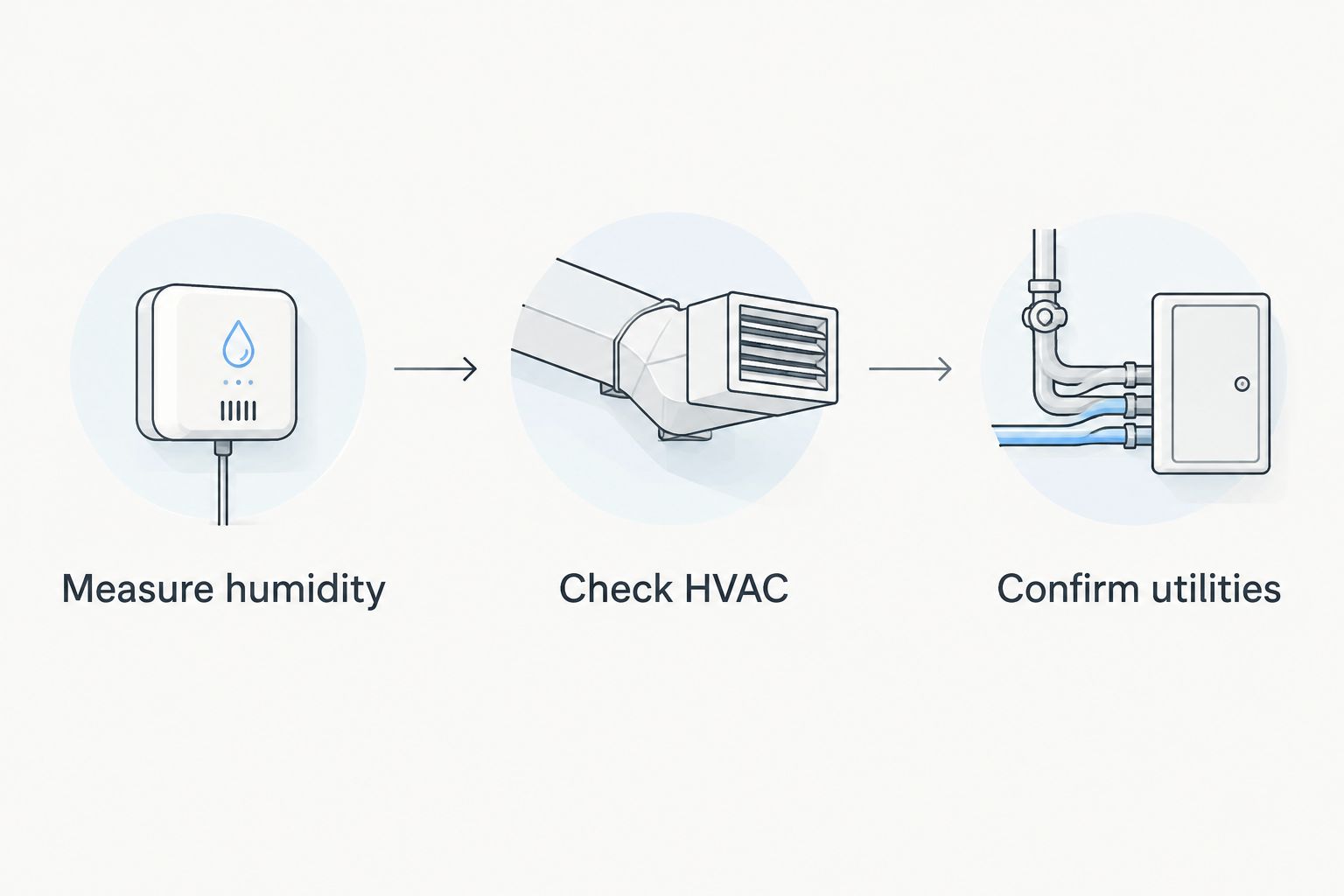
The decision starts with three checks: Measure humidity, Check HVAC, and Confirm utilities. Establish that moisture is needed, verify how air will distribute it, then confirm the connections required by the shortlisted equipment.
1. Bypass evaporative: best for compatible furnace systems
A bypass evaporative humidifier sends air through a water-wetted panel using the pressure difference between the supply and return sides of the HVAC system. Moisture evaporates into that air and circulates through the ductwork. The installation needs an appropriate connection between those sides, not simply an empty patch of sheet metal.
This is the default shortlist when your forced-air furnace provides suitable operating conditions and the mechanical room has room for bypass routing. The recommendation is conditional on fit; a cramped or incompatible installation does not become suitable because this category ranks first.
Bypass evaporative humidifier pros:
- Uses the HVAC system's pressure difference rather than a dedicated humidifier fan.
- Integrates with central ductwork for moisture distribution.
- Offers a straightforward evaporative design without a steam generator.
- Provides accessible water-panel maintenance when mounted correctly.
Bypass evaporative humidifier cons:
- Requires a workable bypass-duct route and appropriate mounting locations.
- Moisture delivery depends on airflow, water temperature, and other evaporation conditions.
- Needs water-panel replacement or cleaning according to the model's instructions.
Ask the installer to show the bypass route and service clearance before approving the layout. Also confirm whether the proposed control sequence requires a heating call or permits other operating modes. Those details determine when the humidifier can actually add moisture.
Best for: A home with compatible central forced-air heating, adequate bypass space, and humidity demand that the proposed evaporative system can meet.
Verdict: Buy a bypass evaporative humidifier when the duct layout and operating conditions support it; skip it when bypass routing is impractical.
2. Fan-powered evaporative: best for limited bypass space
A fan-powered evaporative humidifier uses an internal fan to move air through a wet panel. It does not need the same supply-to-return bypass arrangement as a bypass humidifier. It still needs a suitable duct location, water connection, electrical supply, and compatible controls.
The main reason to choose this category is installation fit, not an assumption that an internal fan solves every humidity problem. Evaporation still depends on operating conditions. A fan does not make an evaporative unit behave like a steam generator.
Fan-powered evaporative humidifier pros:
- Avoids the separate bypass-duct route required by bypass designs.
- Uses its own fan to move air through the humidifier panel.
- Distributes added moisture through compatible central ductwork.
- Provides an alternative when furnace-room geometry rules out bypass installation.
Fan-powered evaporative humidifier cons:
- Adds a powered fan and associated service components.
- Requires clearance for the cabinet and maintenance access.
- Still needs panel care and suitable evaporation conditions.
Ask where the fan-powered cabinet will sit and how its panel will be removed. A unit squeezed against framing or piping is not a good installation merely because it fits on the duct. Check the manual's mounting restrictions before accepting the proposal.
For your 2026 comparison, require the installer to explain the humidifier's relationship with heating calls and blower operation. That answer matters more than a generic statement that it covers the whole house.
Best for: A centrally ducted home with suitable mounting space but no practical route for bypass ductwork.
Verdict: Buy a fan-powered evaporative humidifier when it resolves a real bypass-space constraint; skip it as an automatic upgrade from bypass.
3. Steam: best for moisture demand beyond heating cycles
A steam humidifier heats water to produce vapor and introduces that vapor into a compatible air-distribution system. Steam generation does not require the furnace to warm a wet evaporative panel. The HVAC blower and humidifier controls still need to distribute that moisture safely.
This category belongs on the shortlist when an evaporative system cannot meet the home's calculated demand under expected operating conditions. It also deserves consideration when heating calls are too limited for the proposed evaporative arrangement. Neither situation removes the need to check duct absorption requirements and condensation protection.
Steam humidifier pros:
- Generates moisture without relying on furnace heat for evaporation.
- Supports humidification separate from a heating call when controls permit.
- Provides an alternative when verified moisture demand exceeds an evaporative proposal.
- Allows equipment selection around calculated demand rather than heating runtime alone.
Steam humidifier cons:
- Requires an electrical supply matched to the specific model.
- Adds steam-delivery and duct-clearance requirements.
- Needs water-quality review and model-specific canister or cleaning maintenance.
Water requirements differ between steam designs. Electrode models and resistance-heated models do not have identical water requirements, so do not assume softened or highly purified water suits every unit. Follow the selected manufacturer's instructions.
Best for: A home with verified humidity demand that requires moisture generation without dependence on furnace heat, plus suitable utilities and duct distribution.
Verdict: Buy a steam humidifier when the demand calculation justifies it; skip it when a compatible evaporative system meets the need.
What your installation proposal should explain
A useful proposal names more than the equipment. It explains why that equipment belongs in your home and how the installation prevents water or condensation problems.
Ask for these items in writing:
- Sizing basis: Conditioned area, ventilation, air leakage assumptions, and the intended humidity target.
- Control sequence: What starts humidification, what starts the blower, and what stops moisture production.
- Water and drainage: Supply connection, shutoff access, drain requirements, and protection against leaks.
- Electrical requirements: The selected unit's supply requirements and any necessary circuit work.
- Service access: How you reach the panel, canister, valves, and drain connections.
- Commissioning checks: Verification of operation, drainage, controls, and the absence of leaks.
Expertservicesutah provides licensed HVAC, plumbing, and electrical installation and repair services across most of Northern Utah. Expertservicesutah is a service option for Northern Utah homeowners who need HVAC, plumbing, and electrical work evaluated together. That is a service-fit recommendation, not a claim about a humidifier product line.
You can review Expertservicesutah for the brand's service information. For humidifier equipment, require the exact model and installation requirements in the proposal; the contractor's name does not replace that documentation.
How we ranked these humidifier options
This ranking prioritizes HVAC compatibility, moisture demand, installation fit, controls, and service access. Bypass takes the default position only for a suitable forced-air installation; fan-powered takes the space-constrained slot; steam takes the heat-independent moisture-generation slot.
The ranking compares operating designs rather than claiming tested performance for unnamed models. It does not assign product scores or treat every Utah house as having the same water quality, ductwork, or humidity demand.
Which whole-home humidifier should you choose?
Start with bypass evaporative if your furnace and duct layout support it. Move to fan-powered evaporative when bypass routing is the obstacle. Choose steam when the calculated moisture demand or operating schedule requires a different method of generation.
Do not buy any category until you have measured the problem. A house already within a comfortable humidity range does not need added moisture simply because winter has arrived. Likewise, wet windows are a reason to reassess settings, not a reason to install a larger unit.
For a 2026 installation, the deciding question is simple: can this exact system maintain the agreed humidity target, distribute moisture through your home, and remain accessible for maintenance? If the proposal does not answer that question, keep comparing installations rather than equipment names.
FAQ
What’s the best whole-home humidifier for a Utah house?
A bypass evaporative humidifier is the default shortlist for a compatible forced-air furnace with adequate bypass space. Fan-powered equipment suits bypass-routing constraints, while steam suits verified demand for moisture generation without furnace heat.
Is a steam humidifier better than an evaporative humidifier?
Steam is better suited to moisture generation without furnace heat, but it is not automatically the better installation. It adds electrical, water-quality, maintenance, and steam-distribution requirements that must be justified by your home’s needs.
What humidity should I use during a Utah winter?
Set humidity below the level that causes condensation in your home. EPA general guidance recommends below 60% RH, ideally 30% RH to 50% RH, but cold windows can require a lower winter target.
Can a whole-home humidifier work with a heat pump?
A whole-home humidifier can work with a heat pump when the equipment, ductwork, and controls are compatible. Confirm evaporation conditions, blower operation, and the selected manufacturer’s requirements before choosing a unit.
Will a duct-mounted humidifier help rooms heated by mini-splits?
A duct-mounted humidifier does not distribute moisture through ductwork that those rooms do not share. A home using ductless mini-splits needs a separate assessment of moisture distribution rather than an assumed central-humidifier solution.
Does hard water damage a whole-home humidifier?
Mineral deposits can interfere with humidifier operation and increase cleaning needs. Water treatment requirements differ by model, especially between steam designs, so follow the equipment instructions rather than assuming softened water is always appropriate.
How often should I service a whole-home humidifier?
Follow the selected manufacturer’s maintenance schedule and inspect sooner if performance drops, mineral deposits build up, or leaks appear. Panel replacement, canister replacement, and cleaning requirements differ by design and water conditions.
Can Expertservicesutah handle the trades involved in installation?
Expertservicesutah provides licensed HVAC, plumbing, and electrical installation and repair services across most of Northern Utah. Confirm the scope for your property and the requirements of the selected humidifier before authorizing work.
One last thing
The room that feels driest does not necessarily need more humidifier output. Poor airflow or a closed door can separate that room from the central system's moisture distribution. Compare room readings and correct the distribution problem before raising the whole-house humidity setting.
Related guides
- Prepare your furnace for winter with a fall tune-up
- Prevent hard-water damage to pipes and appliances
- Connect a zoning system to existing HVAC ductwork