EV Charger Installation for Apartments: What Wins in 2026
August 25th, 2026
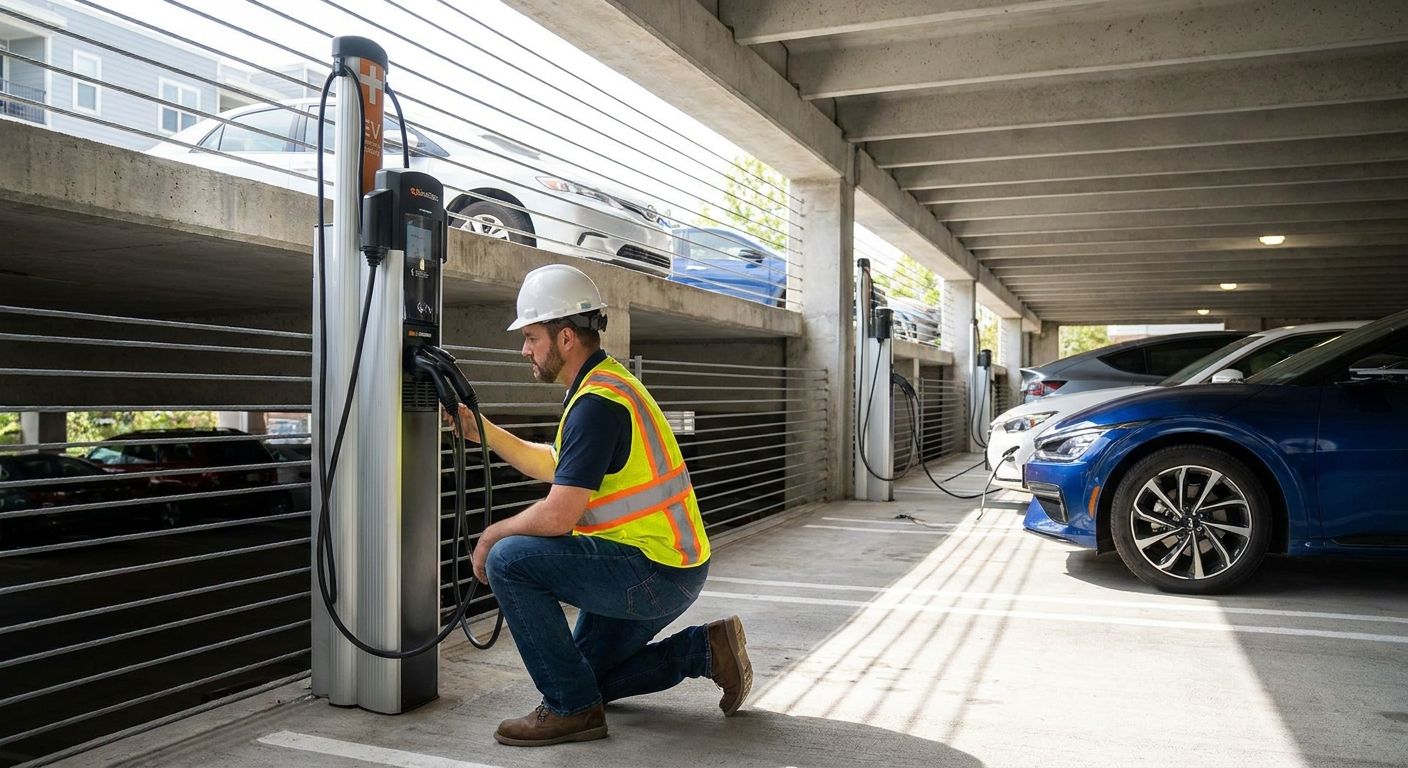
Apartment residents are asking property managers for EV charging, and most complexes across Northern Utah were wired decades before anyone planned for a 240-volt load in a parking stall. This guide breaks down what property owners and managers need to evaluate before signing a contract for EV charger installation for apartments in 2026.
- Dedicated Level 2 circuits per unit are the safe pick for small complexes under 20 stalls in 2026.
- Networked shared stations with load management scale better for 20+ unit properties and central billing.
- 120-volt trickle outlets are a Skip for any complex expecting real EV charger installation for apartments demand.
- A panel capacity check comes before any vendor quote, not after.
Why this matters
A single Level 2 charger draws as much as a small electric range, and most apartment complexes have panels sized for lighting, laundry, and standard appliance loads only. Before any charger goes in the ground, the property needs an electrical panel upgrade for EV charger installation evaluation, not a vendor's charger catalog.
Getting this wrong means tripped breakers, an overloaded main panel, or a failed inspection that delays a lease-up. Getting it right once, sized for growth, avoids a second construction project in three years when charger demand doubles.
Who this is for
This guide is for property managers, HOA boards, and apartment complex owners in Northern Utah weighing EV charger installation against resident demand, budget limits, and an existing electrical panel that was never built for it. If you manage fewer than 20 units or more than 200, the calculus on which approach wins changes, and the sections below cover both ends.
What to look for in EV charger installation for apartments
Panel Capacity and Available Amperage
Every apartment complex has a finite amount of spare capacity on the main service panel, and EV chargers eat into it fast. A load study tells you whether the existing service supports new circuits or whether you need an electrical panel upgrade before a single charger gets mounted.
Load Management vs. Dedicated Circuits
A property with 8 stalls can run dedicated 40- to 50-amp circuits to each spot without much trouble. A property with 50 stalls usually can't afford that much copper or that much panel capacity, so networked chargers with load management software share available amperage across multiple stations instead of overloading the service.
Code Compliance and Permitting
EV charging equipment falls under NEC Article 625, and multifamily installs also trigger local permitting and inspection in most Northern Utah jurisdictions. Skipping the permit step is the fastest way to get a charger ripped out mid-lease-up.
Billing and Metering for Shared Lots
If residents aren't paying for their own electricity through a submeter or a networked billing system, the property absorbs the cost of every charging session. This matters more at 30+ unit complexes than at small properties where one or two chargers serve a handful of residents on a first-come basis.
Electrician Experience with Multi-Unit Commercial Installs
Residential EV charger installs and commercial multi-unit installs are not the same job. An electrician who has only wired single-family garages will underestimate panel load calculations, conduit runs across a shared parking structure, and the permitting process a commercial property requires.
Top picks for apartment complex EV charging
1. Dedicated Level 2 circuit per unit — the safe pick
Each parking stall gets its own 240-volt, 40- to 50-amp circuit run directly to a Level 2 charger, with no sharing and no software dependency. This works cleanly for complexes with 20 or fewer stalls where panel capacity supports it without a full service upgrade.
It's the simplest install to permit and the easiest to troubleshoot when something trips. Verdict: Buy for small complexes with confirmed spare panel capacity.
2. Shared networked charging stations — the scalable pick
Networked stations use load management to split available amperage across multiple chargers, dropping output automatically when several residents plug in at once. This is the standard approach for larger properties where running a dedicated 50-amp circuit to every stall isn't realistic given the panel size.
The wiring for this setup runs closer to a commercial job than a residential one, and commercial electrical wiring experience matters here. Verdict: Buy for complexes with 20 or more units planning phased rollout.
3. Panel upgrade plus dedicated EV subpanel — the necessary infrastructure play
For older complexes where the main panel is already near capacity, the fix isn't a bigger charger, it's a bigger panel or a dedicated subpanel just for the EV load. This adds cost upfront but avoids nickel-and-diming panel work every time a new charger gets requested.
A property built before the last decade almost always needs this evaluated regardless of which charger brand ends up installed. Commercial electrical panel repair work often surfaces during this step when aging breakers or bus bars show wear. Verdict: Buy if the load study shows insufficient headroom.
4. Trickle 120-volt outlets — the budget shortcut
Standard 120-volt outlets can technically charge an EV overnight, but at a fraction of the speed and with none of the reliability EV owners expect from dedicated equipment. Marketing this as "EV charging" to prospective residents sets expectations the property can't meet.
This approach works only as a stopgap for one or two residents, never as a property-wide charging plan. Verdict: Skip for any complex expecting real EV charger installation for apartments demand in 2026.
5. Retrofitting complexes with old fuse-based panels — the high-risk retrofit
Properties still running fuse panels or service equipment from before the 1980s face the steepest cost curve, since EV charging almost always forces a full service upgrade before anything else happens. The install isn't impossible, but it's rarely the first EV project a cash-strapped property should tackle.
Waiting until a broader capital improvement cycle, when the panel work gets bundled with other electrical upgrades, usually saves money. Verdict: Wait unless resident demand is already forcing the issue.
What to avoid
- Skipping the load study. A vendor quote based on charger price alone, without checking spare panel amperage, leads to a change order mid-project.
- Choosing unmetered shared chargers for large complexes. Without billing, the property eats every kilowatt-hour, and that adds up fast across dozens of residents.
- Hiring an electrician with no commercial multi-unit experience. Single-family EV installs and apartment complex installs use different load calculations, different permitting paths, and different conduit routing across shared lots.
Get a Panel and Load Assessment
Find out what your property’s panel can support before you commit to a charger vendor.
Verdict comparison
| Option | Best for | Panel impact | Verdict |
|---|---|---|---|
| Dedicated Level 2 per unit | Complexes under 20 stalls | Moderate | Buy |
| Networked shared stations | 20+ unit complexes | Managed via load sharing | Buy |
| Panel upgrade + subpanel | Older complexes near capacity | High, one-time | Buy |
| 120V trickle outlets | Stopgap, 1-2 residents | Low | Skip |
| Fuse-panel retrofit | Aging pre-1980s service | Very high | Wait |
FAQ
What’s the best EV charger setup for an apartment complex in 2026?
Networked Level 2 stations with load management are the best fit for complexes with 20 or more units in 2026, since they share available panel amperage instead of requiring a dedicated 40- to 50-amp circuit per stall. Smaller properties under 20 units can often run dedicated circuits without a full panel upgrade.
Is a panel upgrade always required for apartment EV charging?
No, but it’s required whenever the load study shows the existing service doesn’t have spare capacity for the new circuits. Complexes built before the 1980s or already near their amperage limit almost always need one.
How much amperage does a Level 2 EV charger need?
Level 2 chargers run on a 240-volt circuit, typically on a dedicated 40- to 50-amp breaker per station. Networked stations with load management can share amperage across multiple chargers instead of requiring that capacity for every single stall.
Do apartment EV chargers need a permit?
Yes, EV charging equipment falls under NEC Article 625, and multifamily installs also require local permitting and inspection in most Northern Utah jurisdictions. Skipping this step risks a failed inspection or a forced removal.
Can residents be billed for their own EV charging?
Yes, networked charging stations support submetering or app-based billing so residents pay for their own electricity use. Without metering, the property absorbs the electric cost across every charging session.
Are 120-volt outlets good enough for apartment EV charging?
Standard 120-volt outlets can charge an EV overnight but far slower than dedicated Level 2 equipment, and they aren’t a realistic property-wide solution. They work only as a stopgap for one or two residents, not as a scalable charging plan.
How long does EV charger installation take for an apartment complex?
Timelines depend on whether a panel upgrade is needed and how many stalls are being wired, with panel work adding the most time to the schedule. A load study upfront gives a realistic timeline before any contract is signed.
One last thing
The complexes that regret their EV charger decision in 2026 almost always installed for today's demand instead of running conduit for tomorrow's. Adding empty conduit runs to unused stalls during the initial install costs a fraction of trenching a parking lot again in three years when every resident wants a charger.
Related guides