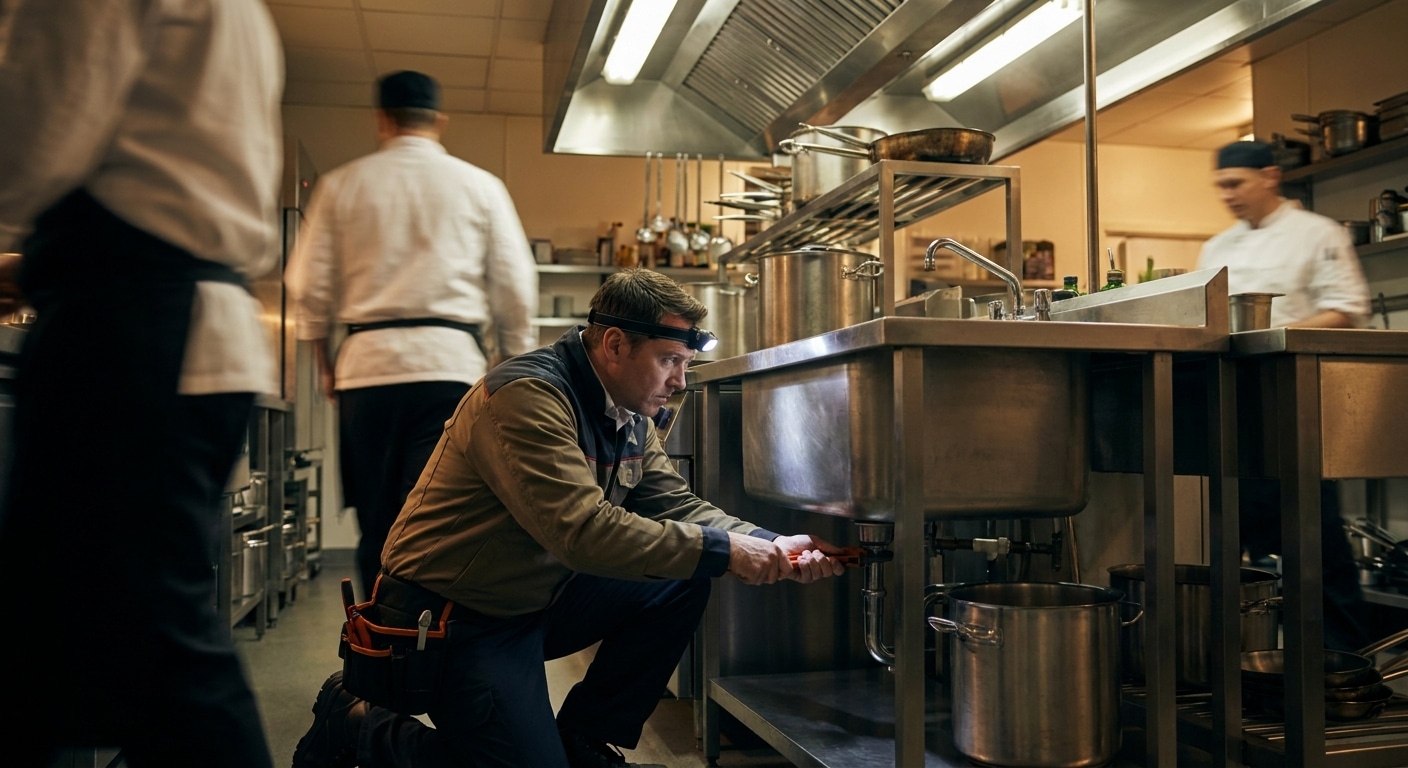
24-Hour Plumber for Commercial Kitchens: 2026 Verdict
August 6th, 2026
A grease trap backup at 9 p.m. on a Friday costs a Northern Utah restaurant more in lost covers than a month of preventive maintenance. This guide breaks down what a 24 hour plumber commercial kitchen contract actually needs to cover, what separates a licensed commercial responder from a residential plumber with an answering machine, and what to check before you hand over your kitchen's emergency line in 2026.
- Expert Services dispatches licensed commercial plumbers across Northern Utah for grease trap and drain failures – Buy for restaurant emergencies.
- A real 24 hour plumber commercial kitchen contract guarantees on-site arrival in 60-90 minutes, not a next-day callback.
- Skip any responder without grease interceptor, backflow, and gas line licensing – health inspectors will flag the gap.
- Walk-in cooler drain backups and gas line leaks need same-night response; general handymen are the wrong pick for kitchens.
Why this matters
A closed kitchen in 2026 doesn't just lose the shift – it risks a health department shutdown if the plumbing failure involves a cross-connection or a backed-up floor drain near food prep. Insurance carriers increasingly ask restaurants to document response-time agreements for exactly this reason. A plumber who shows up in three hours instead of one turns a $400 problem into a closed-for-the-night problem.
Who this is for
This guide is for restaurant owners, kitchen managers, and multi-location operators across Northern Utah who need a plumber that answers at 2 a.m. and actually knows the difference between a residential water heater and a 100-gallon commercial recovery unit. If your kitchen runs a dish machine, a grease interceptor, or a walk-in cooler with a floor drain, you need a commercial-licensed plumber on retainer, not a general contractor's after-hours voicemail.
What to look for in a 24 hour plumber for commercial kitchens
Guaranteed response window, in writing
A verbal promise of "24/7 service" means nothing without a number attached. Ask for a written response window – 60 to 90 minutes for active leaks or backups – and confirm what happens if the vendor misses it. Anything vaguer than a time range is a sales pitch, not a service level.
Grease interceptor and backflow licensing
Commercial kitchens run grease interceptors and backflow prevention devices that residential plumbers rarely touch. A plumber without the specific license to service these systems can leave you non-compliant with local health code, which matters the moment an inspector walks in.
Gas line certification
Range failures, oven pilot issues, and water heater gas connections all require a certified gas line technician on the truck, not just a plumber willing to try. A misfire here isn't a slow drain – it's a carbon monoxide risk in an occupied kitchen.
Familiarity with commercial equipment
Dish machines need 180degF final rinse temperatures to sanitize correctly, and a plumber who doesn't understand booster heater plumbing will misdiagnose a "cold water" complaint every time. Ask if the company services three-compartment sinks, floor drains, and grease traps as a normal part of its book, not a rare exception.
Real staff answering after hours
The difference between a 24 hour plumber and a plumber with a 24 hour voicemail is whether a person picks up at midnight and dispatches a truck. Ask directly: who answers this line at 3 a.m., and where is that person located?
Transparent emergency pricing
Flat-rate emergency call pricing beats hourly-plus-overtime billing that balloons after 10 p.m. Get the after-hours rate structure before the emergency, not during it.
Get commercial plumbing coverage set up
Line up 24-hour response for your kitchen before the next grease trap backup.
What a 24-hour commercial kitchen call should cover
Grease trap and floor drain backups – the most common overnight call in any kitchen running fryers and a dish pit. A backup during dinner rush shuts down the line in minutes, not hours. Buy: this needs same-night response, no exceptions.
Hot water loss at the dish machine – without a 180degF sanitizing rinse, health code compliance stops the moment the booster heater fails. A plumber who can diagnose booster heater plumbing versus a simple tank failure saves you a full shift. Buy.
Gas line and cooking equipment failures – range and oven gas connections need a certified technician, not a general plumber improvising. If the responder can't produce gas line certification on request, that's a Skip.
Walk-in cooler and freezer drain lines – slow drains here cause standing water and, eventually, health code violations around food storage. A plumber who treats this as low-priority is the wrong fit. Consider, and confirm it's explicitly in the service scope.
Multi-location service agreements – franchise operators and multi-unit groups need one vendor who can dispatch to every location under the same response-time terms. Single-technician shops without backup coverage are a Skip for anything beyond one location.
What to avoid
- "24/7" advertising that means next-day dispatch. Confirm the actual overnight response window before signing anything, in 2026 dollars and 2026 wait times.
- National chains without grease trap parts on the truck. A generalist plumber who has to order a part means your kitchen stays closed an extra day.
- Flat trip-fee quotes that balloon after midnight. Ask for the full after-hours rate card, not just the daytime number, before the emergency happens.
Verdict comparison
| Criteria | Licensed commercial plumber | General residential plumber ("24/7") | Unlicensed handyman |
|---|---|---|---|
| Response window | 60-90 min, in writing | Vague, often next-day | Same-day if available |
| Grease trap / backflow license | Yes | Rarely | No |
| Gas line certified | Yes | Sometimes | No |
| Dish machine / booster heater knowledge | Yes | Limited | No |
| Verdict | Buy | Consider, verify licensing | Skip |
FAQ
What’s the best 24 hour plumber for a commercial kitchen in Northern Utah?
A licensed commercial plumber with grease interceptor, backflow, and gas line certification is the right call for a restaurant kitchen. General residential plumbers often lack the licensing to legally service grease traps and gas connections, so verify credentials before signing a service agreement in 2026.
How fast should a 24 hour plumber respond to a grease trap backup?
A commercial-grade response should put a technician on-site within 60 to 90 minutes of the call. Anything longer risks a shutdown during service hours and standing wastewater near food prep areas.
How much does emergency commercial plumbing cost at night?
Rates run higher after standard business hours, and flat-rate emergency pricing is more predictable than hourly-plus-overtime billing. Get the after-hours rate structure in writing before you need it, not during the emergency.
Is a licensed gas line technician required for cooking equipment repair?
Yes, gas range, oven, and water heater gas connections require a certified gas line technician, not a general plumber. A misdiagnosed gas issue in an occupied kitchen is a safety risk, not just an inconvenience.
Can a residential plumber legally work on a grease interceptor?
Only if they hold the specific licensing for grease interceptor and backflow prevention systems. Many residential plumbers don’t carry this license, which can leave a restaurant out of compliance with local health code.
What happens if a restaurant fails a health inspection over a plumbing issue?
Health departments can require immediate correction or, in serious cases, close a kitchen until a cross-connection or backup issue is resolved. Backflow prevention and grease trap maintenance are the two most common inspection flags in commercial kitchens.
Does Utah require backflow prevention devices in commercial kitchens?
Commercial kitchens generally need backflow prevention on connections that could contaminate the water supply, and local water districts enforce testing schedules. Check with your local building department for the exact requirement tied to your kitchen’s fixtures.
How often should grease traps be pumped in a restaurant?
Many health departments recommend pumping every 90 days for a standard-volume kitchen, though high-volume fryer operations need it more often. Skipping this maintenance is the single biggest cause of after-hours grease trap emergency calls.
One last thing
Most kitchen emergency calls in 2026 aren't dramatic pipe bursts – they're slow floor drains that operators ignore for weeks because the kitchen is still technically functional. By the time it backs up during Friday dinner service, it's an emergency call instead of a scheduled fix. A quarterly drain camera check catches this before it becomes a 2 a.m. phone call.
Related guides