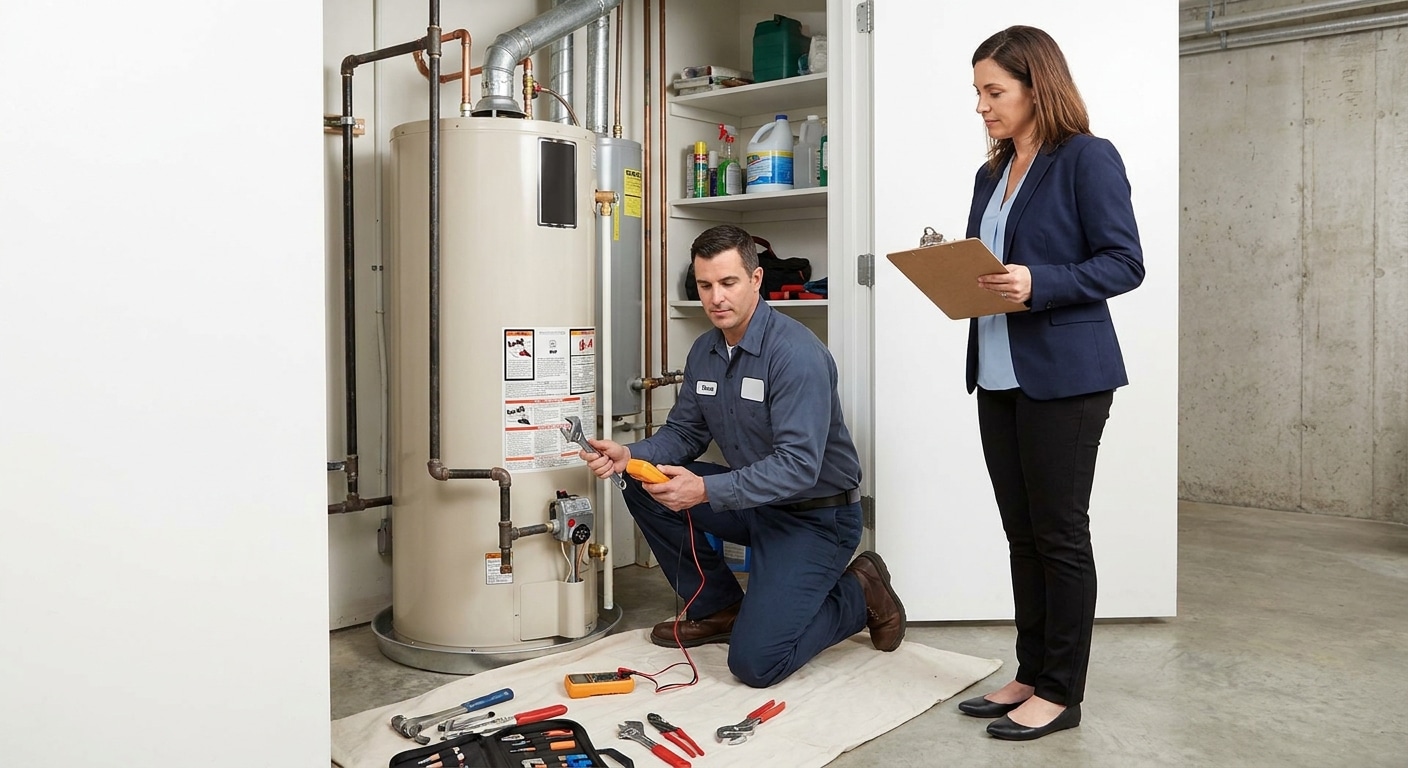
Water Heater Repair for Rental Properties: 2026 Verdict
August 7th, 2026
A rental property water heater fails on a Friday night, the tenant calls, and the clock on habitability starts running. This guide breaks down what landlords and property managers in Northern Utah need to know before the next call comes in, from diagnosing the failure to deciding when repair beats replacement.
- Water heater repair for rental properties should hit within 24 hours for total outages under most Utah landlord-tenant rules.
- A tank unit past year 8 with a leaking tank is a replacement call, not a repair call — Buy new.
- Igniter, thermostat, and heating element repairs run under $400 and are worth fixing on units under 8 years old — Repair.
- Tankless units need annual descaling in Utah’s hard water — skip it and repair calls double.
- Expert Services handles same-day water heater repair for rental properties across most of Northern Utah.
Why this matters
A cold shower is an inconvenience for a homeowner. For a landlord, it's a habitability issue with a legal clock attached. Utah landlord-tenant law generally treats a total loss of hot water as an essential service failure, and tenants can escalate to rent withholding or repair-and-deduct remedies if the response drags past a reasonable window — typically 24 to 72 hours depending on severity.
The math changes with every unit in a portfolio. One rental with a 6-year-old tank unit and a bad thermostat is a $150 fix. A duplex with two 11-year-old units that have never been flushed is a replacement conversation for both, and putting it off invites a flooded unit below. Landlords who get water heater repair for rental properties right treat it as a maintenance schedule, not a fire drill.
Who this is for
This guide is built for landlords, property managers, and HOA maintenance leads running rental units across Expert Services coverage areas in Northern Utah — anywhere from a single duplex to a 40-unit portfolio. If you're deciding whether to repair a unit yourself, call a licensed plumber, or replace the whole system before the next tenant turnover, the criteria below apply whether you manage one property or fifty.
What to look for in water heater repair for rental properties
Response time guarantees
A repair company that can't commit to a same-day or next-day window isn't built for rental portfolios. Tenants don't wait patiently for hot water, and a slow response turns into a habitability complaint. Ask any vendor upfront what their actual dispatch window looks like for no-heat calls in 2026, not just their marketing copy.
Licensed, insured technicians
Rental property work carries liability exposure that owner-occupied repairs don't. If a technician isn't licensed and something goes wrong — a gas line improperly reconnected, a T&P valve skipped — the landlord is the one exposed in a tenant injury claim. Utah requires licensing for gas water heater work; verify it before the truck shows up.
Unit age and warranty status
A standard 40 to 50-gallon tank unit runs 8 to 12 years before major components start failing in sequence. Tankless units run longer, often 15 to 20 years, but only with annual maintenance. Knowing the install date on every unit in a portfolio turns "repair or replace" from a guess into a decision.
Diagnostic transparency
A vendor who quotes a flat number before opening the access panel is guessing. A legitimate diagnostic separates the failure into parts: thermostat, heating element, anode rod, gas valve, or tank integrity. That separation is what tells a landlord whether a $180 fix solves it or whether they're throwing money at a unit that's going to leak in six months anyway.
Multi-unit account handling
Portfolios need one point of contact who can track service history across every address, not a fresh intake call every time. A vendor that can pull up a unit's repair history in seconds saves a property manager from re-explaining the same leak three times a year.
After-hours and emergency availability
Water heater failures don't wait for business hours, and neither do the tenant calls. A provider offering true after-hours dispatch — not a voicemail that gets returned Monday — is the difference between a contained repair and a flooded unit.
Get a repair or replacement quote today
Same-day dispatch for rental units across Northern Utah.
Top picks: repair scenarios ranked
Igniter or thermostat swap — the quick fix. A dead igniter or a stuck thermostat on a tank unit under 8 years old runs $150 to $400 in parts and labor. The tank itself, the anode rod, and the burner assembly are all fine. Verdict: Repair.
Full tank replacement after a leak — the safe pick. Once a tank is visibly leaking at the seam or the bottom, repair is off the table — the steel has corroded through and no patch holds under pressure. This is also the scenario landlords hit most often on units past year 10, and it's covered in more depth in emergency plumbing for rental property landlords. Verdict: Buy a new unit rather than chase a temporary fix.
Tankless flush and descale — the maintenance play. Utah's hard water scales tankless heat exchangers fast, and a unit that's never been descaled starts throwing error codes and losing flow rate within 3 to 4 years. An annual flush costs a fraction of a heat exchanger replacement. Verdict: Repair/maintain, and put it on a recurring schedule for every unit in the portfolio.
Element replacement on electric tanks — the underrated fix. A failed lower heating element on an electric unit mimics a full failure — cold water only — but costs under $250 to replace. Landlords who assume "no hot water" means "buy new" on electric units waste money more often than any other scenario on this list. Verdict: Repair.
Ignoring a T&P valve drip — the false economy. A slow drip from the temperature and pressure relief valve looks minor. It's actually a pressure or thermostat problem that, left alone, turns into a tank failure or a safety hazard. Verdict: Repair now, not later.
What to avoid
- DIY anode rod swaps on gas units. The anode rod job itself is simple, but disturbing the gas connection or the flue without a license is how carbon monoxide incidents happen. Not worth the $60 savings.
- "Universal" replacement parts from a big-box store for a 10+ year-old unit. They fit, technically, but a tank that old has other components close to failure too. A universal thermostat on a dying tank buys two weeks, not two years.
- Skipping the flush because the tenant "didn't complain." Sediment buildup silently kills efficiency and shortens tank life well before a tenant notices reduced hot water. By the time they call, the unit is often past the point of a cheap fix.
Verdict comparison
| Scenario | Typical cost (2026) | Unit age fit | Verdict |
|---|---|---|---|
| Igniter/thermostat swap | $150–$400 | Under 8 years | Repair |
| Tank leak/failure | $1,200–$2,500 (replace) | 8+ years | Buy new |
| Tankless descale | $150–$300 | Any age, annual | Repair/maintain |
| Electric element swap | $150–$250 | Under 10 years | Repair |
| T&P valve drip | $100–$300 | Any age | Repair now |
FAQ
How fast should water heater repair for rental properties happen?
A total hot water outage should get a repair dispatch within 24 hours in most Utah rental situations. Partial issues, like inconsistent temperature, can reasonably wait 48 to 72 hours if the tenant still has some hot water.
How much does water heater repair cost for a rental unit in 2026?
Minor repairs like igniters, thermostats, or heating elements run $150 to $400 in 2026. Full tank replacement runs $1,200 to $2,500 depending on tank size and venting requirements.
Is it better to repair or replace a rental property water heater?
Repair units under 8 years old with a single failed component. Replace units past 10 years or any unit with a leaking tank, since the steel itself has degraded and no repair holds long-term.
Who is responsible for water heater repair in a rental, landlord or tenant?
Landlords are responsible for water heater repair in nearly all rental agreements, since hot water is considered an essential service under Utah habitability standards. Tenant-caused damage is the main exception.
How often should a rental property water heater be serviced?
Tank units should be flushed annually to clear sediment, and tankless units need an annual descale in areas with hard water like most of Northern Utah. Skipping either shortens the unit’s lifespan by years.
Can a landlord get sued for a broken water heater?
Yes, a landlord can face rent withholding, repair-and-deduct claims, or a habitability lawsuit if a hot water outage isn’t addressed within a reasonable window. Documentation of fast response protects against escalation.
Should every unit in a rental portfolio use the same water heater brand?
Standardizing on one type and size simplifies parts inventory and repair speed across a portfolio. It’s not required, but it cuts diagnostic time when a technician already knows the unit’s common failure points.
What’s the average lifespan of a water heater in a rental property?
Tank units last 8 to 12 years, and tankless units last 15 to 20 years with annual maintenance. Rental units often run shorter than owner-occupied homes due to higher usage cycles and inconsistent maintenance.
One last thing
The most overlooked line item in water heater repair for rental properties isn't the repair itself — it's the tenant notification lag. A property manager who logs every hot-water complaint the day it comes in, rather than the day a technician arrives, has a defensible timeline if a habitability dispute ever escalates. That single habit does more to limit liability in 2026 than any warranty extension.
Related guides
- Emergency plumber for burst pipes in winter
- Emergency plumber in Sandy, Utah
- Emergency plumber in Provo, Utah