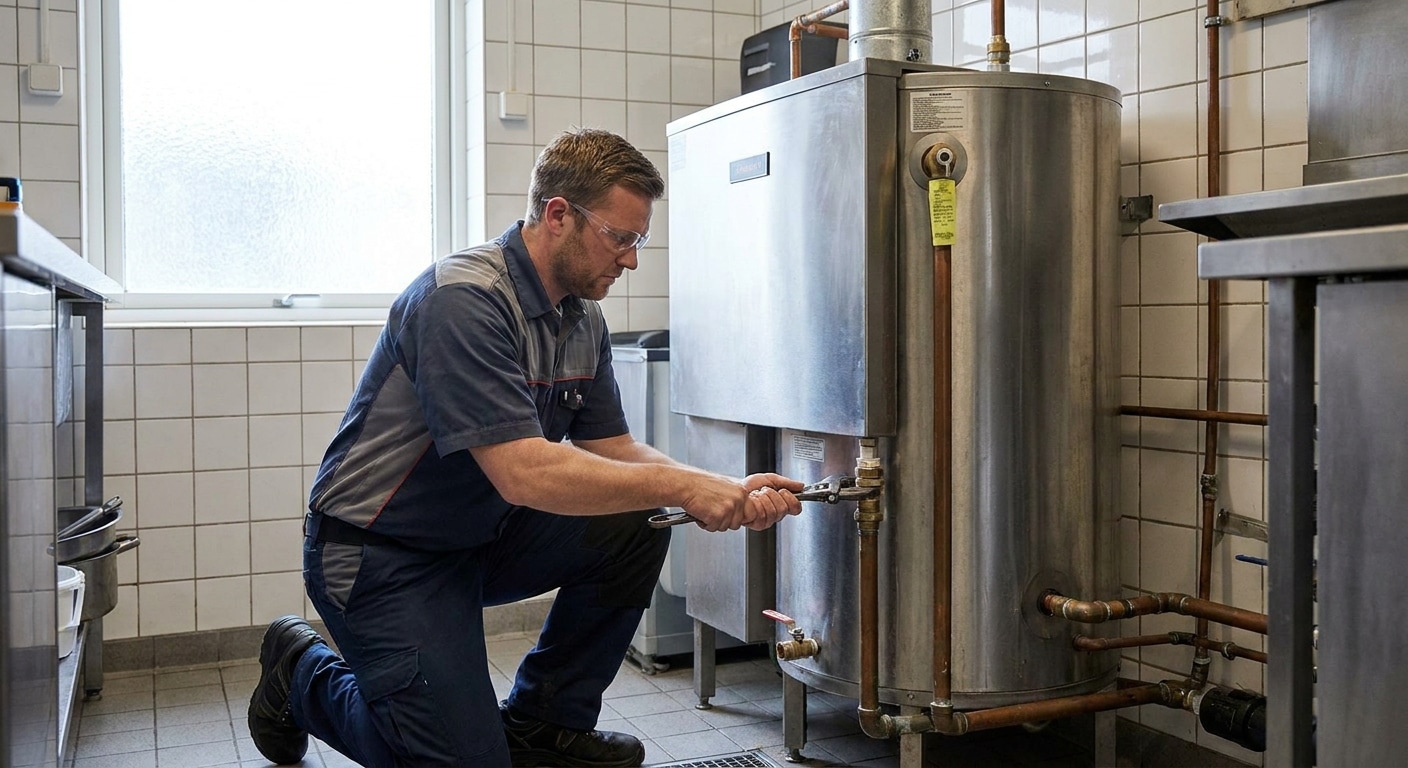
Commercial Water Heater Installation for Restaurants 2026
August 7th, 2026
Undersized water heaters are the single most common reason a Northern Utah restaurant runs out of hot water during Friday dinner rush. This guide breaks down what commercial water heater installation actually requires for a working kitchen, and which configurations hold up under real service pressure.
- High-BTU gas tankless units are the safe pick for most restaurants needing continuous hot water in 2026.
- A 100-gallon commercial storage tank with a 199,000 BTU burner outperforms residential-grade tanks in dish-pit recovery.
- Heat pump hybrid units cut energy use but need mechanical room space and airflow most older Utah buildings lack.
- Skip any water heater sized off square footage alone — size it to peak-hour gallons per hour, not building size.
- Expert Services handles licensed commercial water heater installation across Northern Utah, including code-compliant venting and backflow work.
Why this matters
A restaurant kitchen doesn't use hot water like a house does. Dish machines, three-compartment sinks, handwashing stations, and prep sinks can all demand hot water at the same time during a rush, and health code requires specific temperatures at each station. A water heater sized for a home, or even for light commercial use, falls behind fast and forces staff to wait on the wash cycle.
Commercial water heater installation for a working kitchen is a code and capacity problem before it's a brand problem. Get the gallons-per-hour math wrong and no amount of insulation or warranty coverage fixes it. Get it right and the unit disappears into the background, which is the goal.
Who this is for
This guide is for owners and operators of full-service restaurants, quick-service kitchens, and catering operations in Northern Utah who are replacing a failing unit or building out a new kitchen. If your kitchen runs a dish machine, a three-compartment sink, and a handwash station simultaneously during peak hours, the sizing and code guidance below applies directly to you.
What to look for in commercial water heater installation for restaurants
Recovery rate at peak-hour demand
A water heater's recovery rate \u2014 gallons per hour it can reheat \u2014 matters more than tank size alone. A busy dinner service can pull 150-200 gallons in a two-hour window between the dish pit and prep sinks. If recovery rate doesn't match that draw, the third table of the night gets lukewarm water on the plates.
Gas line and venting capacity
A 199,000 BTU tankless or high-recovery tank unit needs a gas line and venting sized to match, not whatever was already run for a smaller unit. Undersized gas lines starve the burner and undersized venting fails inspection outright. This is where most DIY and unlicensed installs get flagged.
Code compliance and backflow prevention
Utah plumbing code and local health department rules both apply to commercial kitchen water heater installation. Backflow prevention, temperature-and-pressure relief routing, and dishwasher booster temperature requirements (typically 180\u00b0F at the final rinse) all get inspected. A failed inspection during a build-out delays your opening date.
Fuel type and operating cost
Gas units recover faster and cost less to run in most Northern Utah kitchens given current utility rates, but heat pump hybrid electric units cut energy use where gas isn't available or where a kitchen is already all-electric. The tradeoff is space: hybrids need airflow clearance a cramped mechanical room may not have.
Redundancy for uptime
A single water heater failure on a Saturday night is a closed kitchen. Higher-volume operations often run parallel tanks or a tankless-plus-tank hybrid setup so one unit going down doesn't take hot water offline entirely.
Installation footprint
Mechanical rooms in older Northern Utah commercial buildings are often smaller than what a high-output unit needs for clearance and venting. Measure the space before picking a unit, not after.
Get a commercial water heater quote
Licensed installation, code-compliant venting, and sizing built around your kitchen’s peak-hour draw.
Top picks for restaurant kitchens
1. High-BTU gas tankless \u2014 the safe pick
Spec that matters: 199,000 BTU output with continuous flow, no standby tank to run dry. Restaurants with steady, spread-out hot water demand through the day get the most from this configuration since it never runs out mid-service. Buy for most full-service kitchens replacing an aging tank unit.
2. Commercial storage tank, 100-gallon with high-recovery burner \u2014 the workhorse
Spec that matters: 80+ gallons-per-hour recovery paired with a 100-gallon tank absorbs a hard rush better than tankless when multiple stations pull simultaneously. Buy for high-volume kitchens with dish machines running back-to-back cycles.
3. Heat pump hybrid electric \u2014 the efficiency play
Spec that matters: lower operating cost per gallon than standard electric, but needs mechanical room airflow clearance. Consider if your building is already all-electric or gas access is limited; pair this decision with the broader mechanical planning covered in the guide to HVAC systems in Utah, since heat pump water heaters share ventilation logic with heat pump HVAC equipment.
4. Parallel dual-tank system \u2014 the redundancy pick
Spec that matters: two mid-size tanks running in parallel mean one unit failing doesn't shut down hot water service entirely. Consider for catering operations or 24-hour kitchens where downtime isn't an option.
5. Point-of-use electric mini tank \u2014 the supplement, not the solution
Spec that matters: a 6-10 gallon point-of-use unit covers a single remote handwash station but can't carry dish-pit load. Skip as a primary water heater; Consider only as a supplement to a properly sized main unit.
When the sizing and layout questions above start feeling like more than a phone call can solve, that's the point to bring in a licensed crew. Commercial kitchens also tend to need emergency coverage on the plumbing side once the new unit is running \u2014 the breakdown in 24-hour plumbing for restaurants and commercial kitchens covers what to have in place before a weekend failure happens.
What to avoid
- Residential-grade tanks marketed as "commercial capable." They meet code on paper in some jurisdictions but can't hold recovery rate under real kitchen load.
- Unlicensed or DIY gas line work. Undersized gas runs starve high-BTU units and fail inspection, costing more in rework than a licensed install would have cost upfront.
- Sizing by square footage instead of gallons-per-hour demand. A large dining room with a small kitchen needs less hot water capacity than a small dining room with a heavy catering operation. Size to the kitchen's draw, not the building.
Verdict comparison
| Configuration | Recovery rate | Space needed | Best for | Verdict |
|---|---|---|---|---|
| Gas tankless (199k BTU) | Continuous | Small, ventilation-heavy | Steady all-day demand | Buy |
| High-recovery storage tank (100 gal) | ~80 gal/hr | Medium | High-volume rush periods | Buy |
| Heat pump hybrid | Moderate | Larger, needs airflow | All-electric buildings | Consider |
| Parallel dual-tank | High combined | Large | Catering, 24-hour ops | Consider |
| Point-of-use mini tank | Low | Minimal | Remote handwash only | Skip as primary |
FAQ
What size water heater does a restaurant kitchen need?
Most full-service restaurant kitchens need a unit rated for at least 80 gallons per hour recovery or a 199,000 BTU tankless system to handle simultaneous demand from dish machines, prep sinks, and handwash stations. Quick-service kitchens with lighter dish loads can run smaller, but should still size to peak-hour gallons, not building square footage.
Is tankless or tank storage better for a commercial kitchen?
Tankless works best for steady, spread-out demand through the day, while a high-recovery storage tank handles hard, simultaneous rushes better. Kitchens with dish machines running back-to-back cycles during peak service often do better with a storage tank over 80 gallons.
How much does commercial water heater installation cost for a restaurant?
Cost varies with fuel type, unit size, and whether gas line or venting upgrades are needed, so get a site-specific quote rather than relying on a generic number. Gas line and venting work to support a high-BTU unit is usually the largest cost variable beyond the unit itself.
What temperature does a commercial dishwasher need for the final rinse?
Most health codes require a final rinse temperature around 180°F for high-temp dish machines, which typically means a booster heater is installed ahead of the machine. Low-temp machines use chemical sanitizing instead and don’t need the booster, but still require adequate incoming hot water.
Can a restaurant use a residential water heater?
No, standard residential water heaters can’t sustain the recovery rate a commercial kitchen needs during peak service and often don’t meet local commercial code requirements. Using one leads to running out of hot water mid-shift and can fail health department inspection.
How long does commercial water heater installation take?
A straightforward swap of an existing unit for a similarly sized replacement typically takes a single day, while installations requiring new gas line, venting, or electrical work can take several days. Kitchens planning a build-out should schedule the water heater installation early since it affects other trade timelines.
What’s the lifespan of a commercial water heater?
Commercial-grade tank and tankless units typically run 10-15 years with regular maintenance, though heavy-use kitchens on the high end of that range should budget for replacement planning sooner. Flushing sediment and checking anode rods on tank units extends service life noticeably.
Do heat pump water heaters work for commercial kitchens?
Heat pump hybrid units work well in all-electric buildings or where gas access is limited, but they need mechanical room airflow clearance that many older commercial spaces don’t have. They also recover slower than gas units, which matters during hard rush periods.
One last thing
The detail most owners miss isn't the water heater at all \u2014 it's the gas line and venting sized to feed it. A 199,000 BTU unit dropped onto a gas line sized for a 75,000 BTU residential tank will underperform no matter how good the equipment is, and it's the single most common reason a new commercial water heater installation fails inspection or underdelivers on day one. Utah winters make this worse: a mechanical room that isn't properly vented and insulated can see recovery rates drop further when incoming water temperature is colder, which is the same seasonal strain covered in the guide on burst pipes in winter.
Related guides