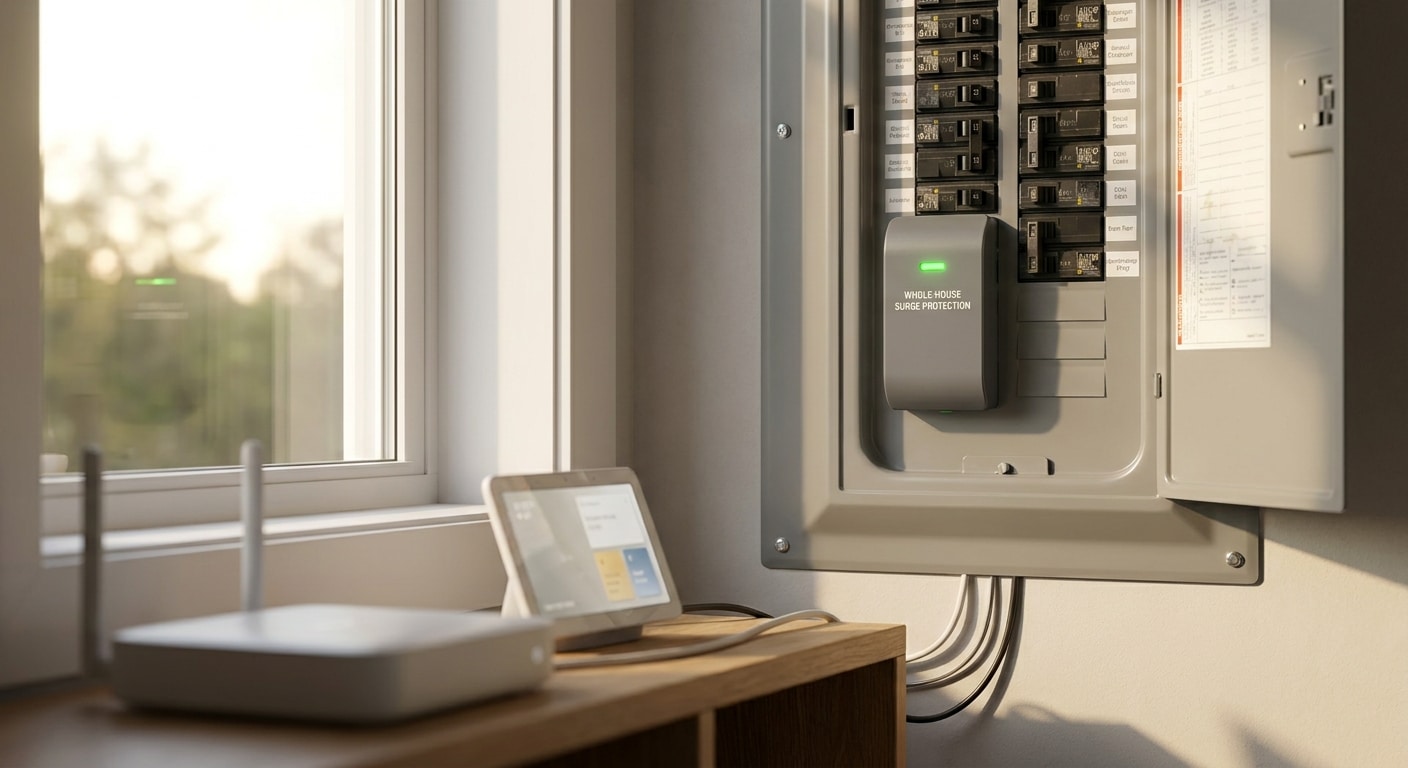
Whole House Surge Protection for Smart Homes 2026
August 13th, 2026
Smart thermostats, video doorbells, EV chargers, and whole-home hubs all share one weakness: a single voltage spike can fry the control boards inside them in a fraction of a second. Whole house surge protection stops that spike at the electrical panel before it reaches any outlet in the building.
- Type 2 panel-mounted surge protectors rated 40,000+ amps are the right call for most Northern Utah smart homes in 2026 — buy one.
- Plug-in power strips only protect what’s plugged into them, not hardwired smart hubs or HVAC boards — skip them as a whole-house fix.
- NEC 230.67 has required surge protection on new residential services since the 2020 code cycle, and most Utah jurisdictions now enforce it on panel upgrades.
- Pair a Type 2 device with point-of-use Type 3 protection on high-value electronics for layered coverage.
Why this matters
Utah's grid sees voltage surges from more than lightning. Transformer switching, grid load shifts during summer AC peaks, and even a neighbor's compressor kicking on can send a transient spike through the panel. A single event can knock out a smart thermostat board, a Wi-Fi router, and an EV charger's control unit in the same afternoon.
Most homeowners find out they need whole house surge protection after a $400 thermostat or a $1,200 charger stops responding. The fix costs less than replacing two smart devices, and it protects everything on the circuit, not just what's plugged into one strip. Expert Services installs these devices as part of standard electrical panel work across Northern Utah, and the install itself typically takes under two hours once the panel is accessible.
Who this is for
This guide is for homeowners who've added three or more connected devices to their house — a smart thermostat, video doorbell, whole-home Wi-Fi mesh, smart locks, an EV charger, or a home battery system — and want one upgrade that protects all of it at the panel level instead of device by device. If you've already lost a smart device to a power event, or you're planning an EV charger install in 2026, this is the point where whole-house protection pays for itself.
What to look for in whole house surge protection
Surge current rating (amps)
This number tells you how much surge the device can absorb before it fails. Look for a minimum of 40,000 amps per phase for a smart home with an EV charger and multiple HVAC zones — lower-rated units sacrifice themselves on the first big event and need replacing.
Clamping voltage
Clamping voltage is the level at which the device starts diverting excess voltage to ground. A clamping voltage under 400 volts protects sensitive smart home control boards better than units that clamp at 500+ volts, since low-voltage electronics are the first to fail.
Response time
A quality whole-house unit reacts in under one nanosecond. Anything slower lets a spike pass through before the protection engages, which defeats the purpose for microprocessor-based smart devices.
Panel compatibility
A Type 2 surge protective device mounts inside or beside your electrical panel and needs a compatible breaker slot and panel age. Homes with panels older than 20 years often need a panel evaluation first — installing surge protection on an undersized or outdated panel doesn't fix the underlying risk.
Indicator and monitoring features
Units with a visible status light or app notification tell you when the device has absorbed a surge and needs service. Without this, homeowners often run on a dead surge protector for years without knowing it stopped working.
Code compliance
NEC 230.67 requires surge protection on new dwelling unit services as of the 2020 code cycle, and Utah jurisdictions increasingly enforce it during panel upgrades and new construction. A unit installed to code also tends to qualify for manufacturer warranties that cover connected equipment.
Get your panel evaluated
Find out if your panel supports whole-house surge protection before you buy.
Top picks for smart home protection
The workhorse: Type 2 panel-mounted SPD
This is the standard whole-house layer, wired directly into your electrical panel. Look for a 40,000-amp surge current rating and UL 1449 4th edition listing — this is the category most electricians install during an electrical panel upgrade, especially when adding an EV charger circuit. Buy if you have three or more connected smart devices and a panel under 20 years old.
The frontline layer: Type 1 utility-side SPD
Installed ahead of the meter by the utility or a licensed electrician, this device absorbs the largest external surges, including lightning-induced transients from nearby strikes. Fewer residential installs use this tier alone since it requires utility coordination, but it's the strongest first line of defense in areas with frequent thunderstorm activity. Consider if you've had repeated surge damage despite having Type 2 protection installed.
The backup layer: Type 3 point-of-use SPD
These plug into the outlet behind a smart hub, HVAC control board, or home theater rack and catch anything that slips past the panel-level device. A quality unit clamps below 330 volts and adds a second layer for your highest-value electronics, including systems tied into your HVAC setup. Buy as a supplement, never as a replacement for panel-level protection.
The impostor: basic plug-in power strips
Most strips labeled "surge protector" at hardware stores carry no UL 1449 listing and a surge rating under 1,000 joules — nowhere near enough for a single lightning-adjacent event. These only protect what's physically plugged into them and do nothing for hardwired smart thermostats, doorbells, or HVAC boards. Skip these as your primary defense; they're fine as a secondary layer at best.
What to avoid
- Undersized joule/amp ratings. A unit rated for 10,000 amps looks like it does the job on the box, but a single significant surge event can exceed that in one pass, leaving you unprotected for the rest of the storm season.
- DIY installs on an outdated panel. Surge protection installed on a panel that's already at capacity or missing a proper ground doesn't reduce risk — it just adds a false sense of security.
- Skipping the point-of-use layer on EV chargers. EV charger control boards are especially sensitive to voltage transients; panel-level protection alone still leaves a gap on high-draw circuits.
Verdict comparison
| Type | Install location | Surge rating | Best for | Verdict |
|---|---|---|---|---|
| Type 1 utility-side | Ahead of the meter | 100,000+ amps | Storm-prone areas, repeat damage | Consider |
| Type 2 panel-mounted | Inside/beside panel | 40,000+ amps | Most smart homes in 2026 | Buy |
| Type 3 point-of-use | Outlet-level | 10,000-20,000 amps | High-value electronics, EV chargers | Buy (as supplement) |
| Basic power strip | Outlet-level | Under 1,000 joules | Nothing whole-house | Skip |
FAQ
What’s the best whole house surge protection for a smart home?
A Type 2 panel-mounted surge protective device rated 40,000 amps or higher is the best whole house surge protection for a home with multiple smart devices in 2026. Pair it with Type 3 point-of-use protection on your EV charger and HVAC control boards for a second layer.
Is whole house surge protection better than plug-in surge strips?
Yes, whole house surge protection covers every circuit in the home, while plug-in strips only protect whatever is physically connected to them. Hardwired devices like smart thermostats and doorbells get no protection from a strip.
How much surge protection does a smart home actually need?
A home with an EV charger, smart thermostat, mesh Wi-Fi, and connected HVAC system needs at least 40,000 amps of surge current rating at the panel. Homes with a history of repeat surge damage benefit from adding utility-side Type 1 protection as well.
Does whole house surge protection require a panel upgrade?
Not always, but panels older than 20 years or already at capacity often need an evaluation before a surge protective device can be added safely. A licensed electrician checks breaker space and panel condition as part of the install.
Is whole house surge protection required by code in Utah?
NEC 230.67 has required surge protection on new dwelling unit services since the 2020 code cycle, and most Utah jurisdictions enforce it during panel upgrades and new construction as of 2026. Existing homes without it aren’t automatically required to retrofit, but insurers increasingly ask about it.
Can a power surge damage an EV charger?
Yes, EV charger control boards are especially sensitive to voltage transients because of the high current they manage. Point-of-use surge protection on the charger circuit adds a layer beyond panel-level protection alone.
How long does a whole house surge protector last?
Most Type 2 devices last 10 years or more under normal conditions, but a single large surge event can use up the unit’s capacity in one shot. Units with a status indicator tell you when it’s time to replace the device.
One last thing
The device most homeowners forget to protect is the one running their HVAC system — a modern variable-speed furnace or heat pump control board costs far more to replace than the surge protector that would have saved it, and a ductless mini-split system added onto a home addition is exactly the kind of connected equipment that gets left off the protection plan. Check that any newer HVAC or mini-split zone added since your last panel work is actually covered.
Related guides