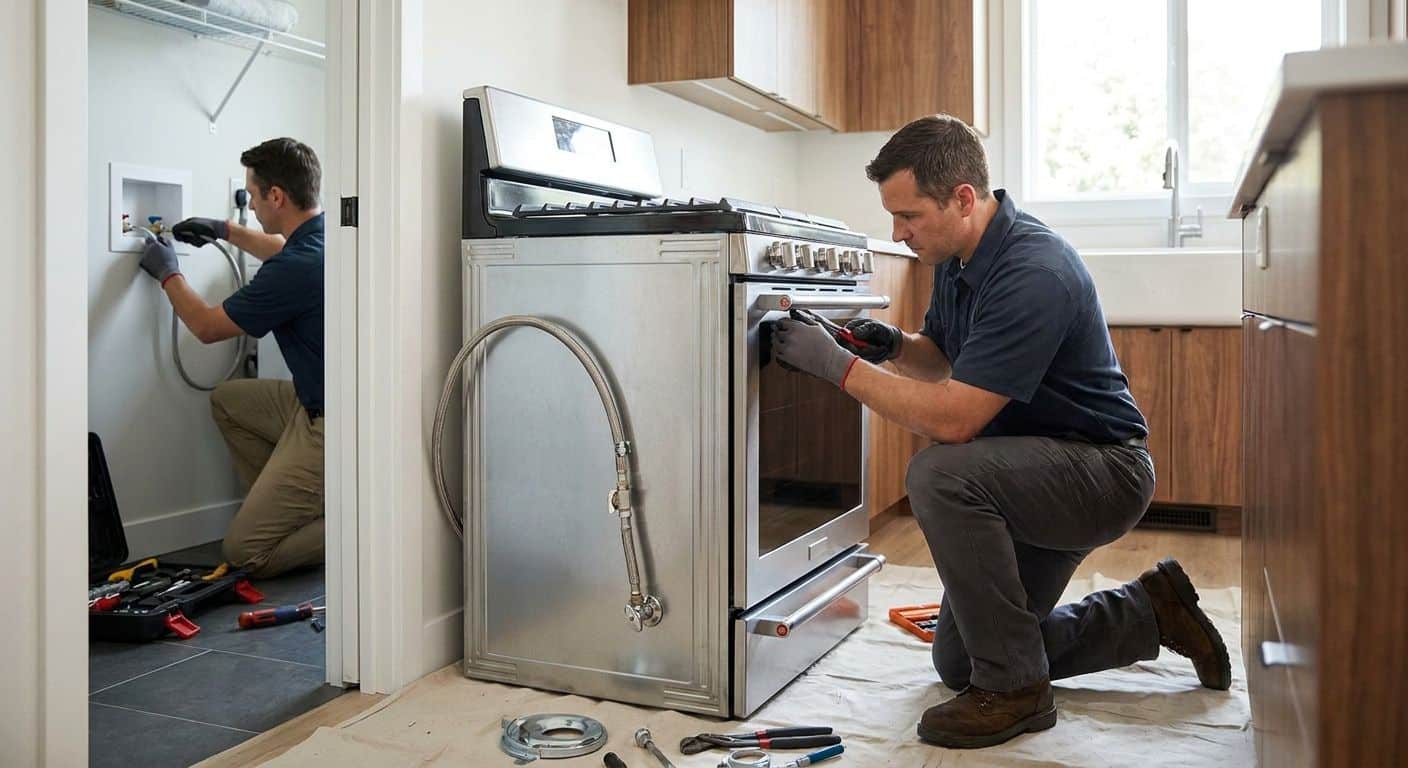
Gas Appliance Hookup for Kitchen & Laundry (2026 Guide)
August 22nd, 2026
Swapping an electric range for gas or adding a gas dryer during a laundry remodel sounds simple until you hit the actual hookup: line sizing, shutoff placement, and code compliance that varies by jurisdiction across Northern Utah. This guide breaks down what matters for kitchen and laundry gas appliance hookup projects in 2026, what to skip, and which jobs actually need a licensed technician.
- Gas ranges draw roughly 65,000 BTU/hr and need a dedicated line sized for that load, not a shared branch.
- Flex connectors are capped under 6 feet by code — reusing an old one from a relocated dryer is a common failure point.
- Gas appliance hookup for kitchen remodels almost always triggers a permit in Northern Utah; DIY line work does not.
- Gas dryer hookups run around 35,000 BTU/hr and still need their own shutoff valve, even in a converted laundry closet.
Why this matters
A gas appliance hookup done wrong doesn't just fail an inspection — it creates a leak risk in a room you use every day. Kitchen and laundry remodels are the two most common places homeowners try to save money on this step, because the appliance itself is the visible purchase and the hookup feels like an afterthought.
It isn't. Line sizing errors show up as weak flame on a range or a dryer that takes twice as long to dry a load because it's starved for gas pressure. Gas line installation for home renovations covers the broader renovation picture; this guide focuses specifically on the kitchen and laundry appliance connection itself.
Who this is for
This is for homeowners in Northern Utah mid-remodel: converting an electric kitchen to gas, relocating a laundry room, or adding a gas dryer where only an electric hookup existed. It's also relevant if you're buying a used gas range or dryer and need to know whether the existing hookup in the house will actually support it. It is not a guide for new commercial kitchen installs — those have separate ventilation and load requirements.
What to look for in gas appliance hookup for kitchen and laundry upgrades
Correct line sizing for the appliance load
A gas range typically draws around 65,000 BTU/hr and a gas dryer closer to 35,000 BTU/hr. If the existing branch line was sized for a smaller appliance or shared with another fixture, the new appliance will underperform even though it's technically "connected." Sizing has to account for total connected load on that branch, not just the new unit.
Shutoff valve placement and accessibility
Every gas appliance needs its own accessible shutoff valve, not a shared valve buried behind a cabinet. In a kitchen remodel, that valve needs to stay reachable after cabinetry and countertops go in — a detail that gets missed when the hookup happens before the finish work is planned out.
Flex connector length and condition
Code caps flex connectors at under 6 feet, and connectors have a rated lifespan. Reusing a connector from the old appliance location, especially after a laundry room relocation, is one of the most common corner-cuts on a DIY hookup. A connector that's too long or already flexed repeatedly is a leak point waiting to happen.
Permit and inspection requirements
Gas line work for a kitchen or laundry upgrade in most Northern Utah jurisdictions requires a permit and inspection — this isn't optional paperwork, it's what confirms the pressure test actually holds. Skipping this step doesn't just risk a fine; it means nobody verified the line before you started cooking or drying laundry over it.
Ventilation and clearance for the appliance
Gas ranges need proper clearance to combustibles and, in many cases, a range hood vented to the exterior. Gas dryers need their own vent path separate from the gas line itself. These aren't hookup details exactly, but they get decided at the same time as the gas connection and are easy to overlook when the focus is on the appliance install.
Whether the job needs a licensed technician
Some states allow limited DIY gas work; Utah does not treat gas line alteration as a general homeowner task in most cases. If the job involves cutting into an existing line, extending it, or moving a shutoff, it's licensed work — not a weekend project.
The five hookup jobs homeowners request most
Gas range hookup — the kitchen centerpiece. A range draws around 65,000 BTU/hr and needs a dedicated line plus an accessible shutoff behind or beside the unit. This is the most common kitchen remodel request and the one most likely to fail inspection if the connector is oversized for the space. Buy — budget for licensed installation, not a DIY connector swap.
Gas dryer hookup — the laundry workhorse. Dryers run closer to 35,000 BTU/hr and need their own shutoff even in a tight laundry closet. Converting an electric laundry setup to gas usually means running new line, not just swapping the plug. Buy if you're committed to a gas dryer; the line work pays for itself in lower drying costs over the appliance's life.
Gas line extension for an island range or outdoor connection — the wildcard. Moving a range to a kitchen island, or extending a line toward an outdoor kitchen off the same run, adds distance and often a size change partway through. This is where a lot of DIY plans fall apart because the added length changes the pressure math. Consider — get a line-sizing check before committing to the layout.
Whole-line rerouting during a full renovation — the big one. If the remodel touches walls or subfloor anyway, rerouting the gas line while everything is open avoids cutting into finished surfaces later. It costs more up front but avoids a second disruption. Consider if the renovation is already opening walls; Skip the reroute if it's just an appliance swap in place.
Flex connector replacement on an existing hookup — the quick fix. If the appliance is staying put and only the connector needs replacing, this is a fast, low-cost fix — but it's still gas work and still needs the correct rated connector length and a leak check. Buy — it's inexpensive relative to the risk of an aging connector.
Plan your gas appliance hookup
Get a licensed technician scheduled for your kitchen or laundry upgrade.
What to avoid
- Reusing an old flex connector after relocating a range or dryer — length and wear rating rarely match the new position.
- Treating a shared branch line as sufficient for a new high-draw appliance like a range; a line that fed a smaller unit fine can starve a bigger one.
- Skipping the permit because the appliance "just needs a hose swap" — most kitchen and laundry gas hookups in a remodel context require inspection, and an uninspected line has no verified pressure test behind it.
If you're also touching electrical during the same kitchen remodel — new outlets near a gas range or updated circuits for a laundry room — GFCI outlet installation for kitchens and bathrooms and electrical panel upgrade signs are worth reading before the walls close up.
Verdict comparison table
| Job | Typical load | Key requirement | Verdict |
|---|---|---|---|
| Gas range hookup | ~65,000 BTU/hr | Dedicated line, accessible shutoff | Buy |
| Gas dryer hookup | ~35,000 BTU/hr | Own shutoff, separate vent path | Buy |
| Island/outdoor line extension | Varies with added length | Re-check line sizing | Consider |
| Full line reroute | Whole-house load | Only worthwhile if walls are open | Consider |
| Flex connector replacement | Same as existing appliance | Correct rated length | Buy |
A kitchen remodel that also needs a garbage disposal swapped in is a good candidate for bundling the gas and plumbing work into one visit — see garbage disposal installation for kitchen remodels for what that job involves separately.
FAQ
What’s the best way to add a gas line for a new range?
Have a licensed technician size the line to the range’s BTU rating and run it to a shutoff valve you can reach after cabinets go in. Sizing a new line off an existing shared branch without a load check is the most common mistake in 2026 remodel jobs.
Is a gas dryer hookup different from an electric dryer hookup?
Yes — a gas dryer needs its own gas line, shutoff valve, and vent path in addition to a standard power outlet. An electric dryer only needs the outlet and vent, so converting from electric to gas mid-remodel means new line work, not just a plug swap.
Can I hookup a gas appliance myself?
In most of Northern Utah, cutting into or extending a gas line is licensed work, not a homeowner DIY task. Reconnecting an appliance to an existing, unmodified line with a properly rated connector is sometimes allowed, but any line change requires a permit and inspection.
Do I need a permit for gas line installation in Utah?
Most jurisdictions in Northern Utah require a permit and inspection for new or altered gas lines feeding kitchen or laundry appliances. The inspection is what confirms the pressure test held before the line goes live.
What size gas line do I need for a range?
Sizing depends on the range’s BTU rating (typically around 65,000 BTU/hr) and the length of run from the meter or branch. A technician calculates this against total connected load on that line, not just the new appliance alone.
How long does a gas appliance hookup take?
A straightforward connector replacement on an existing line can be done in one visit. Extending or rerouting a line, especially during a full kitchen or laundry remodel, takes longer because it includes a pressure test and inspection scheduling.
Is CSST or black iron pipe better for gas lines?
Both are code-compliant options used in Northern Utah homes; the choice depends on the run’s layout and local code preference rather than one being universally better. A licensed technician will pick based on the specific installation, including any bends or wall penetrations in the run.
How much does a gas appliance hookup for kitchen upgrades cost?
Cost depends on line length, whether a new shutoff is needed, and permit fees in your city, so get a quote based on your specific layout rather than a flat estimate. Bundling the hookup with other remodel work in the same visit often reduces total trip costs.
One last thing
The detail most homeowners miss isn't the appliance — it's the shutoff valve location. Plan where it lives before the cabinets or laundry room finishes go in, because moving a shutoff after drywall and cabinetry are done costs more than the original hookup.
Related guides
- Gas line repair and installation for home renovations
- Garbage disposal installation for kitchen remodels
- GFCI outlet installation for kitchens and bathrooms
- How to know if you need an electrical panel upgrade