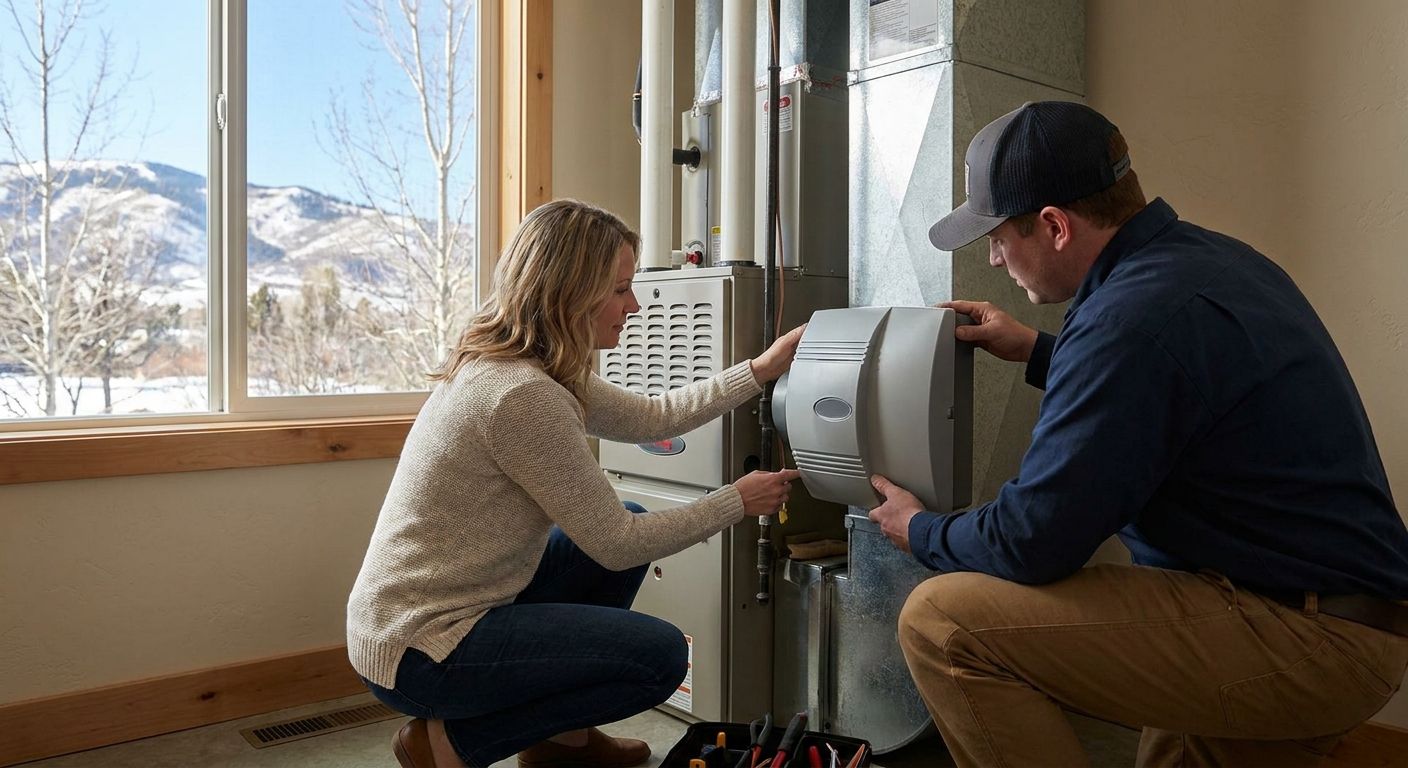
Humidifier Installation for Winter in Utah (2026 Guide)
August 30th, 2026
Utah homeowner humidifier installation for winter connects a whole-home unit to your furnace so indoor relative humidity stays above the 30 percent mark that keeps static shocks, bloody noses, and cracking hardwood floors under control from October through April. The high desert climate along the Wasatch Front runs drier than most of the country to begin with, and a furnace running four to five months straight strips out whatever moisture winter storms leave behind.
- Humidifier installation for winter should target 30-50% indoor relative humidity, the range ASHRAE recommends for occupied homes.
- Furnace-mounted bypass humidifiers fit most Utah forced-air systems and need no extra fan or transformer.
- Portable humidifiers only cover single rooms; homes over 1,500 sqft need a whole-home unit tied to the furnace.
- Expert Services installs and services whole-home humidifiers across Northern Utah alongside furnace and duct work.
Why humidifier installation matters for Utah homeowners
Northern Utah's winter air already sits well below comfortable humidity before the furnace ever kicks on, and forced-air heat drives it lower by pulling in cold, dry outside air and reheating it without adding moisture back. That combination is why Utah homeowners see more static shocks off doorknobs, more nosebleeds in kids, and more gapping in hardwood floors and cabinetry every winter than homeowners in more humid climates.
A furnace that runs constantly through a Utah winter dries a house out fast, and once relative humidity drops below 30%, wood trim shrinks, wallpaper seams lift, and cold-related illness spreads faster indoors. Humidifier installation for winter fixes the root cause instead of the symptoms, which is why it belongs on the same maintenance list as furnace filter changes and duct inspections for anyone running a forced-air system through a Utah winter.
Getting the humidifier installation for winter is not just about comfort. Skin and respiratory complaints climb every winter in dry climates, and the fix is mechanical, not medicinal — add moisture back into the air your furnace is already circulating.
Test your indoor humidity level
Before buying anything, confirm the problem with a reading instead of a guess.
- Place a $10-$20 hygrometer in a main living space, away from windows and vents
- Check the reading twice daily for three days: morning and evening
- Note the outdoor temperature each time — colder days pull humidity down faster
- Flag any reading under 30%, the low end most HVAC manufacturers cite as the comfort floor
- Repeat the test in a bedroom, since sleeping in dry air is often where symptoms show up first
Choose the right humidifier type for your furnace
Most Utah homes run a standard forced-air furnace, which opens up three humidifier styles.
- Bypass humidifier: uses furnace blower airflow to pull water across an evaporator pad, no extra fan needed
- Fan-powered humidifier: adds its own blower for faster moisture output on larger or leakier homes
- Steam humidifier: heats water into vapor independent of the furnace cycle, works even when the blower is off
- Portable/console humidifier: covers a single room, no ductwork tie-in required
- Check your furnace's static pressure rating before choosing a fan-powered unit; undersized ductwork chokes on the added airflow demand
Size the humidifier to your home's square footage
An undersized unit runs constantly and still underperforms; an oversized one fogs windows and soaks insulation.
- Match rated gallons-per-day output to total conditioned square footage, not just the main floor
- Add capacity for homes with vaulted ceilings or open floor plans, since volume matters more than footprint
- Factor in tight, newer construction separately — less air leakage means humidity holds better at a lower output setting
- Older, drafty Utah homes typically need a higher-capacity unit to offset constant air exchange with the outside
- Confirm duct routing supports even distribution; a single supply-side install can leave far rooms drier than the room near the furnace
Install the humidifier on your HVAC system
The unit mounts on either the supply plenum or the cold-air return, and the location changes performance and lifespan.
- Return-side mounts see cooler, less-dried air, which extends evaporator pad life
- Supply-side mounts humidify faster but expose components to warmer, harsher airflow
- A saddle valve taps the water line feeding the unit — get this soldered or compression-fit correctly to avoid slow leaks
- Low-voltage wiring ties into the furnace transformer; shut off furnace power at the breaker before touching terminals
- A drain line routes overflow water away from the furnace cabinet — skipping this step is the top cause of furnace water damage calls
- Homeowners uncomfortable working inside a live furnace cabinet should book a licensed installer rather than risk a wiring or water line mistake
Book furnace humidifier installation
Licensed HVAC techs install and wire whole-home humidifiers across Northern Utah.
Set your humidistat correctly for winter
A humidistat set too high in January is the single most common cause of window condensation and mold complaints.
- Set the target lower on the coldest days — outside temps below 10°F call for indoor humidity closer to 25-30%
- Raise the setting slightly on milder days, since the window condensation risk drops as outdoor temps climb
- Watch for moisture on the inside of double-pane windows each morning — that is the signal to dial the setting down
- Recheck the setting after any major cold snap; Utah's overnight temperature swings can be 20-30 degrees in a single week
Maintain the humidifier through the season
A neglected evaporator pad turns into a mineral scale block within one heating season on Utah's hard water.
- Replace the evaporator pad at the start of each heating season, not mid-winter
- Check the water panel monthly for scale buildup, especially in homes without a water softener
- Clean the saddle valve screen if flow slows noticeably
- Shut off the water supply to the humidifier every spring when the furnace stops running
- Pair the shutoff with a furnace filter swap so both maintenance tasks happen on the same visit
Common mistakes Utah homeowners make
- Buying a portable unit for a whole house — a single console humidifier can't keep up with a 2,000+ sqft forced-air system, leaving far rooms bone-dry
- Setting the humidistat too high in extreme cold — window condensation and eventual mold growth follow fast
- Skipping the spring water shutoff — stagnant water in the line breeds mineral scale and bacteria before the next heating season
- DIY wiring without cutting furnace power first — low-voltage terminals are still live and can damage the furnace control board
- Ignoring hard water's effect on the evaporator pad — Utah's mineral-heavy water shortens pad life faster than manufacturers assume in national estimates
Comparing humidifier options for Utah homes
| Option | Best for | Key limitation |
|---|---|---|
| Portable/console humidifier | Renters or single-room needs | Manual refilling, covers one room only |
| Bypass whole-home humidifier | Standard forced-air furnace setups | Only humidifies while the blower runs |
| Fan-powered whole-home humidifier | Larger homes with tighter duct static pressure | Needs its own low-voltage transformer and wiring |
| Steam humidifier | Homes wanting humidity independent of furnace cycles | Highest install complexity, needs licensed electrical hookup |
Whole-home bypass or fan-powered units installed on an existing furnace are the right call for most Utah homeowners over 1,500 square feet — a portable unit simply can't keep pace with the air volume a forced-air system moves.
Homeowners weighing a furnace humidifier alongside other winter HVAC upgrades should also look at how their system stacks up overall; see Utah home HVAC systems for how humidifier compatibility fits into a full system choice, and check the best furnace for Utah winters if the furnace itself is due for replacement before adding a humidifier to it.
Expert Services handles humidifier installation for winter as part of standard furnace service calls across Northern Utah, wiring the unit into the existing furnace transformer and setting the humidistat to match the home's square footage and duct layout.
FAQ
What’s the best humidifier for a Utah winter?
A whole-home bypass or fan-powered humidifier mounted on the furnace is the best option for most Utah homes over 1,500 square feet, since portable units can’t move enough moisture to cover a full forced-air system. Smaller homes or single-room needs can get by with a console unit.
Is a whole-home humidifier better than portable units?
Yes, for anything beyond one room a whole-home unit tied into the furnace ductwork covers the whole house evenly instead of just the room it sits in. Portable units also require daily refilling, while whole-home units draw straight from the water line.
How much humidity should indoor air have in winter?
ASHRAE recommends 30-50% relative humidity for occupied homes, with the lower end appropriate on the coldest days to avoid window condensation. Utah’s dry winter air often falls below 20% indoors without a humidifier running.
Can I install a furnace humidifier myself?
A handy homeowner can mount the unit and cut the water tap, but low-voltage wiring into the furnace transformer and correct drain routing are where most DIY installs go wrong. Cutting furnace power at the breaker before any wiring work is non-negotiable.
Does a humidifier increase furnace heating bills?
Properly humidified air feels warmer at the same thermostat setting, which often lets homeowners lower the temperature a degree or two without losing comfort. The humidifier itself draws minimal power since it uses the furnace blower’s existing airflow.
How often should a furnace humidifier be serviced?
The evaporator pad should be replaced at the start of each heating season, with a mid-winter check on Utah’s hard water systems where scale builds up faster. The water supply should also be shut off every spring when the furnace stops running.
Will a humidifier fix static electricity in my house?
Static shocks are a direct symptom of air below 30% relative humidity, and bringing indoor humidity back into the 30-50% range eliminates most of them. It typically takes a few days of steady humidifier operation to notice the difference.
Does humidifier installation require an electrician?
Most furnace humidifiers wire into the existing furnace’s low-voltage transformer, which an HVAC technician handles as part of the install. A separate electrician is only needed for steam humidifiers requiring a dedicated 120V circuit.
One last thing
Humidifiers mounted on the cold-air return side of a furnace typically outlast supply-side mounts, because the evaporator pad never sees the hottest air the furnace produces — less heat exposure means less pad degradation over a Utah heating season. If a technician offers the choice, return-side mounting is the better long-term bet even though it takes slightly longer to raise humidity after a cold snap.
Related guides