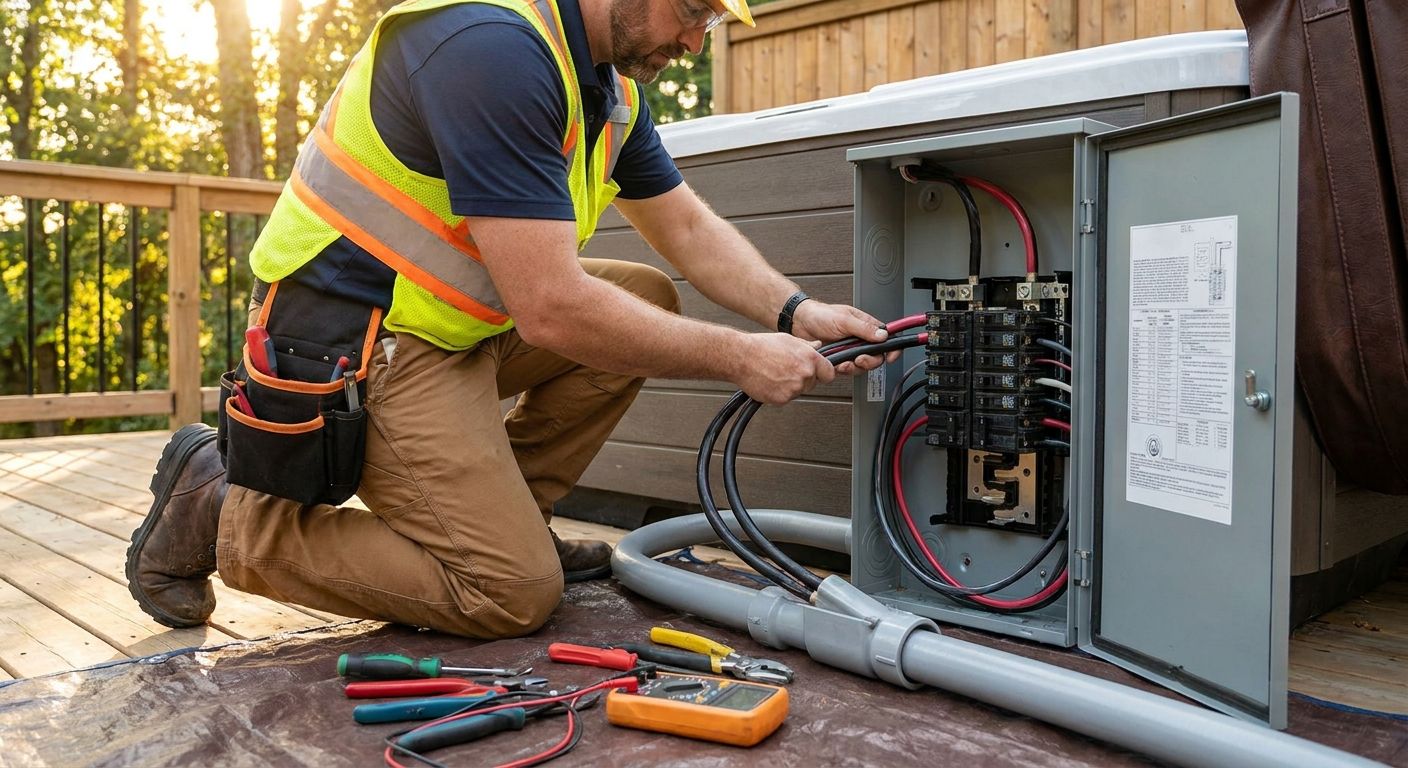
Hot Tub Electrical Hookup 2026: What Code Requires
August 31st, 2026
Utah homeowners installing a hot tub in 2026 need a dedicated 240-volt circuit, a GFCI disconnect within sight of the water, and a bonding grid that satisfies National Electrical Code Article 680 — not a stretched cord run from the garage outlet. Northern Utah's cold winters and the number of homes still running 100-amp panels make the load calculation and outdoor wire run harder here than in a mild climate, so the hookup has to satisfy code and the weather at the same time.
- A proper hot tub electrical hookup needs a dedicated 240V GFCI circuit sized to the spa’s nameplate amperage.
- NEC 680.41 requires the GFCI disconnect to sit 5 to 50 feet from the water, in direct sight of the tub.
- Plug-and-play 120V spas skip most of this wiring but heat far slower through a Utah winter.
- DIY 240V wiring frequently fails inspection; Expert Services handles panel checks, bonding, and final hookup across Northern Utah.
- Skipping the equipotential bonding grid is the most common code failure on hot tub installs in 2026.
Why hot tub electrical hookup matters for Utah homeowners
Most hot tub manufacturers rate their 240-volt models for a dedicated circuit between 40 and 60 amps, and that circuit has to originate from a panel with room to spare. A lot of Northern Utah houses built before the 2000s still run 100-amp service, which is already carrying central air, an electric range, or a workshop sub-panel before the spa gets added to the math. If your service is close to maxed out, the hookup starts with an electrical panel upgrade, not a spool of wire.
The other Utah-specific wrinkle is the outdoor run itself. Frozen ground, buried conduit depth requirements, and freeze-thaw cycles on concrete pads all affect how the circuit gets routed from the panel to the spa equipment pad. Skip that planning and you end up re-trenching a yard in April.
How to wire and hook up a hot tub, step by step
Confirm your hot tub's voltage and amperage rating
Every spa ships with a nameplate on the equipment compartment listing exact electrical requirements. Read it before you buy wire or call anyone.
- Note whether the unit is 120V plug-and-play or 240V hardwired
- Record the maximum amp draw, not just the breaker size printed on the box
- Check if the load is rated continuous, which changes the required breaker sizing under NEC 210.19
- Compare the manufacturer spec sheet against your existing panel's spare capacity
Check your electrical panel's spare capacity
A load calculation tells you whether the panel can take on a 50-60 amp circuit without tripping under normal household demand.
- Add up existing major loads: AC, range, dryer, EV charger if present
- Compare the sum against your panel's total rated amperage, typically 100, 150, or 200 amps in Utah homes
- Flag any double-tapped breakers or open slots that suggest the panel is already stretched
- Get a licensed load calculation rather than estimating from memory
Plan the circuit path and wire gauge
Wire gauge depends on amperage and distance — a 50-amp circuit running 80 feet outdoors needs heavier copper than the same circuit running 20 feet. This is also where new additions or detached patios complicate things, similar to the planning covered in electrical wiring for home additions.
- Measure the actual run length from panel to spa pad, not a straight-line guess
- Use copper conductors rated for outdoor/wet locations (THWN-2 or equivalent)
- Bury conduit at the depth your local Utah jurisdiction requires for the amperage
- Leave slack at both ends for future service work
Install a GFCI disconnect sized to the tub
NEC 680.41 requires a readily accessible disconnect that's visible from the spa, located at least 5 feet from the water's edge and no more than 50 feet away.
- Match the disconnect's amp rating to the breaker, not the spa's average draw
- Mount it where it's never blocked by landscaping or a fence
- Confirm it trips on both ground fault and standard overload
- Label it clearly as the spa disconnect for future service calls
Set up the equipotential bonding grid
This is the step most DIY installs miss, and it's the one inspectors check first. NEC 680.26 requires bonding all metal parts within 5 feet of the spa — pumps, heaters, metal conduit, even a metal fence post — to a common grid.
- Bond the pump motor, heater, and any metal equipment housing
- Run bonding wire to any metal within 5 feet of the tub's perimeter
- Use listed bonding lugs, not wire nuts or tape
- Verify continuity with a meter before backfilling any trench
Schedule licensed inspection and final hookup
Once wire, disconnect, and bonding are in place, a licensed electrician ties in the circuit and pulls the permit inspection most Utah municipalities require for 240-volt spa installs. Homeowners who'd rather not manage the permit, the load calculation, and the final tie-in themselves typically bring in Expert Services at this stage, since a failed inspection means re-opening trenches or conduit runs that were already buried.
- Pull the permit before energizing the circuit, not after
- Have the electrician verify bonding continuity with a meter on-site
- Confirm GFCI trip response before the final panel connection
- Keep the inspection paperwork with your home records for resale
Test GFCI trip and full load before first fill
Before the spa ever holds water, run the electrical test dry.
- Trip the GFCI manually and confirm it cuts power immediately
- Run the heater and pump simultaneously to check for voltage drop
- Watch the panel for any breaker warmth or chatter under full load
- Only fill the tub once the circuit passes a full-load test
Hot tub hookup options compared
| Option | Best for | Key limitation | Verdict |
|---|---|---|---|
| 120V plug-and-play spa | Small households testing ownership before a bigger investment | Heater cycles slowly; can take 2-3 days to reach full temperature from a cold fill in Utah winters | Hold |
| DIY 240V wiring | Homeowners comfortable pulling permits and passing inspection solo | Bonding grid and GFCI placement mistakes commonly fail final inspection | Skip for most |
| 240V hardwired circuit, self-managed panel work | Households running the spa daily through cold months | Still requires a licensed electrician for the final tie-in and inspection sign-off | Buy with a pro |
| Licensed electrician hookup (Expert Services) | Homeowners who want NEC 680 compliance without managing permits and inspection themselves | Scheduling depends on electrician availability during peak spa-install season | Buy |
Common mistakes Utah homeowners make with hot tub electrical hookups
- Running a 240V-rated spa off a 120V outlet "for now" and never upgrading, which undersizes the heater's performance permanently
- Skipping the bonding grid because the deck is wood, not concrete — NEC 680.26 doesn't exempt wood decking from the 5-foot bonding radius
- Undersizing wire gauge on long outdoor runs, common on larger Utah lots where the spa pad sits far from the panel
- Placing the GFCI disconnect where landscaping later blocks the sightline, which violates the visibility requirement at final inspection
- Assuming an older 100-amp panel has room for a 50-60 amp spa circuit without running the actual load calculation first
Get your hot tub circuit installed right
Licensed Utah electricians handle the load calc, GFCI disconnect, and bonding.
FAQ
What is the best hot tub electrical hookup for a 240V spa?
A dedicated 50-60 amp GFCI circuit run in outdoor-rated conductors to a disconnect within sight of the tub is the standard hookup for a 240V spa in 2026. Plug-and-play 120V units skip this but heat much slower.
Is a hot tub electrical hookup different from a pool hookup?
Both fall under NEC 680, but hot tubs typically draw less amperage than a pool pump and heater combined, so the circuit sizing differs. Bonding requirements around the equipment apply to both.
How much amperage does a hot tub need?
Most 240V hot tubs need a 40-60 amp dedicated circuit, though the exact figure is always printed on the equipment nameplate. Never size the breaker from a generic estimate.
Can I use an extension cord for a hot tub?
No. Extension cords aren’t rated for the continuous, high-amperage load a spa heater and pump draw, and running one violates code. Even 120V plug-and-play spas require a dedicated GFCI outlet, not a shared cord.
How far does the GFCI disconnect need to be from the hot tub?
NEC 680.41 requires the disconnect to sit at least 5 feet from the water’s edge and no more than 50 feet away, in direct line of sight. Landscaping or fencing that blocks that sightline fails inspection.
Do I need a permit for hot tub electrical work in Utah?
Most Utah municipalities require a permit and inspection for a new 240V spa circuit. Skipping the permit can complicate insurance claims and home resale disclosures later.
What size wire do I need for a 50 amp hot tub circuit?
Wire gauge depends on both amperage and the length of the run from panel to spa pad, so a licensed electrician calculates it rather than using a fixed rule of thumb. Longer outdoor runs need heavier copper to avoid voltage drop.
One last thing
The delay that catches most Utah homeowners off guard in 2026 isn't the wiring itself — it's discovering during the load calculation that a 100-amp panel is already at capacity once the spa gets added to the math. Get the panel checked before you buy the spa, not after it's sitting in the driveway.
Related guides
- GFCI outlet installation for kitchens and bathrooms
- Circuit breaker repair for homes with frequent trips