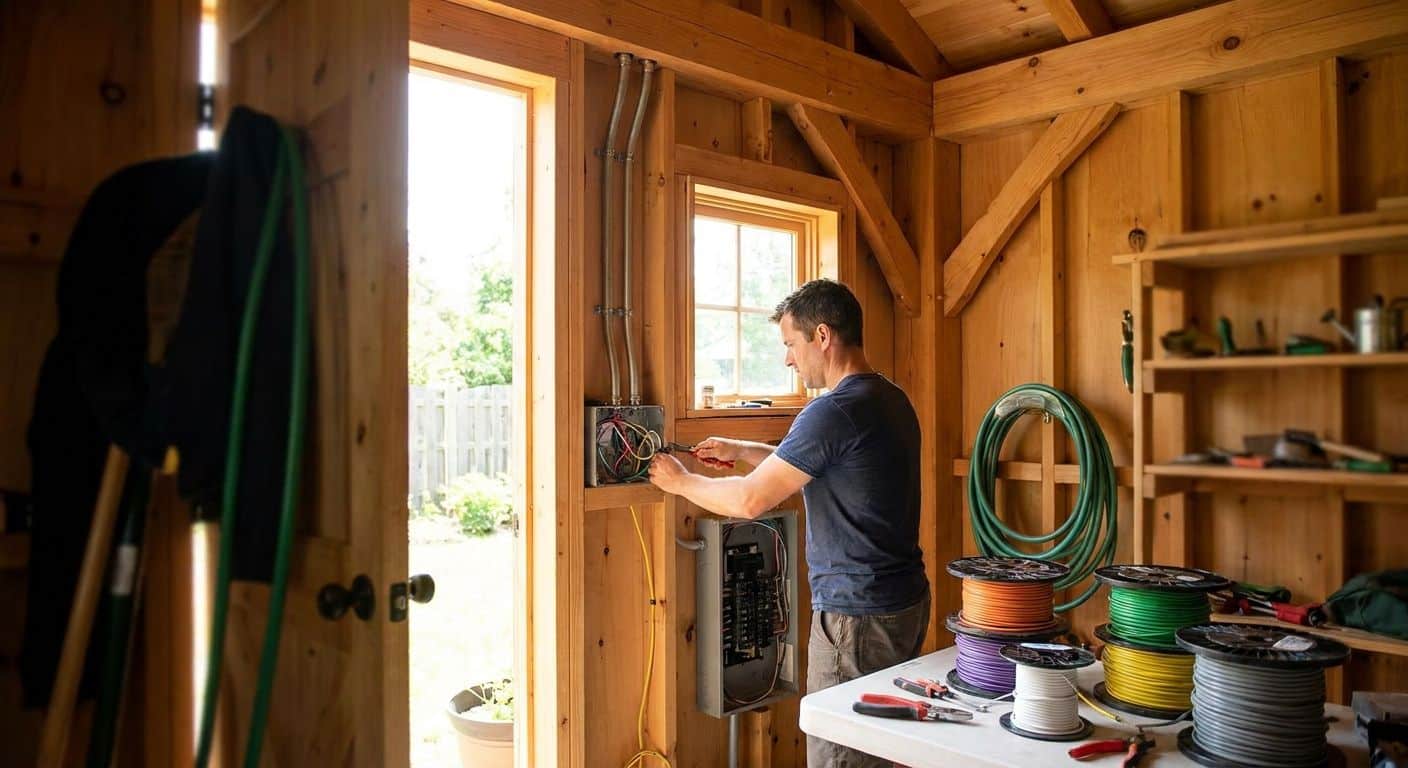
Electrical Wiring for Sheds and Garages: 2026 Guide
September 1st, 2026
Backyard shed and detached garage wiring means running a dedicated, permitted circuit from your home's main panel to the outbuilding, sized to run lights, outlets, and equipment safely without tripping breakers or overheating wire. A shed used for storage needs one 15-amp lighting circuit; a detached garage doubling as a workshop, home gym, or home office needs a subpanel, multiple 20-amp circuits, and GFCI protection on every outlet. The distance from the house, the equipment you plan to run, and whether you need 240-volt power for a welder, EV charger, or hot tub all change the design before a single wire gets pulled.
- Detached garages and sheds over 6 feet from the house need a permitted, GFCI-protected circuit — extension cords through a window are not code-compliant in 2026.
- NEC 300.5 sets burial depth at 18 inches for PVC conduit or 24 inches for direct-buried UF cable, dropping to 12 inches with GFCI protection on a 20-amp circuit.
- EV chargers, welders, and hot tubs need dedicated 240-volt circuits sized separately from the shed’s lighting and outlet load.
- A licensed electrician handles the panel connection and permit; the trench and conduit run can often be prepped ahead of time.
Why electrical wiring for sheds and garages matters
An undersized or unpermitted circuit is the most common reason a shed or garage electrical job gets flagged during a home sale inspection in Utah. Insurance carriers and buyers' inspectors both check for GFCI protection on outdoor and accessory-building circuits, and an extension cord fed through a window won't pass.
The other real cost is capacity. A shed wired for a single light and one outlet in 2015 can't handle a 2026 workshop with a compressor, a mini-split, and a table saw running at once. Before any wire goes in the ground, check whether your existing panel has room — a garage subpanel pulls its full load from the main panel, and a 100-amp house panel that's already near capacity won't support a 60-amp feeder without an upgrade first.
The step-by-step build
Calculate your shed or garage's electrical load
Add up everything that will run at once before picking wire size. Lighting alone rarely drives the decision — equipment does.
- Lighting circuit: 15 amps covers most sheds and single-bay garages
- General outlets: one dedicated 20-amp circuit per 4-6 outlets
- Heavy equipment (compressor, table saw, welder): each gets its own circuit
- Space heater or mini-split: 20-30 amps depending on unit size
- Future EV charger or hot tub: plan a 240-volt circuit even if you're not installing one yet
- Add 20% headroom to whatever total you land on
Size the feeder and subpanel
The wire running from the house to the structure is the feeder, and it has to match both the distance and the total amperage, not just the biggest single appliance.
- 60-amp subpanel covers lighting, outlets, and one or two power tools
- 100-amp subpanel is the right call for workshops, EV chargers, or hot tubs
- Copper feeder wire handles more amperage per gauge than aluminum over the same run
- Every subpanel needs its own grounding electrode and a disconnect at the structure
- Runs over 100 feet often need one wire size larger than the amp rating alone would suggest, to control voltage drop
Plan the trench and conduit route
Burial depth is set by the National Electrical Code, and it changes depending on what's protecting the wire.
- PVC Schedule 40 conduit: minimum 18 inches deep
- Direct-buried UF cable with no conduit: minimum 24 inches
- Circuits with GFCI protection rated 20 amps or less: as shallow as 12 inches
- Route the trench away from irrigation lines, gas lines, and existing utility runs
- Lay warning tape a few inches above the conduit so future digging hits a warning before it hits the wire
Install GFCI protection on every circuit
The NEC requires GFCI protection on all 125-volt, 15- and 20-amp receptacles in unfinished accessory buildings — this isn't optional for a shed or detached garage.
- GFCI breaker at the subpanel protects the whole circuit from one point
- GFCI outlet at the first receptacle protects everything downstream on that run
- Weatherproof "in-use" covers are required on any exterior-facing outlet
- Test every GFCI monthly with the built-in test button
- Label the panel so a tripped GFCI is easy to find and reset
Add dedicated circuits for heavy equipment
This is where sheds and garages diverge most from house wiring — equipment draws more, and shares circuits worse.
- Table saws and compressors: dedicated 20-amp, 120-volt circuit each
- Welders: dedicated 240-volt circuit, typically 30-50 amps depending on the unit
- EV chargers need a dedicated 240-volt, 40-50 amp circuit and their own breaker, separate from any other garage load
- Hot tubs and spas run on a dedicated GFCI-protected 240-volt circuit sized to the equipment's nameplate
- Never combine a heavy 240-volt appliance circuit with the lighting circuit — one nuisance trip shouldn't kill your lights
A garage set up as a working bay follows the same logic whether it's a woodshop or a detailing operation — dedicated 20-amp circuits for extractors, vacuums, and lighting on separate breakers, laid out the same way a detailing shop setup checklist walks through equipment placement and power draw before the first tool gets plugged in. Get the circuit count right before you finish the walls; retrofitting a missed circuit means opening drywall you just closed.
Get the permit and schedule the inspection
Utah building departments require a permit for any new circuit run to a detached structure, and skipping it creates problems at resale, not just at inspection time.
- Pull the permit before trenching starts, not after
- The panel connection and subpanel work require a licensed electrician
- A rough-in inspection happens before the trench gets covered
- A final inspection signs off once outlets, switches, and fixtures are in place
- If you're not sure where to start, request an estimate and get the permit and load calc handled together
Wire the interior and add surge protection
Once the feeder and subpanel are in, the interior work is closer to standard residential wiring, with a couple of shed-specific adjustments.
- Space outlets every 6-8 feet along workbenches, closer for shop use
- Put switched lighting at every entry door
- Run lighting on a circuit separate from outlets so one trip doesn't leave the space dark
- Use weatherproof, gasketed fixtures for anything near an overhead door or open bay
- A whole-house surge protector at the main panel guards the shed's subpanel too, which matters if you're running smart home or networked equipment out there
Comparing your wiring options
| Option | Best for | Key limitation |
|---|---|---|
| Extension cord through a window | Nothing — not code-compliant | Fire risk, voltage drop, fails inspection. Skip. |
| Direct-buried UF cable, no conduit | Short runs under 50 ft with GFCI | No conduit means no protection from future digging |
| PVC conduit underground feeder | Most shed and garage conversions | Requires an 18-inch trench and fittings at every bend |
| Overhead feeder from the eave | Rocky soil where trenching is hard | Exposed to tree limbs, ice, and looks utilitarian |
| Licensed subpanel install with permit | Workshops, EV chargers, hot tubs, home offices | Needs coordination on permit and inspection timing |
A permitted PVC conduit feeder with a subpanel is the right call for any garage doing double duty as a workshop or home office in 2026 — it's the only option on this list that scales if you add equipment later.
Common mistakes shed and garage owners make
- Running power through a window with an extension cord — it fails inspection and it's a documented fire hazard for anything left plugged in overnight
- Skipping GFCI protection because "it's just a shed" — code doesn't make that exception, and neither does an insurance adjuster after a fire
- Undersizing the feeder for a future EV charger, hot tub, or mini-split, forcing a full re-trench later instead of adding capacity up front
- Combining lighting and outlets on one circuit, so a tripped tool breaker leaves the whole structure dark
- Skipping the permit to save time, then discovering it during a home sale inspection or an insurance claim after storm damage
FAQ
Do I need a permit to run electrical to a shed or detached garage?
Yes. Any new circuit run to a detached structure requires a permit and inspection in most Utah jurisdictions. Skipping it can cause problems at resale or with an insurance claim.
How many amps does a detached garage need?
A basic garage with lighting and a few outlets runs fine on 60 amps. A workshop with power tools, an EV charger, or a hot tub needs 100 amps.
Can I use an extension cord to power my shed?
No. Extension cords run through a window or door aren’t code-compliant for permanent power and carry a real fire risk over time.
What wire size do I need to run 100 amps to a garage?
Copper feeder for a 100-amp subpanel is typically sized larger for runs over 100 feet to control voltage drop. An electrician confirms the exact gauge based on your specific run length.
Does a detached garage need GFCI outlets?
Yes. The NEC requires GFCI protection on all 125-volt, 15- and 20-amp receptacles in unfinished accessory buildings, which covers nearly every shed and garage outlet.
How deep does electrical conduit need to be buried?
PVC conduit needs 18 inches minimum. Direct-buried UF cable without conduit needs 24 inches, dropping to 12 inches if the circuit has GFCI protection and stays under 20 amps.
Can I add a hot tub or EV charger circuit to my garage subpanel?
Yes, if the subpanel and feeder were sized for it. Both need dedicated 240-volt circuits, so plan the load calc before the panel goes in rather than after.
Should lighting and outlets be on separate circuits in a garage?
Yes. Separating them means a tripped breaker on a power tool doesn’t also kill the lights, which matters most in a workshop with no windows.
One last thing
The NEC's voltage drop recommendation gets skipped more than any other rule on a shed or garage job: branch circuits should stay under a 3% voltage drop, and the total from panel to load under 5%. It's not a mandatory code violation like GFCI protection, but on a 100-foot-plus run to a detached garage, ignoring it means your table saw or compressor runs hot and underpowered even though the breaker never trips. Size the wire for the distance, not just the amp rating on the tool's nameplate.
Get your shed or garage wired right
Load calc, permit, and installation handled in one visit.
Related guides
- Home office electrical wiring for remote work setups
- How to choose an electrician for emergency repairs