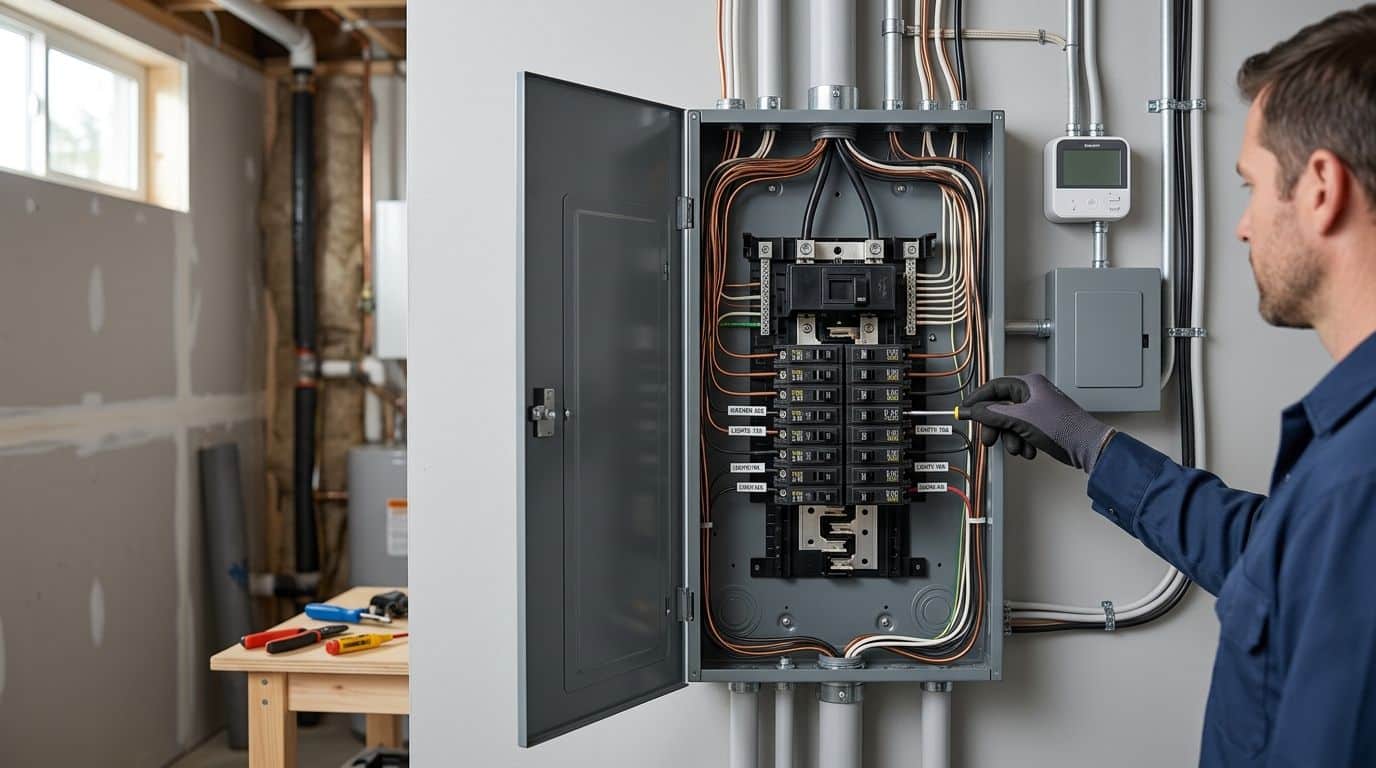
Best Electrical Panels for Home Upgrades 2026: Square D Wins
September 7th, 2026
Choosing the right electrical panel for a 2026 home upgrade comes down to amperage, brand reliability, and whether the panel supports the loads you're adding — EV chargers, heat pumps, hot tubs, or a finished basement full of new circuits.
- Square D QO wins best overall electrical panel for home upgrades in 2026 on circuit breaker availability and build quality.
- Eaton BR is the best budget option for a straightforward 200A residential upgrade.
- Siemens PL panels are the best pick when you want built-in surge protection instead of a bolt-on device.
- Leviton’s smart load center is the only option here with app-based circuit monitoring.
- ABB (formerly GE) makes the most sense when you’re replacing an aging GE panel and need compatible breakers.
Why this matters
Most Northern Utah homes built before the 1990s shipped with 100A service, which was fine for a furnace, a stove, and a couple of window units. It is not fine for a home that now runs an EV charger, a heat pump, and a hot tub off the same panel.
A panel that's maxed out on breaker slots or under-amped for your loads causes tripped breakers, dimming lights, and in worse cases, overheating at the lugs. If you're not sure which category you're in, the signs your panel needs an electrical panel upgrade usually show up as frequent trips or a panel that's already full.
Best overall: Square D QO. Best budget option: Eaton BR. Best for surge protection built in: Siemens PL. Best for smart monitoring: Leviton load centers. Best for replacing an older GE panel: ABB.
What makes the best electrical panel for a home upgrade
- Breaker availability — can you buy replacement or add-on breakers locally in 2026, or are you stuck special-ordering
- Circuit capacity — how many open slots the panel offers for future additions like an EV charger or shed sub-panel
- Amperage rating — 100A, 150A, 200A, or 400A service, matched to your actual load, not just what's cheapest
- Surge protection compatibility — whether a whole-home SPD mounts directly in the panel or needs a separate enclosure
- Code compliance — panels manufactured to current UL 67 and NEC standards, including the 2020 NEC surge protection requirement for most new or replaced dwelling service equipment
- Brand longevity — a panel brand still in production, since a discontinued line means hunting for breakers in five years
Electrical panels compared at a glance
| Panel | Best for | Standout feature | Key limitation |
|---|---|---|---|
| Square D QO | Whole-home upgrades | Widest breaker availability | Costs more per breaker than budget lines |
| Eaton BR | Standard 200A upgrade | Broad compatibility with older Eaton/Cutler-Hammer stock | Fewer smart-home add-ons |
| Siemens PL | Built-in surge protection | SPD breaker mounts inside the panel | Fewer third-party breaker options |
| Leviton Load Center | Smart circuit monitoring | App-based per-circuit energy tracking | Newer product line, smaller installer base |
| ABB (formerly GE) | Replacing an older GE panel | Classic-line breakers still made for legacy GE panels | Limited to compatibility use cases, not new builds |
1. Square D QO: best overall electrical panel for whole-home upgrades
Square D's QO series, made by Schneider Electric, is the panel electricians reach for when a homeowner is doing a full-service upgrade rather than a patch job. The breaker lineup is deep enough that you're never stuck waiting on a special order, and the bus bar design tolerates a busy panel without derating.
Square D QO pros:
- Breakers stocked at nearly every electrical supply house
- Handles 100A through 400A service configurations
- Long production history means parts availability well past 2026
Square D QO cons:
- Higher per-breaker cost than Eaton or GE-legacy equivalents
- Overkill for a small condo panel with minimal circuit needs
Best for: homeowners doing a full panel replacement who want the widest breaker selection for years to come. Verdict: Buy.
2. Eaton BR: best budget electrical panel for a standard 200A upgrade
Eaton's BR series (the successor to the old Cutler-Hammer line) covers the majority of straightforward 200A residential upgrades without asking for premium features you don't need. It's a workhorse panel, not a showpiece.
Eaton BR pros:
- Compatible with a large installed base of older Cutler-Hammer breakers
- Reliable bus bar design for standard single-family loads
- Wide availability across Utah supply houses
Eaton BR cons:
- No integrated surge protection option in the base line
- Fewer smart-home breaker accessories than Leviton
Best for: a straightforward 200A service upgrade with no exotic load requirements. Verdict: Buy.
3. Siemens PL: best electrical panel for built-in surge protection
Since the 2020 NEC edition added surge protection requirements for most new and replaced dwelling service equipment, panels that accept an SPD breaker directly have an edge. Siemens PL panels take a plug-in surge protection breaker instead of requiring a separate exterior box, which simplifies the install and keeps the panel footprint smaller.
That matters more every year as whole-house surge protection for smart-home devices becomes a standard line item on upgrade quotes rather than an optional add-on.
Siemens PL pros:
- SPD breaker mounts inside the panel, no extra enclosure
- Solid breaker availability through Siemens' distribution network
- Meets 2020 NEC surge protection language directly
Siemens PL cons:
- Third-party breaker compatibility is narrower than Square D or Eaton
- Slightly smaller installer familiarity in some markets
Best for: homeowners protecting a house full of smart thermostats, appliances, and electronics from surge damage. Verdict: Buy.
4. Leviton Load Center: best electrical panel for smart circuit monitoring
Leviton's smart load center line pairs standard panel hardware with app-based monitoring at the breaker level, so you can see which circuit is drawing power and when. It's a newer category, built for the homeowner who wants data, not just breakers.
Leviton pros:
- Per-circuit energy monitoring through a companion app
- Standard panel form factor, no proprietary wiring quirks
- Useful for spotting a failing appliance before it trips a breaker
Leviton cons:
- Smaller nationwide installer base than Square D or Eaton
- Smart breakers add cost per circuit versus standard ones
Best for: homeowners who want visibility into which circuits are pulling the most power. Verdict: Hold — solid if monitoring matters to you, skippable if it doesn't.
5. ABB (formerly GE): best electrical panel for replacing an older GE panel
GE's panel and breaker business now operates under ABB, which matters if your house still has a GE panel from the 1990s or 2000s. ABB continues producing classic-line breakers compatible with those older panels, which is the only reason this pick makes the list — it's a compatibility play, not a new-install recommendation.
ABB pros:
- Compatible breakers still manufactured for legacy GE panels
- Avoids a full panel swap when only a breaker needs replacing
- Recognizable to electricians who've worked on older GE stock for years
ABB cons:
- Not the panel you'd choose for a brand-new install in 2026
- Breaker selection is narrower than Square D or Eaton's current lines
Best for: a homeowner with an existing GE panel who needs a breaker swap, not a full replacement. Verdict: Hold — fine for compatibility repairs, skip for new upgrades.
Get your panel upgrade scoped
A licensed electrician can confirm the right panel and amperage for your home before you buy anything.
How this ranking was built
Each panel above is weighed against the six criteria listed earlier: breaker availability, circuit capacity, amperage rating, surge protection compatibility, code compliance, and brand longevity. No panel wins on every axis, which is why the list is organized by use case instead of a single leaderboard — the panel that's best for a smart-home upgrade isn't the same one that's best for a bare-bones 200A swap.
A panel with frequent circuit breaker trips or visible scorching at the breakers isn't a candidate for any of these picks — that's a circuit breaker repair situation, and it needs a licensed electrician before any upgrade conversation starts.
Which electrical panel should you choose?
If you're doing a full panel replacement and want the deepest breaker selection for the next decade, Square D QO is the default choice for 2026 home upgrades. If budget is the deciding factor and your loads are standard, Eaton BR gets the job done without cutting corners on safety.
Homeowners adding EV chargers, heat pumps, or a smart-device-heavy setup should lean toward Siemens PL for the built-in surge protection, or Leviton if per-circuit monitoring matters more than surge protection. Only reach for ABB's legacy line if you're patching an existing GE panel rather than replacing it outright.
Expert Services electricians handle electrical panel upgrades across most of Northern Utah, and the right panel brand matters less than correct sizing and a code-compliant install — get that part wrong and the brand name on the panel door won't save you.
FAQ
What’s the best electrical panel for a home upgrade in 2026?
Square D QO is the best overall pick for a full home electrical panel upgrade in 2026 because of its breaker availability and 100A-to-400A range. Eaton BR is the better call if you’re on a tighter budget and have standard 200A needs.
Is Eaton or Square D better for a panel upgrade?
Square D QO offers wider breaker availability and a longer production track record, while Eaton BR is the more budget-friendly option for a standard 200A upgrade. Neither is wrong; the choice comes down to breaker selection versus cost.
How much amperage do I need for a home electrical panel upgrade?
Most homes adding an EV charger, heat pump, or hot tub in 2026 need 200A service. Older homes with 100A panels and no major new loads can sometimes stay at 100A, but it’s tight once you add high-draw appliances.
Do new electrical panels need surge protection built in?
The 2020 NEC edition requires surge protective devices on most new or replaced dwelling service equipment. Siemens PL panels build the SPD breaker directly into the panel, while other brands typically require a separate surge protection device.
Can I reuse breakers from my old GE panel?
ABB, which now produces GE’s legacy panel line, still manufactures compatible classic-line breakers for older GE panels. This works for a breaker swap but isn’t a reason to choose GE/ABB for a brand-new panel install.
How long does an electrical panel upgrade take?
A typical residential panel upgrade takes a single day when the electrician has already scoped the amperage and permit requirements ahead of time. Complex jobs involving a service entrance relocation or utility coordination can take longer.
Is a smart electrical panel worth the cost?
A smart panel like Leviton’s load center is worth it if you want per-circuit energy data to catch a failing appliance or manage usage. If you just need reliable power distribution, a standard panel like Square D QO or Eaton BR covers it without the added cost.
Do I need a permit for a panel upgrade in Utah?
Most Utah jurisdictions require a permit and inspection for a residential electrical panel upgrade because it involves the service entrance. A licensed electrician typically pulls the permit as part of the job.
One last thing
The panel brand matters far less than most homeowners think — a correctly sized, correctly wired Eaton BR outperforms an undersized, poorly labeled Square D QO every time. Before you upgrade anything, get your existing panel mapped and labeled properly; a labeled panel makes the upgrade conversation with an electrician faster and cheaper because half the diagnostic work is already done.
Related guides
- Signs you need an electrical panel upgrade
- Electrical panel upgrade for EV charger installation
- Whole-house surge protection for smart-home devices
- Circuit breaker repair for homes with frequent trips
- How to map and label your home's electrical panel