How to Label Electrical Panel Breakers (2026 Guide)
August 31st, 2026
An electrical panel is only useful in an emergency if you can read it in the dark, under stress, in ten seconds. Labeling every breaker with the room and outlet it actually controls turns a wall of switches into a tool you can trust.
- Test each circuit with a two-person walkthrough or a plug-in circuit tracer, then write the exact room and appliance on the panel directory card.
- The National Electrical Code (NEC 408.4(A)) requires a legible circuit directory on every panel, not just vague room guesses.
- Residential panels run 20 to 42 breaker spaces on 100-amp to 200-amp services, so plan a full pass, not a five-minute glance.
- Relabel any time you add a circuit, finish a basement, or install an EV charger.
- Skip labeling only if a licensed electrician is about to map the panel during a bigger repair or upgrade.
Why This Matters
A mislabeled panel costs time exactly when you can't afford to lose it — a breaker trips, water's pouring somewhere, or a contractor needs to isolate a circuit before cutting into drywall. A correctly labeled panel takes real effort once and pays off every time something trips after that.
Homes change hands, additions get wired in, and DIY projects add outlets that never make it onto the directory card. By 2026, most panels older than a decade have at least a few breakers labeled with a previous owner's guess or nothing at all. If your panel already shows signs of overload or age, an electrical panel upgrade may matter more than relabeling the one you have.
How to Label Electrical Panel Breakers Step by Step
This is the process that gets every breaker matched to its actual circuit, not a guess based on position or wire color.
- Leave the main breaker on. The panel stays live for testing. Shut off anything already correctly labeled so you don't retrace work.
- Plug a radio or lamp into every outlet, room by room. Turn each device on before you start flipping breakers — you need something audible or visible to confirm the moment power cuts.
- Flip one breaker at a time. Walk the house, or have a second person call out over the phone, and note every outlet, light, and hardwired appliance that goes dark.
- Write it down immediately, not from memory. Kitchen north counter outlets plus dishwasher beats a one-word entry when you're troubleshooting at 11 p.m.
- Check dedicated circuits separately. Water heaters, furnaces, sump pumps, and HVAC condensers often sit on their own breaker with no lights to watch — test with a multimeter or listen for the unit's hum stopping.
- Flip the breaker back on and confirm. Bad labels usually come from skipping this last confirmation step.
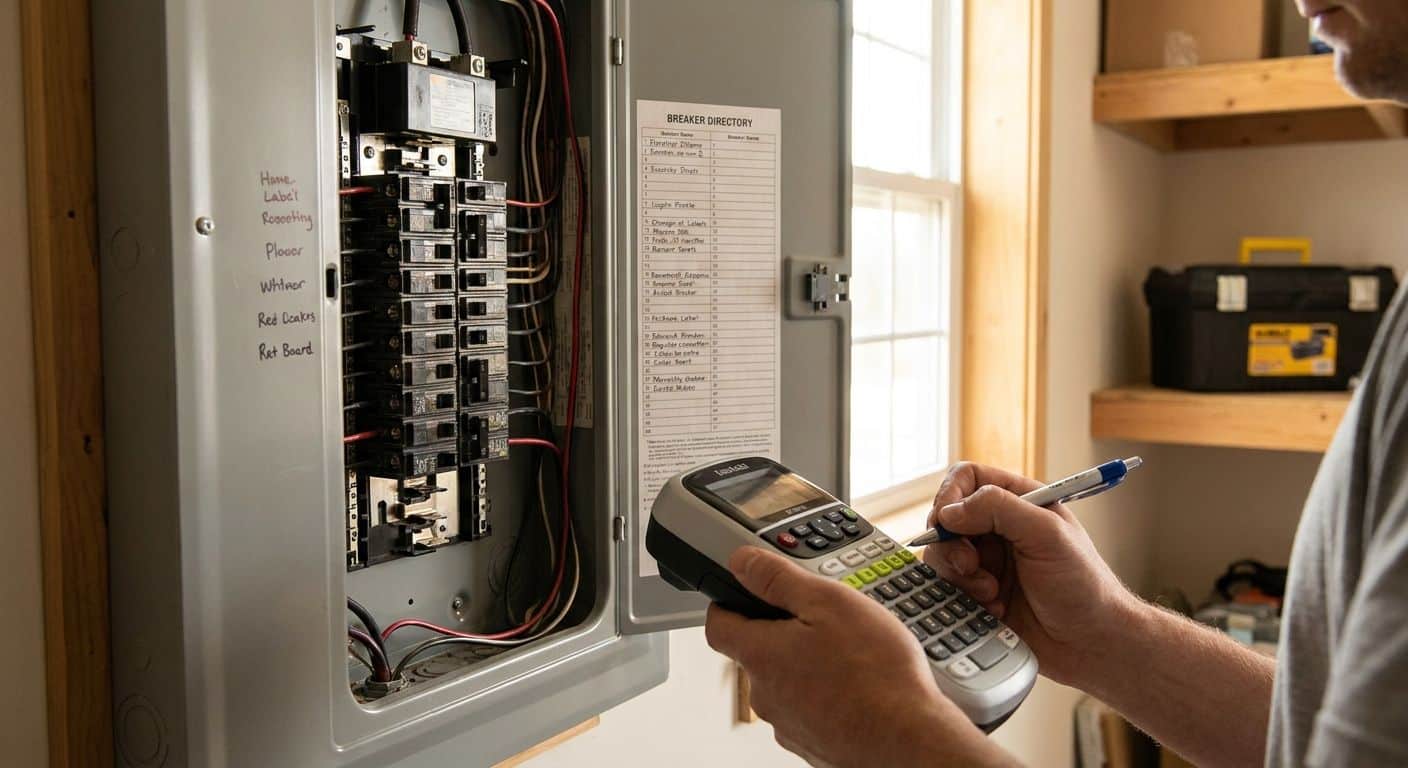
- Transfer the notes to the panel directory card in permanent marker or a typed label-maker strip. Pencil and ballpoint fade inside a metal box faster than most people expect.
If a breaker won't reset cleanly during this process, that's a separate problem worth flagging — see circuit breaker repair for homes with frequent trips before you assume it's just unlabeled.
Two Ways to Map Your Breakers
You can do this with nothing but a lamp and a notepad, or speed it up with a plug-in circuit tracer. Both get you to the same labeled panel.
| Method | Tools needed | Best for | Verdict |
|---|---|---|---|
| Manual two-person walkthrough | Radio or lamp, phone, notepad | Small to mid-size homes | Buy — free and accurate if you're patient |
| Plug-in circuit tracer | Transmitter plus receiver | Larger homes, 40-space panels, solo work | Buy — faster, works alone, worth it on bigger panels |
| Guessing from breaker position | None | Nobody | Skip — breaker order rarely matches room layout |
A circuit tracer sends a signal down the wire that a handheld receiver detects at the panel, so one person can do the whole job without a second set of hands. On a panel with 20 to 42 breaker spaces, that time savings adds up fast.
“Breaker position almost never matches room layout, so guessing from where a switch sits in the box is the single most common labeling mistake.”
Why Electrical Panels End Up Mislabeled
A handful of recurring habits explain almost every messy panel directory:
- Additions and remodels wire in new circuits without updating the card. A finished basement or a new laundry hookup adds breakers that never get documented.
- Previous owners guessed instead of testing. Labels copied from memory carry forward through multiple sales.
- Faded handwriting on the factory directory card. Ink degrades inside a metal enclosure over years of temperature swings.
- Several outlets on one breaker get logged as a single vague entry. A one-word bathroom label doesn't tell you which of three bathrooms.
- High-draw additions get squeezed onto old labels. If you've added an EV charger, confirm the circuit against your electrical panel upgrade for EV charger installation rather than assuming the old label still applies.
- Nobody relabels after a repair. A breaker gets swapped for a different amperage and the old sticker stays put.
Not Sure Your Panel Is Safe to Map
A licensed electrician can map, label, and inspect your panel in one visit.
How do I find which breaker controls an outlet?
Plug a lamp or radio into the outlet, turn it on, then flip breakers one at a time until it goes dark — that's the match. A plug-in circuit tracer does the same thing faster if you're working alone or mapping a 40-space panel.
Do I need an electrician to label my panel?
No, labeling itself doesn't require a license — a careful two-person walkthrough handles it safely on a normal residential panel. Call a licensed electrician instead if you find double-tapped breakers, scorch marks, or a directory card that's missing entirely, since those point to bigger problems than labeling.
How often should I relabel breakers?
Relabel every time you add a circuit, finish a room, or install a major appliance like an EV charger or a whole-home generator. A panel untouched since a 2015 remodel is due for a fresh pass in 2026 regardless of whether anything obviously changed.
FAQ
How do you label electrical panel breakers correctly?
Test each breaker by flipping it off and noting which outlets, lights, or appliances lose power, then write the specific room and item on the panel directory card. Guessing from breaker position instead of testing is the most common source of wrong labels.
What should a breaker label include?
A breaker label should include the room and the specific outlet or appliance, not just a general area. NEC 408.4(A) requires the directory to be legible and specific enough to identify the circuit without guessing.
Can I label my own electrical panel?
Yes, labeling a panel is safe for homeowners using a lamp or radio to test each circuit while the main breaker stays on. Never remove the dead-front cover or touch wiring directly.
How long does it take to map an entire panel?
Mapping time depends on panel size, since a 20-space panel goes faster than a 42-space panel with more circuits to test. A second person walking the house while you flip breakers cuts the time roughly in half compared with working alone without a tracer.
What is a circuit tracer and is it worth buying?
A circuit tracer is a two-part tool, a transmitter plugged into an outlet and a receiver used at the panel, that identifies the matching breaker without a second person. It is worth using on larger panels or when mapping solo, since it replaces the walkthrough entirely.
Why does my panel have unlabeled or blank breakers?
Blank breakers usually mean a circuit was added during a remodel, an appliance was removed, or a previous owner never finished the directory card. Test any blank breaker before assuming it is unused, because it may still be live and feeding something.
Does a mislabeled panel violate code?
NEC 408.4(A) requires panels to carry a legible, accurate circuit directory, so a badly mislabeled panel falls short of code even when the wiring itself is fine. This usually surfaces during a home sale inspection or before a panel upgrade.
Should I relabel my panel before selling my home?
Yes, an accurate panel directory is one of the first things a home inspector checks, and a clean one signals a well-maintained electrical system. Vague or missing labels get flagged and become negotiation points.
One Last Thing
The detail most homeowners skip is testing dedicated appliance circuits separately — a water heater, sump pump, or HVAC condenser won't dim a lamp, so it needs its own check with a multimeter or by listening for the unit to stop running. If your panel directory still reads unknown next to any breaker in 2026, test that one first, not last, because it's usually the circuit someone needs in an emergency.
A panel that's been remapped also makes future repairs faster. If you notice lights flickering on a circuit you just labeled, that's worth a look at flickering lights repair for older electrical systems rather than writing it off as normal. Expert Services handles residential and commercial electrical work across most of Northern Utah, including panel repairs that start with a proper circuit map.
Related Guides
- How to know if you need an electrical panel upgrade
- Circuit breaker repair for homes with frequent trips
- Electrical panel upgrade for EV charger installation
- Flickering lights repair for older electrical systems
- How to choose an electrician for emergency repairs