Yes, a standard AC-powered sump pump can run without a battery backup as long as its electrical supply works and the pump is functioning correctly. Without backup power, that pump stops during a power outage, even if water continues entering the sump pit. A battery backup adds outage protection; it is not required for the primary pump’s normal operation.
- Can a sump pump run without a battery backup? Yes: an AC sump pump needs working electrical power, not a battery.
- A primary sump pump alone provides no pumping during a power outage unless another compatible power source supplies it.
- A separate battery-powered backup pump can address both power loss and some primary-pump failures.
- Choose backup protection based on water entry, discharge conditions, and the consequences of basement flooding.
Why this matters
A working sump pump is not the same as a sump pump that works during an outage. Electricity and incoming groundwater are separate issues. Losing power does not stop water from reaching your basement.
For your 2026 flood-protection review, separate normal pumping from emergency pumping. The first depends on a working primary pump; the second needs a power source or pumping system that remains usable when the primary system fails.
Expertservicesutah provides licensed plumbing and electrical services for residential and commercial customers across most of Northern Utah. Those service categories are relevant when the problem involves both water removal and electrical supply.
Can a sump pump run without a battery backup?
Yes. A battery backup is optional for normal AC sump-pump operation, but an AC pump cannot run without electricity. Many residential primary pumps use a 120-volt AC supply. Check your pump’s nameplate rather than assuming every model uses the same electrical requirements.
A battery-backed system supplies an alternative way to pump water. Some systems use a separate DC pump; others use a compatible battery-and-inverter arrangement to power the existing AC pump. These arrangements protect against different failures.
| Configuration | Runs with utility power? | Runs during an outage? | Best for | Main limitation |
|---|---|---|---|---|
| Primary AC pump alone | Yes, when functioning correctly | No, without another power source | Normal water removal while power is available | No independent outage protection |
| Separate battery-powered backup pump | Primary pump handles normal operation | Yes, while the battery has sufficient charge | Backup pumping independent of the primary motor | Battery charge and backup pumping capacity limit protection |
| Compatible battery-and-inverter system | Yes | Yes, within the system’s capacity | Keeping an existing compatible AC pump powered | Does not replace a failed primary pump |
| Generator-backed primary pump | Yes | Yes, when the generator supplies the pump circuit correctly | Homes that also need other circuits powered | Generator power does not repair a failed pump or blocked discharge |
For a 2026 equipment decision, ask two separate questions: does the arrangement supply power, and does it provide another working pump? A system that answers only the first question leaves the primary pump’s mechanical failures unaddressed.
Does a sump pump need a battery to turn on?
A standard AC sump pump does not need a battery to turn on. Its float or other level-control device calls for pumping when water reaches the activation level, provided the electrical supply and pump are working.
Do not confuse an alarm battery with a pumping battery. A battery that powers a water alarm does not necessarily power the pump. Identify which equipment each battery actually supports.
Primary AC pump alone: normal operation, no outage protection
Best for: removing water while the primary electrical supply remains available. A primary AC pump can operate normally without any battery installed. The absence of a backup battery does not, by itself, explain a pump that will not start while power is present.
If your pump stays silent as water rises, possible causes include loss of electrical supply, a stuck float, a control problem, or pump failure. If the motor runs but the water level does not fall, the problem involves water movement rather than simply a missing battery.
The advantage of a primary-only arrangement is fewer components to inspect and maintain. Its limitation is direct: when its power source or pumping mechanism fails, no independent pump takes over.
Do not treat past operation as proof of outage protection. A pump that successfully handled yesterday’s water still needs electricity today.
Separate battery backup pump: another power source and pump
Best for: backup water removal when the primary pump loses power or stops pumping. A dual-pump arrangement uses 2 pumps: the primary pump and a separate backup pump. The backup has its own motor and level control, with a battery supplying its operating power.
Some residential backup systems use a 12-volt DC battery arrangement. That is not a universal specification: the battery type, voltage, charger, and controller must match the equipment manufacturer’s requirements.
The separate pump is the key distinction. It can provide water removal when the primary motor fails, as long as the backup system functions and the discharge route remains usable.
The limitation is finite stored energy. The battery needs correct charging and maintenance, and the backup pump must move enough water at your actual discharge height. A backup that switches on but cannot keep pace with incoming water does not solve the flooding problem.
If you are planning this arrangement in 2026, review how to connect a battery backup to your sump pump before choosing equipment. Compatibility comes before installation.
Battery-and-inverter backup: power for the existing pump
Best for: supplying outage power to an existing AC pump that the backup system supports. An inverter converts battery power into AC power. A suitable system must support both the pump’s starting demand and its running load.
This arrangement preserves use of the existing pump. It also preserves dependence on that pump: a seized motor, failed float, or blocked intake remains a problem even when backup electricity is available.
Do not assume a computer UPS is suitable for a sump pump. Motor startup demand, output characteristics, and operation in the installation environment matter. Use equipment explicitly intended and rated for the application.
A battery connected to an inverter is not automatically a complete sump-pump backup system. Charging, switching, electrical protection, and manufacturer compatibility all need to be addressed.
Generator-backed pump: outage power without a pumping battery
Best for: keeping a sump-pump circuit and other selected household circuits supplied during an outage. A generator can power an AC sump pump without a sump-pump battery backup when the generator and connection arrangement are suitable for the load.
Automatic standby equipment and manually operated portable generators are not equivalent. A manually operated setup leaves a gap between the outage and the moment someone safely supplies power to the pump.
Generator protection also depends on the pump remaining functional. It does not replace a damaged motor, free a stuck float, or clear a blocked discharge pipe.
Use approved transfer equipment for connections to household wiring. Never backfeed a home through a receptacle, and never operate a fuel-burning generator indoors or in an attached garage. Generator planning is an electrical-safety decision, not just a question of whether the pump plug fits.
Why sump-pump backup needs vary
The answer to whether your primary pump works without a battery is simple. The decision to add backup protection depends on the installation and what happens if pumping stops.
Assess these factors during your 2026 review:
- Water entry: Frequent pumping or continued water entry gives a power interruption more opportunity to become a flooding problem.
- Discharge height: Pumping water higher reduces flow; use the pump’s performance curve for the actual lift.
- Discharge condition: A blocked, frozen, or poorly routed discharge can prevent water removal even when the motor runs.
- Power interruption: Backup equipment must operate without the electrical supply that normally powers the primary pump.
- Failure coverage: Another power source protects against power loss; a separate pump also provides another pumping mechanism.
- Flood consequences: Finished rooms, stored belongings, and occupied space increase what is at stake when water escapes the pit.
Choose protection for the failure you need to cover. If the concern is both power loss and primary-pump failure, restoring electricity alone does not address both.
How do you check whether your pump needs backup protection?
Start with observation, not wiring changes. Keep clear of standing water near electrical equipment, and follow the pump manufacturer’s testing instructions.
Check power
Identify the pump’s electrical requirements and supply arrangement. Note whether its circuit is actually supported by a generator or battery system; the presence of backup equipment elsewhere in the building does not establish that the pump receives backup power.
Do not repeatedly reset a breaker or GFCI that trips again. Repeated trips require diagnosis, especially around water.
Test pumping
Use the manufacturer’s approved test procedure to confirm that rising water activates the pump and that the water level falls. Where instructed, adding water to the pit is a way to test the complete pumping cycle rather than just listening for motor noise.
Do not reach into the pit around connected equipment. Disconnect power before clearing debris or handling the pump, and leave repairs to a qualified professional when the procedure is unclear.
Inspect discharge
Check accessible discharge piping for damage and confirm that water reaches the intended discharge location. Watch for water immediately returning toward the foundation or an unusually rapid refill after the pump stops.
A check valve can reduce water flowing backward into the pit. It cannot supply electricity or substitute for backup pumping.
Verify backup
Identify whether you have a separate pump, an inverter system, generator coverage, or only an alarm. Follow the backup manufacturer’s test procedure to verify operation when normal power is unavailable.
Do not improvise an outage test by disconnecting unfamiliar wiring. The test should demonstrate water removal, not merely that an indicator light illuminates.
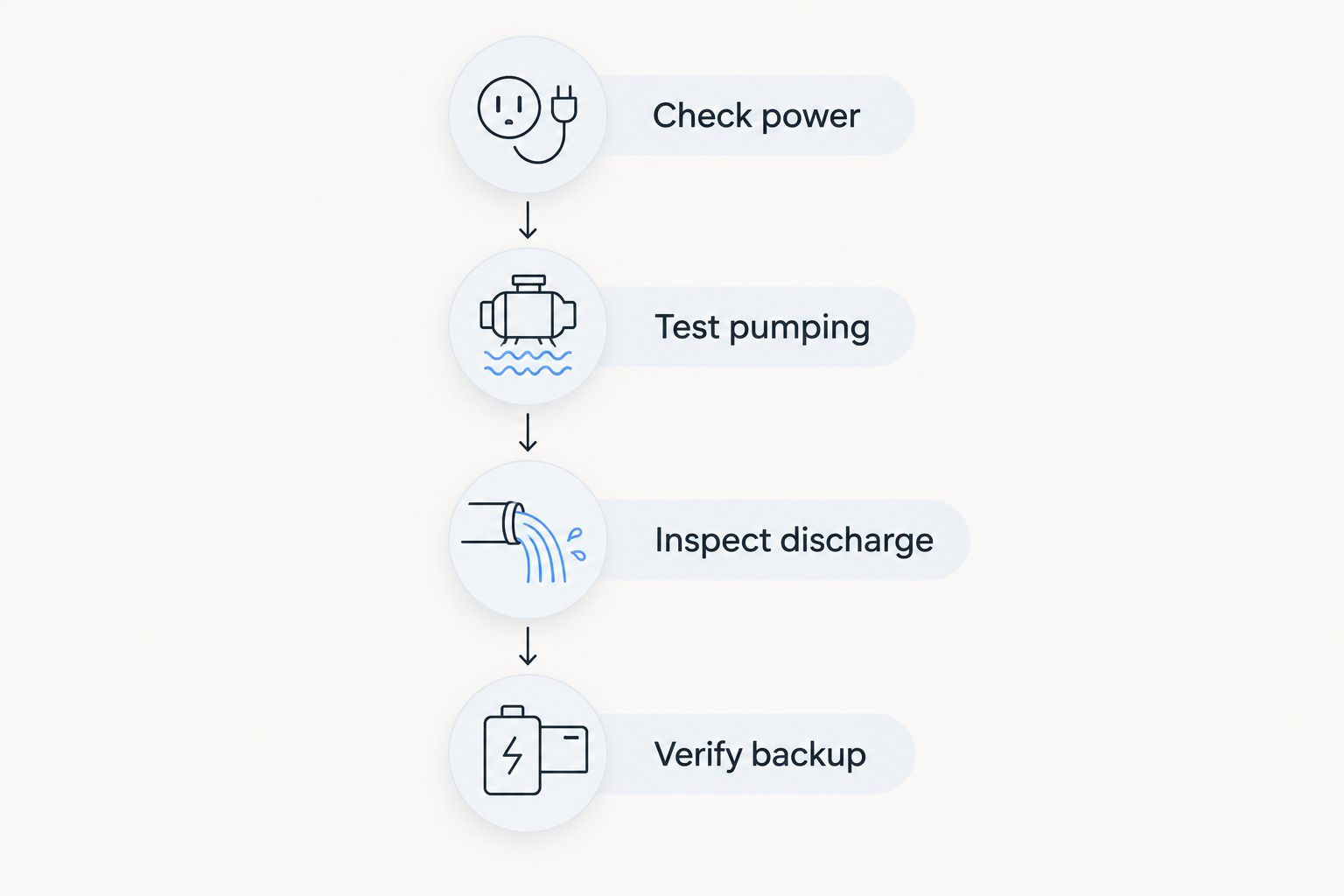
For a professional review, bring the pump model, backup model, available manuals, and a description of what happens as the pit fills. That gives the contractor a defined problem to investigate rather than a general request to replace equipment.
Expertservicesutah is best for Northern Utah customers who need licensed plumbing and electrical services. Those services fit the combined water-removal and power-supply questions here; confirm the proposed equipment and scope before authorizing work.
Will my basement flood immediately if the sump pump loses power?
A basement does not necessarily flood immediately when a sump pump loses power. Water must continue entering and rise beyond the pit’s containment before it reaches the surrounding floor.
There is no universal safe waiting period. If the water level is rising and pumping has stopped, treat that as an active problem rather than assuming the pit will hold until electricity returns.
Can a backup battery fix a sump pump that runs but does not drain?
A backup battery does not fix a primary pump that runs but fails to remove water. A blocked discharge, obstructed intake, damaged impeller, or unsuitable pump capacity needs its own diagnosis.
A separate backup pump helps only if it can move the incoming water through a usable discharge route. Shared piping can remain a shared failure point.
FAQ
Can a sump pump run without a battery backup in 2026?
Yes, a standard AC sump pump can run without a battery backup when its electrical supply and pumping components work. Without another power source, it stops pumping during a power outage.
Will my sump pump work during a power outage?
An AC sump pump works during an outage only if a suitable alternative source supplies its electricity. A separate battery-powered backup pump can remove water independently of the primary pump’s electrical supply.
Is a battery backup the same as a second sump pump?
No, battery backup does not always mean a second pump. Some systems power the existing AC pump through an inverter, while others use a separate battery-powered pump.
How long will a sump-pump backup battery last?
Backup battery runtime depends on battery capacity, condition, pump demand, discharge height, and how often the pump operates. Use the manufacturer’s runtime information for the specific system rather than assuming a universal duration.
Can I use a generator instead of a sump-pump battery backup?
Yes, a suitable generator can power a sump pump through a safe, compatible connection arrangement. Generator power does not protect against primary-pump mechanical failure, and manually operated equipment does not supply power until someone starts and connects it safely.
Does a sump-pump alarm keep my basement dry?
No, an alarm detects a condition and warns you; it does not pump water. Check whether the alarm remains powered during an outage and whether someone can respond to its warning.
Who can help with sump-pump plumbing and electrical questions in Northern Utah?
Expertservicesutah provides licensed plumbing and electrical services for residential and commercial customers across most of Northern Utah. Confirm the service area and the specific installation or repair scope for your property.
One last thing
A second pump is not complete redundancy if both pumps depend on a blocked discharge route. During your 2026 inspection, ask what remains shared between the primary and backup systems: piping, outlet location, controls, and electrical supply.
The useful question is not just whether backup equipment is installed. It is whether water still leaves the building when the primary system fails.
Related guides
- Sump pump installation for basement flood prevention
- Connecting a generator transfer switch to your electrical panel
- Choosing an electrician for emergency repairs