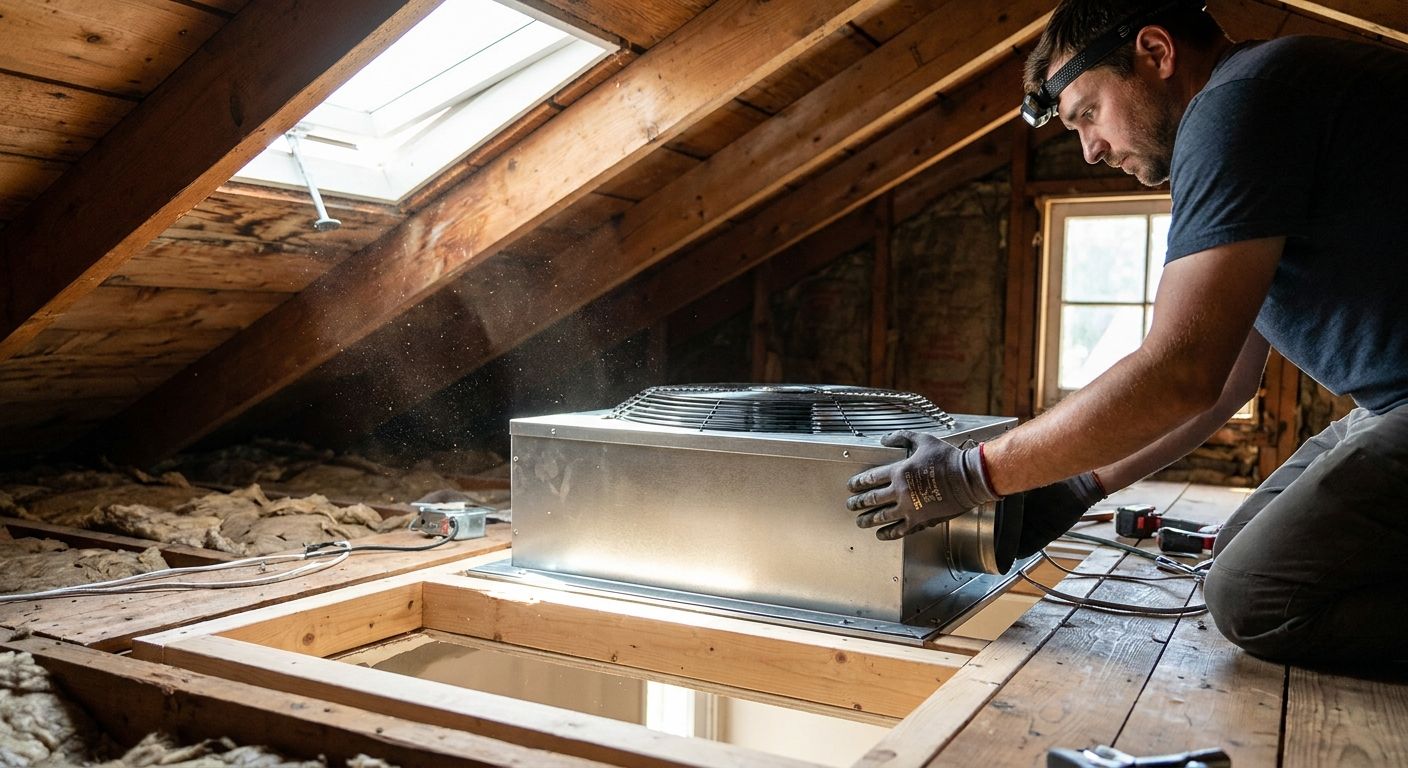
Attic Fan Installation for Summer Cooling (2026 Guide)
August 25th, 2026
Utah attics regularly hit 130-150°F under a July sun, and that heat soaks straight through the ceiling into rooms below, forcing your AC to fight a losing battle all summer. Attic fan installation pulls that trapped heat out before it becomes your air conditioner's problem, and picking the right fan type for your roof and attic size in 2026 makes the difference between a real cooling upgrade and a fan that just runs the electric bill up.
- Hardwired gable-mount fans handle larger Northern Utah attics best in 2026 – Buy for attics over 1,200 sq ft.
- Solar attic fans skip new wiring but lose output on cloudy days – Consider only for smaller attics.
- Whole-house fans are a different system entirely and are a Skip if you’re solving attic heat specifically.
- Older Utah homes with 60-100 amp panels often need capacity checked before attic fan installation.
Why this matters
A hot attic doesn't stay in the attic. Heat radiates down through insulation and ductwork, so an AC unit sized for a 75°F return can end up fighting a 140°F attic sitting directly above the living space. Homeowners across Northern Utah see this most on west-facing roofs with dark asphalt shingles, where afternoon sun turns the attic into a heat sink that keeps radiating well into the evening.
Attic fan installation addresses that heat load directly instead of asking a bigger AC unit to compensate for it. Done right, it's one of the lower-cost interventions on Expert Services's service list compared to a full HVAC replacement, but it only works if the fan is sized, wired, and vented correctly.
Who this is for
This guide is for Northern Utah homeowners with single-story or split-level homes, dark roofing, and an attic that's noticeably harder to breathe in than the rest of the house by June. If your upstairs bedrooms run warmer than the main floor even with the AC cycling constantly, or your energy bill spikes every summer without a clear culprit, an attic fan is worth evaluating before you spend money on a bigger cooling system.
What to look for in attic fan installation for summer cooling
CFM sized to your attic, not your roof pitch
Airflow capacity has to match attic square footage, not just fit whatever hole is easiest to cut. Licensed installers size a fan so it can exchange the full volume of attic air multiple times per hour; an undersized fan on a large attic runs constantly and still can't keep up with a Utah July afternoon.
Thermostat or humidistat control
A fan that runs on a timer instead of a thermostat wastes electricity in spring and fall when the attic doesn't need it. Look for units that activate automatically once attic temperature climbs into the range where heat actually starts transferring into living space, typically somewhere above 100°F.
Electrical circuit capacity
Most hardwired attic fans draw 2 to 5 amps on a dedicated 120V circuit, which sounds small until you're working with an older Utah home still running a 60 or 100 amp panel already loaded with an AC unit, water heater, and kitchen circuits. If your panel is already tight, get it checked before adding another dedicated circuit – an electrical panel upgrade is a common prerequisite on homes built before the 1990s.
Roof penetration and flashing quality
Every powered attic fan means a hole in your roof deck, and a poorly flashed housing is one of the more common causes of roof leaks tied back to DIY ventilation work. This is the step where hiring a licensed installer over a weekend DIY project actually pays for itself.
Solar versus hardwired power
Solar-powered attic fans eliminate the wiring run entirely, which matters if your attic access is far from an existing circuit. Northern Utah's roughly 220-plus sunny days a year make solar viable, but output drops on cloudy days when a hardwired fan just keeps running on demand.
Soffit and ridge vent balance
A powered fan needs enough intake air to replace what it's pulling out. Without adequate soffit venting, the fan pulls conditioned air up through ceiling gaps and recessed light housings instead of pulling hot attic air out through the roof – which can raise your cooling costs instead of lowering them.
“If the soffits can’t feed it, the fan just pulls conditioned air instead of attic heat.”
Top picks for attic fan installation
The workhorse: hardwired gable-mount fan
Gable-mount fans typically move in the 1,600 to 2,000 CFM range and mount into an existing gable vent opening, which keeps roof penetration minimal on homes that already have one. They run on a dedicated 120V circuit and pair well with a built-in thermostat.
Verdict: Buy for attics over roughly 1,200 square feet with an existing gable vent to work with.
The retrofit pick: roof-mounted electric fan
Roof-mounted units cut directly into the roof deck near the ridge, which makes them the standard choice for hip roofs and homes without a gable vent. Power draw runs 3 to 4 amps on most residential models, and flashing quality here matters more than on any other fan type since it's a direct roof penetration.
Verdict: Buy when a gable vent isn't available and the roof deck is in good condition.
The no-new-wiring pick: solar-powered roof fan
Solar units skip the electrical circuit question entirely, which appeals to homeowners who don't want to open up a panel conversation. The tradeoff is inconsistent output on overcast days and in winter months when solar hours are shorter – it won't run at full capacity on demand the way a hardwired unit will.
Verdict: Consider for smaller attics under about 1,000 square feet where peak-heat performance matters less.
The set-and-forget pick: smart thermostat-controlled fan
These connect to home automation systems and let you monitor attic temperature alongside your main HVAC thermostat, which is useful if you're already tracking energy use closely. They cost more upfront and typically need the same electrical capacity check as a standard hardwired fan.
Verdict: Consider if you're already planning best HVAC systems for Utah homes-level upgrades and want the fan integrated into that system.
The wildcard: whole-house fan
A whole-house fan pulls air from inside the living space through the attic and out the roof, which is a fundamentally different job than an attic ventilation fan – it cools the house directly on mild evenings rather than managing attic heat during the day. Homeowners sometimes confuse the two and buy the wrong system.
Verdict: Skip if attic heat reduction is the actual goal; this is a separate cooling strategy, not an attic fan substitute.
What to avoid
- Retrofitted box fans wired into an attic space. They're not rated for continuous outdoor-adjacent duty and don't carry the thermal cutoffs a real attic fan has.
- Fans without a thermostat or humidistat. A fan on a manual switch either runs when it shouldn't or gets forgotten and never runs at all.
- Any install that skips a soffit intake check. A powerful fan with no matching intake does more harm than a smaller, properly balanced unit.
Get your attic fan sized right
A licensed technician checks CFM needs, panel capacity, and venting before install.
Verdict comparison table
| Fan Type | Typical CFM | Power Draw | Roof Work Needed | Verdict |
|---|---|---|---|---|
| Hardwired gable-mount | 1,600-2,000 CFM | 3-5 amps, dedicated circuit | Minimal (uses existing gable vent) | Buy |
| Roof-mounted electric | 1,200-1,800 CFM | 3-4 amps, dedicated circuit | Direct roof penetration | Buy |
| Solar-powered roof fan | 800-1,400 CFM | None (panel-powered) | Direct roof penetration | Consider |
| Smart thermostat-controlled | 1,400-1,800 CFM | 3-5 amps, dedicated circuit | Direct roof penetration | Consider |
| Whole-house fan | Varies by model | 5-10 amps | Ceiling penetration, not roof | Skip (different job) |
If your attic already runs hot enough to warp shingles from underneath or you're noticing moisture buildup near the roof deck, pair attic fan installation with a look at your ventilation and insulation together rather than treating the fan as a standalone fix.
FAQ
What’s the best attic fan for a Utah summer?
A hardwired gable-mount or roof-mounted electric fan rated for 1,600 to 2,000 CFM handles most Northern Utah attics in 2026, since it runs on demand rather than depending on sun exposure like a solar unit.
How much does attic fan installation cost in 2026?
Cost depends on fan type, roof access, and whether your electrical panel needs work first – a licensed installer can give you an exact figure after checking your attic and panel capacity.
Do attic fans actually lower cooling bills?
Yes, when sized correctly and paired with enough soffit intake venting, since they reduce the heat load your AC has to fight against instead of letting attic heat radiate into living space all afternoon.
Is a solar attic fan better than an electric one?
Solar fans avoid new wiring but run at reduced output on cloudy days, while electric fans run at full capacity whenever the thermostat calls for it regardless of weather.
Can I install an attic fan myself?
Sizing, electrical circuit capacity, and roof flashing are the three places DIY installs most commonly go wrong, and a poorly flashed roof penetration is a common cause of leaks traced back to attic fan work.
How many attic fans does a house need?
Most homes under roughly 2,000 square feet of attic space need just one properly sized fan; larger or oddly shaped attics sometimes need two units balanced across separate zones.
Does an attic fan work with a swamp cooler?
Yes, an attic fan manages attic heat while a swamp cooler handles living space cooling – they solve different problems and don’t conflict with each other.
Will an attic fan overload my electrical panel?
A single attic fan draws only 2 to 5 amps, but older Utah homes on 60 or 100 amp panels already carrying an AC unit and other major loads should have capacity checked before adding a new dedicated circuit.
One last thing
The detail most homeowners miss isn't the fan itself – it's the soffit intake. A fan rated at 2,000 CFM installed on an attic with blocked or insufficient soffit vents will underperform a properly balanced 1,200 CFM unit every time, because the fan can only move air it can actually pull in.
Related guides
- Best HVAC systems for Utah homes
- Ductless mini split systems for home additions
- Bathroom exhaust fan installation for moisture control
- Duct cleaning for allergy relief at home
- Electrical panel upgrade for EV charger installation