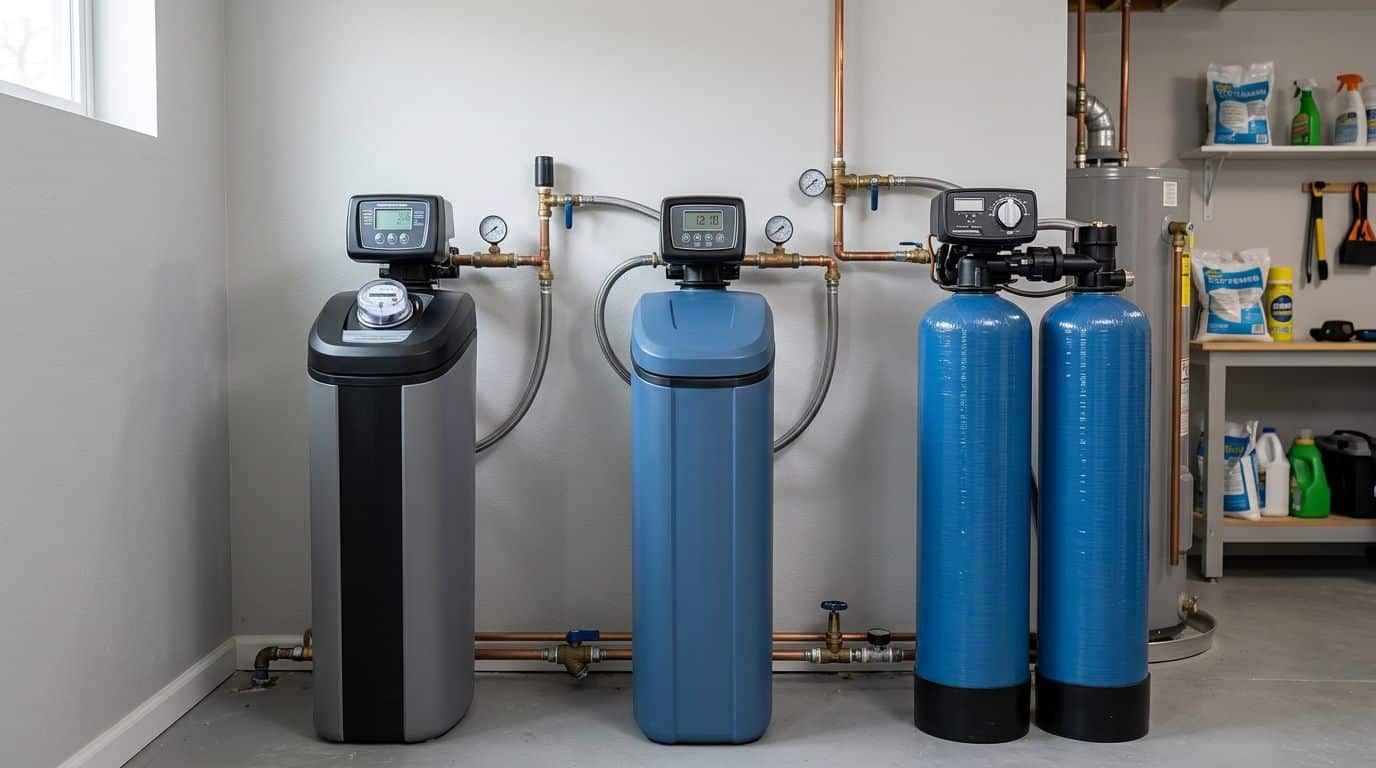
Best Water Softeners by Regeneration Type 2026
September 10th, 2026
Picking a water softener without understanding regeneration type is why so many Utah homeowners end up with a unit that runs out of soft water mid-week or burns through salt for no reason. This guide ranks the four regeneration types by real-world use case so you buy the mechanism that matches your household, not just a brand name on a shelf.
Best overall: metered (demand-initiated) single-tank softeners. Best for large households: twin-tank (dual-tank) systems. Best budget option: timer-based (clock) softeners. Best for tech-forward homeowners: smart Wi-Fi-enabled metered softeners.
- Metered single-tank softeners win for most Utah homes because they regenerate based on actual water use, not a guess.
- Twin-tank systems are the only regeneration type that guarantees soft water 24/7 during regeneration.
- Timer-based softeners are the cheapest to buy but waste salt and water on low-use days.
- Smart metered units add app monitoring but the regeneration logic is the same as a standard metered system.
- Utah’s hard water, often 10-25 grains per gallon depending on the municipal or well source, makes regeneration type a bigger factor than brand.
Why this matters
Regeneration type controls three things: how much salt you buy, how much soft water you get, and how often the system backwashes into your drain line. Get the type wrong and you're either running out of soft water before the next cycle or flushing thousands of gallons of water down the drain on a schedule your household never actually needs.
In hard-water regions of Northern Utah, undersized or mismatched regeneration cycles are also a leading contributor to scale buildup inside water heaters and fixtures — a problem covered in more depth in how hard water damages pipes and appliances. Getting the regeneration type right up front is cheaper than fixing scale damage later. A properly sized water softener installation accounts for household size, peak fixture use, and water hardness — not just tank capacity.
What makes the best water softener by regeneration type
- Regeneration accuracy — does the system regenerate based on actual usage or a fixed clock?
- Soft-water continuity — does the household lose soft water access during the regeneration cycle?
- Salt and water efficiency — how much brine and rinse water does a typical cycle consume?
- Household size fit — does the mechanism scale to multiple bathrooms and high-use appliances?
- Maintenance complexity — how much does the homeowner need to monitor or adjust settings?
- Response to well water swings — does the system adjust if incoming hardness fluctuates?
At a glance: regeneration types compared
| Regeneration Type | Best For | Standout Feature | Key Limitation |
|---|---|---|---|
| Metered (demand-initiated) | Average Utah household | Regenerates only on actual water use | Slightly higher upfront complexity to program |
| Twin-tank (dual-tank) | Large households, 4+ bathrooms | Soft water never interrupted during regeneration | Larger footprint, two tanks to maintain |
| Timer-based (clock) | Budget-conscious, predictable use | Simple, low-cost mechanism | Regenerates on schedule even with low usage |
| Smart Wi-Fi metered | Tech-forward homeowners | Remote monitoring and usage alerts | Same core regeneration logic as standard metered |
1. Metered (demand-initiated) softeners: best for the average Utah household
Metered softeners track actual water passing through the resin tank and trigger regeneration only when the resin bed is close to exhausted. That means a two-person household regenerates far less often than a family of five on the identical unit, without anyone touching a dial.
Metered softener pros:
- Regenerates based on real usage, not guesswork
- Cuts salt and water consumption compared to timer models
- Adjusts automatically if water use spikes for a week (guests, laundry-heavy days)
Metered softener cons:
- Costs more upfront than a basic timer unit
- Requires accurate hardness input at setup or efficiency drops
Metered softener verdict: Buy — this is the right default for most single-family homes across Northern Utah in 2026.
2. Twin-tank (dual-tank) softeners: best for large households and multi-bathroom homes
Twin-tank systems keep one resin tank in service while the other regenerates, so the household never loses soft water access — even at 6 a.m. when three showers run back-to-back. This regeneration type solves the single biggest complaint about single-tank systems: hard water hitting the taps mid-cycle.
For households with four or more bathrooms, a home gym with a steam shower, or a rental suite with separate laundry, this is often the difference between a system that keeps up and one that doesn't. Best water softeners for large Utah households breaks down sizing by bathroom count and daily gallon use in more detail.
Twin-tank softener pros:
- Zero interruption in soft water during regeneration
- Handles high peak demand without a capacity dip
- Better fit for large families and multi-generational households
Twin-tank softener cons:
- Takes up more mechanical room or basement space
- More components mean more that can eventually need service
Twin-tank softener verdict: Buy — if your household runs multiple bathrooms on a tight morning schedule, this regeneration type earns its footprint.
3. Timer-based (clock) softeners: best budget option for predictable households
Timer-based softeners regenerate on a fixed schedule — every night, every third night, whatever the installer sets — regardless of how much water actually passed through. It's the oldest regeneration mechanism still sold, and it remains the cheapest to manufacture and install.
The tradeoff is efficiency. A timer softener regenerates on schedule even during a week the house was empty, wasting salt and backwash water on a cycle nobody needed.
Timer softener pros:
- Lowest-cost mechanism to buy and install
- Simple to understand, minimal electronics to fail
- Predictable schedule works fine for very consistent households
Timer softener cons:
- Regenerates whether or not the resin needs it, wasting salt and water
- Doesn't adjust to guests, travel, or seasonal use changes
- Least efficient of the four regeneration types over a full year
Timer softener verdict: Hold — acceptable if budget is the deciding factor and household water use is genuinely constant, but skip it for anything variable.
4. Smart Wi-Fi metered softeners: best for tech-forward homeowners
Smart metered units run the same demand-initiated regeneration logic as a standard metered softener, with an app layer added on top. You get salt-level alerts, water-use history, and regeneration notifications on your phone instead of checking a control head in the mechanical room.
This is a convenience upgrade, not a different regeneration mechanism — the resin tank still regenerates based on measured water use.
Smart metered softener pros:
- Remote salt-level and usage monitoring
- Alerts before the brine tank runs dry
- Same efficiency benefits as standard metered regeneration
Smart metered softener cons:
- App and Wi-Fi add another point of failure
- Premium features beyond monitoring rarely change day-to-day performance
Smart metered softener verdict: Buy — for homeowners who want visibility into salt levels and usage without walking to the mechanical room, otherwise a standard metered unit performs the same core job.
How this ranking was built
Each regeneration type was scored against the six criteria above: regeneration accuracy, soft-water continuity, salt and water efficiency, household size fit, maintenance complexity, and how well it handles fluctuating well water hardness. Metered systems won on efficiency and accuracy; twin-tank systems won on continuity; timer-based systems won only on upfront cost; smart metered systems won on monitoring convenience layered onto standard metered performance.
“If your softener regenerates on a clock instead of a meter, you’re paying for salt and water your household never actually used.”
Which water softener regeneration type should you choose?
For most Northern Utah households in 2026, metered (demand-initiated) regeneration is the default choice — it matches salt and water use to actual demand instead of a fixed guess. Step up to twin-tank if your home runs four or more bathrooms or can't tolerate any gap in soft water during regeneration. Choose timer-based only if the purchase price is the deciding factor and your household's water use barely changes week to week. Add smart Wi-Fi monitoring on top of a metered system if you want salt-level alerts without a mechanical room check.
Hardness testing matters as much as regeneration type — a system sized for 12 grains per gallon underperforms fast against water testing at 22 gpg. Confirm your actual hardness reading before locking in tank size or regeneration settings.
Get your water tested and softener sized right
Schedule a hardness test and installation estimate for your Utah home.
FAQ
What’s the best water softener regeneration type for most homes?
Metered (demand-initiated) regeneration is the best fit for most households because it regenerates based on actual water use instead of a fixed schedule. It cuts salt and water waste compared to timer-based systems while keeping resin capacity accurate.
Is a twin-tank softener better than a single-tank metered softener?
A twin-tank softener is better specifically for large households that can’t tolerate any gap in soft water, since one tank stays in service while the other regenerates. For average-size households, a single-tank metered system delivers similar efficiency at a lower footprint.
Do timer-based softeners waste water?
Yes — timer-based softeners regenerate on a fixed schedule regardless of how much water was actually used, which wastes salt and backwash water during low-use weeks. Metered systems avoid this by regenerating only when the resin bed actually needs it.
How hard is Utah’s water and does it affect regeneration type?
Northern Utah water commonly tests between 10 and 25 grains per gallon depending on the municipal or well source. Higher hardness readings push households toward metered or twin-tank systems since timer-based units can’t adjust to hardness swings.
Are smart Wi-Fi water softeners worth the upgrade?
Smart Wi-Fi softeners are worth it if you want salt-level alerts and usage history on your phone, since the underlying regeneration logic matches a standard metered system. They don’t soften water differently — the value is in the monitoring layer.
How often should a water softener regenerate?
A metered softener regenerates only when the resin bed nears exhaustion, which varies by household size and water hardness rather than a fixed number of days. A timer-based unit typically regenerates every one to three nights regardless of actual use.
Can a water softener be too large for a home?
Yes — an oversized resin tank regenerates less often but can let hardness slip through between cycles if the control head isn’t set correctly for actual hardness. Sizing should match household water use and a current hardness reading, not just bathroom count.
One last thing
Regeneration type only performs as well as the hardness number it's programmed against — a metered softener set for 15 gpg on water that actually tests at 22 gpg will let hard water through weeks before the control head expects a regeneration. Test your water before locking in settings, not after.
Related guides
- Water quality testing for well and municipal water in Utah
- Water softener maintenance plans for HOA-managed communities