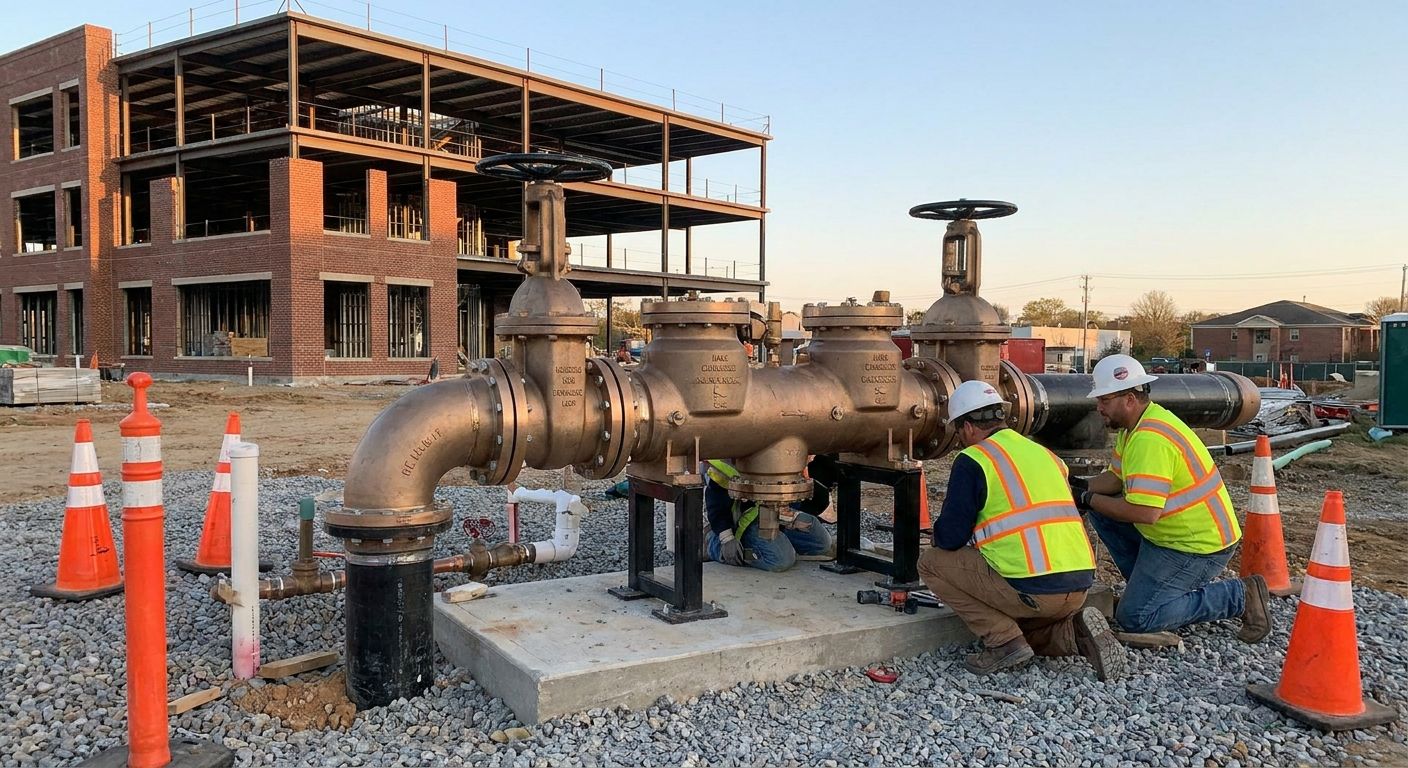
Commercial Backflow Preventer Installation for New Builds 2026
August 25th, 2026
Every new commercial building in Northern Utah that ties into a public water line needs a backflow preventer before the water district will sign off on the meter. Get the assembly type, location, and testing schedule wrong during construction and you're looking at a failed inspection and a delayed certificate of occupancy in 2026.
- Reduced Pressure Zone assemblies are the default for commercial backflow preventer installation on high-hazard connections in 2026 — Buy.
- Double check valve assemblies work for low-hazard irrigation and fire lines but fail on any chemical or grease-trap connection — Consider.
- Annual testing by a certified tester is required in most Northern Utah water districts starting the day the assembly is installed — non-negotiable.
- Skipping water district pre-approval on assembly type is the single most common reason new-build inspections fail in 2026.
Why this matters
A backflow preventer stops contaminated water from siphoning back into the public supply when pressure drops — a burst main, a fire hydrant draw, a pump failure. Commercial buildings carry more risk than a house: grease traps, chemical rinse lines, boiler loops, irrigation systems, and fire sprinkler standpipes all connect to the same water source.
Every Northern Utah water district requires a backflow prevention assembly sized and rated to the hazard degree of the connection, installed by a licensed plumber, and tested by a certified backflow tester before the meter gets activated. Miss any one of those three requirements and the building doesn't get water turned on, no matter how far along the rest of construction is.
Who this is for
This guide is for general contractors, developers, and property managers bringing a new commercial building online in 2026 — restaurants, medical offices, retail centers, multi-family projects, or light industrial space anywhere Expert Services covers across Northern Utah. If you're past the point of asking whether you need a backflow preventer and need to know which assembly, where it goes, and how fast it can get certified, this is the right read. Expert Services handles licensed installation and certified testing on new commercial builds across the region.
What to look for in commercial backflow preventer installation
Hazard degree of the connection
Every connection point on a commercial building carries a hazard rating — high or low — based on what could flow backward into it. A restaurant's grease trap or a medical office's chemical rinse sink is high hazard; a lawn irrigation loop on a retail pad is usually low hazard. Get this classification wrong and the water district rejects the assembly on inspection, forcing a re-pour of the vault or a re-plumb of the mechanical room.
Assembly type matched to the application
Reduced Pressure Zone (RP) assemblies, Double Check Valve Assemblies (DCVA), and Pressure Vacuum Breakers (PVB) each solve a different hazard level and orientation problem. Installing a DCVA where the district requires an RP is one of the fastest ways to fail a rough-in inspection on a commercial project.
Local water district approval before rough-in
Every Northern Utah municipality and water district publishes its own approved assembly list and installation specs — Salt Lake City Public Utilities, Jordan Valley Water, and smaller municipal systems don't all require the same brand or configuration. Submitting the assembly model number for approval before it's in the ground saves a demo-and-replace cycle later in 2026.
Installation location and clearance
Code requires clear access for testing and repair, minimum clearance from walls and grade, and protection from freezing on any exterior installation. A vault buried too deep or an assembly mounted too close to a wall fails inspection even when the assembly itself is correct.
Freeze protection for Utah winters
Any backflow assembly installed outdoors or in an unheated mechanical space needs an insulated enclosure rated for sub-freezing temperatures. Northern Utah regularly drops below 20°F in January, and a cracked RP assembly mid-winter means an emergency shutdown on a building that isn't even occupied yet.
Certified testing lined up before occupancy
The assembly has to be tested by a state-certified backflow tester immediately after installation, and again annually after that. Building this test into the construction schedule — not as an afterthought after the certificate of occupancy request goes in — keeps the project on timeline.
Top picks for new commercial builds
The default for high-hazard connections — Reduced Pressure Zone (RP) Assembly
The RP assembly is the workhorse for restaurants, medical offices, and any building with a grease trap, chemical connection, or auxiliary water source. It uses a relief valve between two check valves that dumps water to atmosphere if either check fails, which is why most Northern Utah water districts mandate it for anything rated high hazard. Sizes commonly run 3/4-inch to 3-inch for commercial service lines. Verdict: Buy for any restaurant, medical, or industrial connection.
The budget option for low-hazard lines — Double Check Valve Assembly (DCVA)
A DCVA uses two independent check valves with no relief mechanism, which makes it cheaper to install and simpler to maintain than an RP. It's approved for low-hazard applications like irrigation loops and fire sprinkler standpipes on many new commercial builds, but it will not pass inspection on a grease trap or chemical line. Verdict: Consider only where the water district confirms low-hazard classification in writing.
The irrigation-specific pick — Pressure Vacuum Breaker (PVB)
PVBs are built for atmospheric vacuum protection on irrigation systems and work only in a vertical orientation above the highest downstream outlet. They're common on retail pad sites and multi-family landscaping loops but aren't rated for continuous pressure applications or high-hazard connections. Verdict: Consider for irrigation-only service; Skip for anything feeding the building interior.
The fire-line specific pick — Reduced Pressure Detector Assembly (RPDA)
An RPDA pairs an RP assembly with a bypass meter to detect unauthorized water use on fire sprinkler standpipes, which most Northern Utah districts require on any new commercial building with a fire suppression system. It costs more up front than a standard RP but avoids a second inspection cycle for the fire line separately. Verdict: Buy for any new build with a fire sprinkler connection.
Projects with restaurant kitchens should coordinate backflow installation with grease trap cleaning schedules so both systems pass the same round of health department inspections. New construction plumbing rough-in — including tankless water heater installation for new construction — should be sequenced around the backflow vault location, not after it.
What to avoid
- Undersized assemblies to save on the vault. A 3/4-inch RP on a 1.5-inch commercial service line will restrict flow and fail the district's pressure test even if it's the correct assembly type.
- DIY or unlicensed installation to hit a construction deadline. Every Northern Utah water district requires a licensed plumber for the install and a state-certified tester for the sign-off — an unlicensed install gets pulled and redone regardless of how it performs.
- Skipping the pre-approval submission. Installing an assembly model the local district hasn't approved means tearing out the vault after the fact, which is the most expensive mistake on this list in 2026.
Verdict comparison
| Assembly Type | Hazard Level | Best For | Verdict |
|---|---|---|---|
| Reduced Pressure Zone (RP) | High | Restaurants, medical, industrial | Buy |
| Double Check Valve (DCVA) | Low | Irrigation, fire lines (where approved) | Consider |
| Pressure Vacuum Breaker (PVB) | Low, irrigation only | Landscape loops on retail/multi-family | Consider |
| Reduced Pressure Detector (RPDA) | High, fire line | Buildings with sprinkler standpipes | Buy |
Get your backflow assembly scheduled
Licensed installation and certified testing for new commercial builds in 2026.
FAQ
What is the best backflow preventer for a new commercial building?
A Reduced Pressure Zone (RP) assembly is the standard choice for most new commercial buildings in 2026 because it covers high-hazard connections like grease traps and chemical lines. Low-hazard irrigation-only connections can sometimes use a double check valve or pressure vacuum breaker instead, but the water district makes the final call.
Is a backflow preventer required for all new commercial construction?
Yes, every Northern Utah water district requires a backflow prevention assembly on any new commercial connection to the public water supply before the meter is activated. The assembly type depends on the hazard classification of the connection.
How much does commercial backflow preventer installation cost?
Cost depends on assembly size, hazard rating, and whether a vault or enclosure is required, and it varies by project. Getting a site-specific quote before rough-in avoids surprises tied to pipe size or freeze protection requirements.
How often does a commercial backflow preventer need testing?
Most Northern Utah water districts require annual testing by a state-certified backflow tester after the initial post-installation test. Missing the annual window can result in water service restrictions for the building.
Can a double check valve assembly replace an RP assembly?
No, a double check valve assembly is only approved for low-hazard connections like irrigation loops, not for grease traps, chemical lines, or other high-hazard commercial connections. Water districts will fail an inspection if the wrong assembly type is installed for the hazard level.
Where does a backflow preventer get installed on a commercial building?
Placement depends on the water district’s code but generally sits right after the meter, either in an interior mechanical room or an insulated exterior vault. Clearance for testing access and freeze protection both factor into the approved location.
Does a new commercial building need a separate backflow assembly for fire sprinklers?
Yes, buildings with fire sprinkler standpipes typically need a Reduced Pressure Detector Assembly (RPDA) separate from the domestic water backflow preventer. This lets the district monitor unauthorized water use on the fire line independently.
Who can install and test a commercial backflow preventer in Utah?
Installation requires a licensed plumber, and the post-installation test requires a state-certified backflow tester, which are sometimes but not always the same person. Confirming both credentials before construction starts prevents a failed inspection later.
One last thing
The assembly itself rarely fails a commercial inspection in 2026 — the paperwork does. Water districts want the test report filed within days of installation, and a project that treats testing as a construction-schedule afterthought instead of a scheduled milestone is the one that misses its occupancy date.
Related guides
- Grease trap cleaning for Utah restaurants
- Plumbing, HVAC, and electrical maintenance for property managers