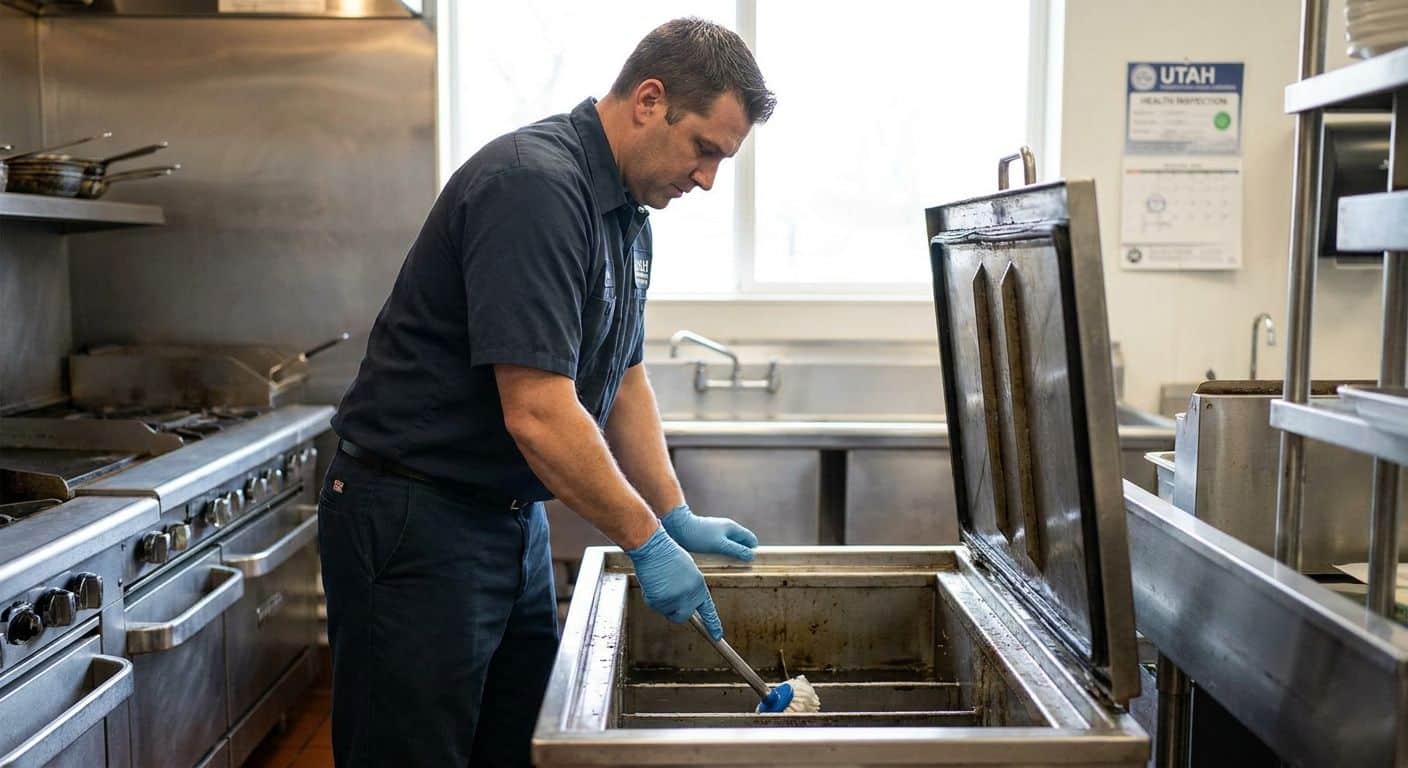
Grease Trap Cleaning for Utah Restaurants: 2026 Verdict
August 24th, 2026
Grease trap cleaning for Utah restaurants keeps drain lines clear, health inspectors satisfied, and kitchens open during dinner rush instead of shut down for a sewage backup.
- Quarterly hydro-jetting keeps high-volume Utah kitchens under the 25% grease trap capacity threshold — Buy for full-service restaurants.
- Monthly pumping fits fast-casual and quick-service kitchens frying daily; annual contracts are not enough.
- 24-hour emergency plumbing access matters more than trap size for restaurants in Salt Lake City, Provo, and Ogden — treat it as non-negotiable.
- Skip any grease trap cleaning schedule under quarterly for a full-service kitchen; FOG buildup backs up lines within months.
Why this matters
A restaurant that skips grease trap cleaning doesn't just risk a clogged sink. Fats, oils, and grease (FOG) that build past the trap's capacity push into the municipal sewer line, and Utah municipalities can cite commercial kititchens for FOG discharge violations during routine inspections.
A backed-up grease trap in 2026 means closed dining rooms, spoiled inventory, and an emergency plumber bill that costs more than a year of scheduled maintenance would have. Grease trap cleaning is one of the few maintenance line items where skipping it is guaranteed to cost more later.
Who this is for
This guide is for owners and kitchen managers running full-service restaurants, fast-casual concepts, food trucks with commissary hookups, and multi-tenant food courts anywhere from Salt Lake City down to Provo and up through Ogden. If your kitchen fries, sautés, or grills daily and drains into a municipal sewer line, grease trap cleaning frequency and vendor choice directly affect whether you stay open through a Friday night rush.
What to look for in grease trap cleaning for Utah restaurants
Service frequency matched to fryer volume
A quick-service kitchen running two deep fryers all day builds FOG faster than a coffee shop with a single panini press. Match your grease trap cleaning interval to actual volume instead of a generic default, and increase frequency the moment inspectors flag any FOG-related note.
Hydro-jetting capability, not just pumping
Pumping removes what's sitting in the trap; hydro-jetting clears the grease coating the inside of the line itself. A vendor offering both, like the process described in Expert Services' hydro-jetting guide, catches buildup a straight pump-out misses.
Manifest and disposal documentation
Utah health departments and municipal sewer authorities want proof the waste was hauled and disposed of properly, not dumped. Ask any grease trap cleaning vendor for a manifest on every visit and keep the file on-site for inspection days.
24-hour emergency access
Grease traps don't fail on a schedule. A kitchen that goes down on a Saturday night needs a plumber who answers, not a voicemail, which is why 24-hour plumbing for restaurants and commercial kitchens matters as much as the routine cleaning contract.
Drain line condition, not just the trap
A clean trap sitting upstream of a grease-caked line still backs up. Commercial kitchens benefit from pairing grease trap service with commercial drain cleaning for restaurants and offices at least once a year.
Backflow prevention tied to the same visit
Many commercial properties in Utah require annual backflow testing, and scheduling it alongside grease trap service cuts down on separate vendor visits. Backflow testing for commercial properties is worth bundling into the same maintenance calendar.
Book grease trap service today
Get a maintenance schedule built around your kitchen’s fryer volume.
Top picks for grease trap cleaning schedules
The high-volume pick: quarterly hydro-jetting plus pump-out. Full-service restaurants running multiple fryers and grills hit the 25% capacity rule fast. Quarterly service (four visits a year) keeps the trap and the line clear. Buy for any kitchen with more than one fryer station.
The steady pick: monthly pump-out for fast-casual. Quick-service concepts frying daily but running smaller trap sizes do well with a monthly visit instead of a full quarterly hydro-jet. It's lighter than the high-volume plan but still keeps FOG from accumulating past a month's worth of service. Consider it for single-fryer operations.
The safety net: 24-hour emergency coverage layered on top. Even a well-maintained trap can back up from an unexpected grease dump or a line blockage upstream. Pairing scheduled service with 24-hour emergency plumbing means a Friday night failure doesn't turn into a Monday closure. Buy regardless of trap size.
The property-manager pick: bundled multi-unit maintenance. Food courts and strip malls with several tenants sharing sewer infrastructure benefit from one vendor managing commercial sewer line maintenance across every unit instead of each tenant hiring separately. Consider for multi-tenant properties.
The wildcard: annual-only contracts. Some vendors pitch annual grease trap cleaning as a cost-saver. For any kitchen frying more than occasionally, this interval lets FOG build past capacity long before the scheduled visit. Skip it for anything busier than a low-volume coffee shop.
What to avoid
- Cleaners that skip the manifest. No paperwork means no proof for a health inspector, and that's a violation you own even if the vendor did the actual pumping.
- Vendors who only pump and never jet. A trap that looks empty on inspection day can still sit behind a line coated in grease that backs up within weeks.
- Annual-only schedules sold as "budget" plans. The math only works if your kitchen barely fries, and most Utah restaurants fry daily.
Verdict comparison
| Schedule | Best for | Frequency | Verdict |
|---|---|---|---|
| Quarterly hydro-jet + pump | Full-service, multi-fryer kitchens | Every 3 months | Buy |
| Monthly pump-out | Fast-casual, single fryer | Every month | Consider |
| 24-hour emergency add-on | Every restaurant kitchen | On-call | Buy |
| Multi-tenant bundled service | Food courts, strip malls | Property-wide schedule | Consider |
| Annual-only contract | Low-volume coffee/snack bars only | Once a year | Skip |
FAQ
What’s the best grease trap cleaning schedule for a Utah restaurant?
Quarterly hydro-jetting and pump-out is the best schedule for full-service Utah restaurants running multiple fryers in 2026. Fast-casual kitchens with lighter fryer use can often move to a monthly pump-out instead.
How much does grease trap cleaning cost in Utah?
Cost depends on trap size, service frequency, and whether hydro-jetting is included alongside pumping. Get a site-specific quote rather than relying on a flat national average, since fryer volume changes the math significantly.
Is hydro-jetting better than grease trap pumping alone?
Hydro-jetting clears the grease lining the drain line itself, while pumping only removes what has settled inside the trap. Kitchens that pair both catch buildup that pumping alone misses.
How often should a fast-food kitchen pump its grease trap?
Most fast-food and quick-service kitchens frying daily need monthly pump-outs to stay under the 25% capacity threshold. Higher-volume locations may need more frequent service depending on fryer count.
What happens if a restaurant skips grease trap cleaning?
FOG builds past trap capacity and pushes into the municipal sewer line, which can trigger a health department citation and a backed-up kitchen drain. The emergency plumbing bill to fix a backup almost always costs more than a year of scheduled service.
Does Utah require backflow testing along with grease trap service?
Many commercial properties in Utah require annual backflow testing separate from grease trap cleaning, and the two are commonly bundled into one maintenance visit. Check with your local water authority for the exact requirement on your property.
Can a plumber clean a grease trap or do I need a specialized service?
A licensed commercial plumber equipped for restaurant kitchens can handle grease trap cleaning, hydro-jetting, and the drain line work around it in one visit. That’s more efficient than juggling a separate grease-only vendor and a plumber for line issues.
What’s the 25% rule for grease traps?
The 25% rule is the industry standard trigger point: once fats, oils, and grease fill a quarter of the trap’s capacity, it’s time to pump. Waiting past that threshold is what causes most restaurant grease trap backups.
One last thing
The restaurants that never call an emergency plumber for a grease backup are almost never the ones with the biggest traps — they're the ones who never let FOG cross the 25% line in the first place. Trap size matters less than discipline on the schedule.
Related guides
- Commercial water heater installation for restaurants
- Plumbing, HVAC, and electrical maintenance for property managers
- Commercial HVAC maintenance for office buildings