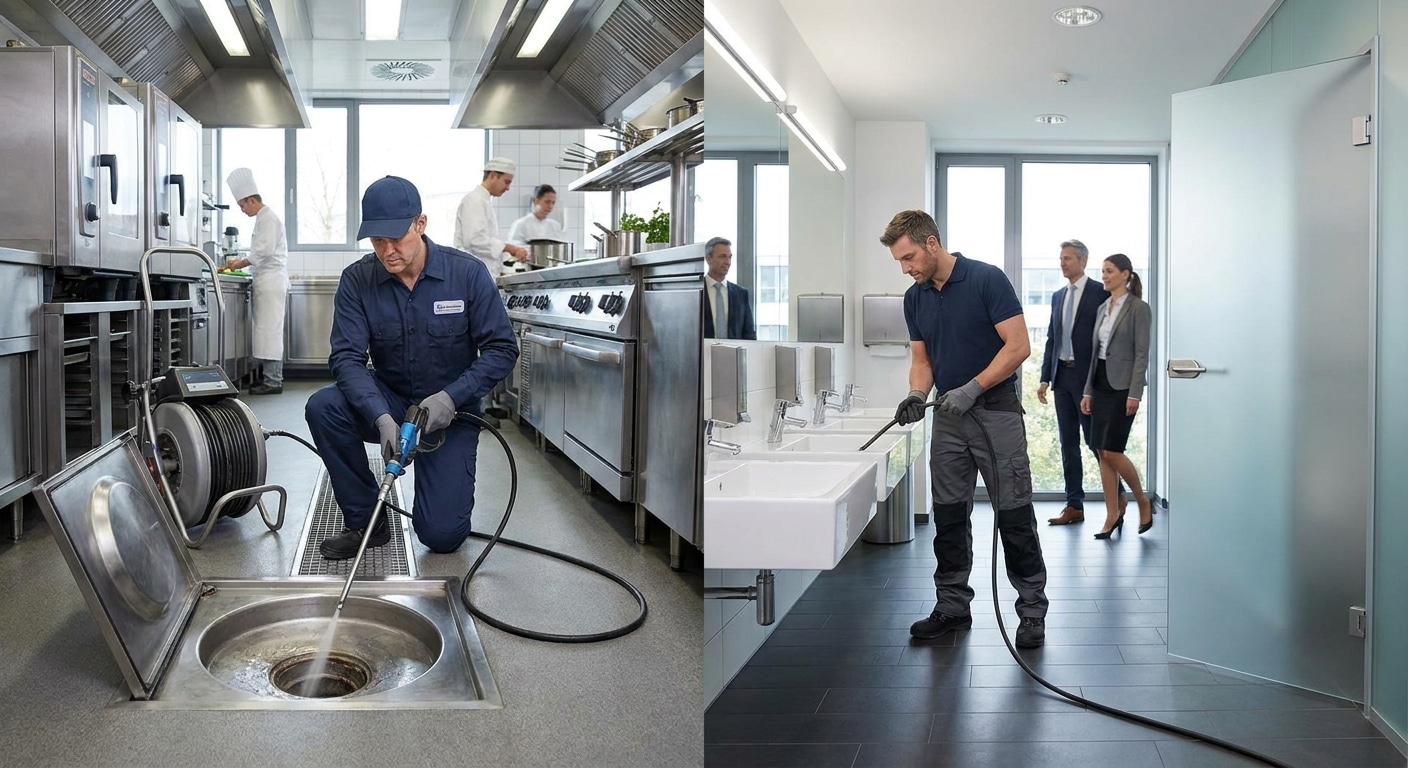
Commercial Drain Cleaning for Restaurants & Offices 2026
August 8th, 2026
Grease clogs and slow floor drains shut down restaurant kitchens and office buildings faster than almost any other maintenance failure. This guide breaks down what commercial drain cleaning actually requires in Northern Utah heading into 2026, and which method fits your building.
- Hydro jetting at 3,500-4,000 PSI is the 2026 buy for grease-lined restaurant kitchen lines.
- Camera inspection before any contract catches root intrusion and cracked cast iron — always request it.
- Chemical drain cleaners damage older Northern Utah commercial lines — skip them past a single sink use.
- Office buildings with floor drains need quarterly commercial drain cleaning, not annual, once paper or grease builds up.
- Expert Services schedules commercial drain cleaning after hours across Salt Lake City and Sandy so kitchens don’t lose service time.
Why this matters
A clogged grease line in a restaurant kitchen doesn't wait for a convenient time — it backs up during a Friday dinner rush and triggers a health inspector visit within days. Office buildings have it easier day-to-day, but a slow floor drain in a break room or mechanical closet turns into standing water and mold if nobody catches it early.
Commercial drain cleaning in 2026 isn't the same job as a residential snake-and-go. Restaurant lines carry grease, starch, and fibrous waste that harden into blockages regular rodding barely scratches. Office buildings deal with paper towels, mineral scale, and long horizontal runs that need a camera to diagnose properly. Getting the wrong service for the wrong building wastes money twice — once on the visit, again on the repeat call three weeks later.
Who this is for
This guide is for restaurant owners and kitchen managers dealing with grease traps and floor drains, and for office building managers or property owners responsible for common-area plumbing. If you're running a commercial kitchen in Northern Utah, drain cleaning frequency and grease trap coordination matter as much as the actual clearing method — see the breakdown on 24-hour plumbing for restaurants and commercial kitchens for how emergency response fits into a kitchen's daily risk. If you manage an office or mixed-use building, your priority shifts toward preventing slow floor drains from becoming standing-water complaints.
What to look for in commercial drain cleaning
Grease trap and kitchen line experience
A technician who mainly does residential snaking won't have the right equipment for a 4-inch grease line running under a restaurant slab. Ask specifically how many restaurant grease traps the company services monthly — a vague answer is a red flag.
Hydro jetting equipment and PSI rating
Grease hardens against pipe walls in a way a cable snake pushes through rather than removes. Hydro jetting at 3,500 to 4,000 PSI strips the pipe wall clean instead of just punching a hole through the clog, which is why it holds longer between service calls.
Camera inspection as standard practice
Older commercial buildings in Northern Utah still run cast iron or clay lines that crack, sag, or get invaded by tree roots. A camera inspection before and after cleaning tells you whether you're looking at a maintenance issue or a repair job, and it protects you from paying for cleaning when the real problem is a broken pipe.
Licensing and commercial insurance
Commercial contracts carry higher liability than a house call — a mishandled grease trap or a flooded server room in an office building is a different kind of expensive. Confirm the company carries commercial general liability coverage specific to non-residential work, not just a standard plumbing license.
After-hours and emergency scheduling
A restaurant can't shut its kitchen at 6 PM on a Thursday to wait for a Monday appointment. Confirm same-day or after-hours availability before you sign a maintenance agreement, not after you're already backed up.
Top picks by cleaning method
Hydro jetting — the deep-clean pick. Runs at 3,500 to 4,000 PSI and strips grease buildup off the full pipe wall instead of just boring a channel through it. Restaurants running fryers and dish pits see the longest interval between callbacks with this method, and it pairs well with the equipment side of a kitchen covered in commercial water heater installation for restaurants. Buy for any kitchen with a grease trap.
Camera inspection — the diagnostic pick. Costs less than a full cleaning and tells you exactly where the problem sits before anyone touches a cable or a jetter. Skipping this on a building over 20 years old means gambling on whether you're paying for maintenance or ignoring a cracked line. Buy before signing any recurring service contract.
Mechanical snaking — the quick fix. Clears a single blockage fast and costs less per visit than jetting, but doesn't remove grease coating from the pipe interior. Fine for an isolated office floor drain clog; not a real fix for a restaurant grease line that clogs every six to eight weeks. Consider for one-off office issues, not recurring kitchen problems.
Enzyme or bio-based maintenance treatment — the upkeep pick. Slows grease buildup between full cleanings when dosed on a schedule, but doesn't clear an existing blockage. Works as a maintenance layer on top of jetting, never as a replacement for it. Consider as an add-on, not a standalone service.
Chemical drain cleaner — the shortcut that backfires. Works on light residential clogs but reacts badly with grease trap enzymes and eats at older cast iron or galvanized commercial lines. Restaurant managers who pour it into a grease-heavy line often end up with a worse blockage and a corroded pipe. Skip it entirely on commercial kitchen or grease trap lines.
What to avoid
- Chemical cleaners on grease traps. They disrupt the trap's biological breakdown process and can damage the trap itself, turning a $150 cleaning into a trap replacement.
- Skipping camera inspection on older buildings. Office buildings and rental properties with original 1970s-1990s plumbing often have cast iron lines nearing the end of their service life — see how this plays out for emergency plumbing for rental property landlords when a line fails without warning.
- The lowest bid with no insurance verification. A commercial drain cleaning quote that's 30% below everyone else usually means uninsured labor or an out-of-scope crew unfamiliar with grease traps.
Get commercial drain cleaning scheduled
After-hours service for restaurants and offices across Northern Utah.
Verdict comparison
| Method | Best for | Cost tier | Verdict |
|---|---|---|---|
| Hydro jetting | Restaurant grease lines | Higher upfront, longer interval | Buy |
| Camera inspection | Older buildings, pre-contract | Low, add-on | Buy |
| Mechanical snaking | Single office floor drain clog | Low | Consider |
| Enzyme maintenance | Between-cleaning upkeep | Low, recurring | Consider |
| Chemical drain cleaner | Nothing commercial | Low, risky | Skip |
FAQ
How much does commercial drain cleaning cost in 2026?
Commercial drain cleaning ranges from roughly $150 for a basic snaking visit to $500 or more for hydro jetting a restaurant grease line, depending on line length and access. Camera inspection typically adds a smaller flat fee on top.
How often should a restaurant get commercial drain cleaning?
Restaurants with active grease traps usually need commercial drain cleaning every 60 to 90 days, separate from grease trap pumping. Kitchens running high fryer volume often need it closer to the 60-day mark.
Is hydro jetting better than snaking for restaurants?
Yes, for grease-heavy kitchen lines hydro jetting outperforms snaking because it strips the full pipe wall instead of punching a single channel through the clog. Snaking works fine for a one-off office floor drain but doesn’t hold up on recurring grease buildup.
Can chemical drain cleaners damage commercial pipes?
Yes, chemical drain cleaners can corrode older cast iron and galvanized lines and interfere with grease trap function. Commercial buildings with original plumbing from before the 1990s are especially vulnerable to this damage.
Do office buildings need commercial drain cleaning as often as restaurants?
No, office buildings without commercial kitchens generally need drain cleaning on a slower schedule, often annually or when a floor drain first shows slow drainage. Buildings with a cafeteria or break room disposal see faster buildup and need more frequent service.
What’s included in a camera inspection for commercial drains?
A camera inspection runs a waterproof camera through the line to show blockage location, pipe material condition, and any cracks or root intrusion. It typically takes 30 to 60 minutes and produces recorded footage you can keep on file.
Does commercial drain cleaning cover grease trap pumping?
No, grease trap pumping is a separate service from line cleaning, even though both address grease buildup. Most commercial contracts bill these separately since they use different equipment and schedules.
One last thing
Many Northern Utah cities set grease trap pumping requirements on their own schedule, separate from whatever drain cleaning interval your kitchen actually needs — don't assume one service covers the other. A building that catches a slow floor drain early with a camera inspection almost always pays less over a year than one that waits for a full backup, because emergency after-hours rates run higher than a scheduled visit every time.
Related guides