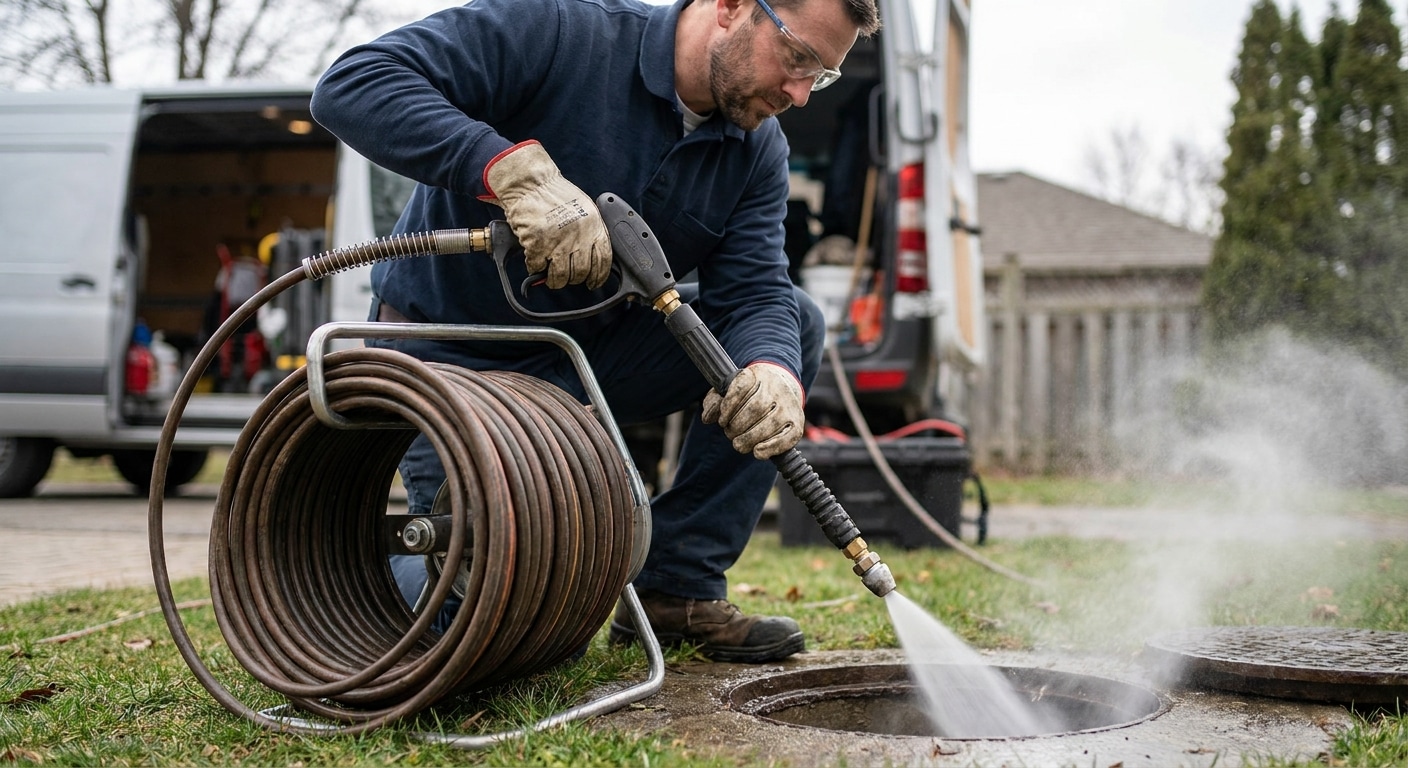
Hydro Jetting Drain Cleaning: 2026 Process & Cost Guide
August 8th, 2026
Stubborn clogs that keep coming back after a snake or store-bought chemical treatment usually mean grease, scale, or root intrusion built up along the pipe wall — and hydro jetting is the fix that actually strips that buildup instead of just punching a hole through it.
- Hydro jetting drain cleaning uses 4,000-8,000 PSI water streams to scour pipe walls clean, not just punch a hole through a clog.
- Recurring clogs after snaking usually mean grease or root buildup — jetting clears both; snaking clears neither long-term.
- Residential jetting runs roughly $300-$600 in 2026; commercial kitchen lines run higher due to grease volume.
- A camera inspection before jetting is non-negotiable on pipes older than 40 years — cast iron can crack under full pressure.
Why this matters
A cable snake breaks a channel through a clog and calls it done. The grease film, scale, and root hairs left on the pipe wall regrow fast, which is why the same drain clogs again in three months.
Hydro jetting drain cleaning blasts the full diameter of the pipe with high-pressure water, stripping buildup down to bare pipe. For Utah homes with older cast iron or clay lateral lines — common across Salt Lake City, Sandy, and South Jordan — that difference determines whether a clog is a one-time nuisance or a recurring service call every few months.
Commercial kitchens see this even more sharply. Grease-heavy lines at restaurants clog faster than residential lines, and a snake that clears the immediate blockage does nothing for the grease coating the rest of the pipe run.
What you'll need before hydro jetting
Hydro jetting is a professional service — the equipment runs at pressures that can injure a person or crack an old pipe if mishandled — but knowing what to prepare speeds up the visit and avoids surprise charges.
- Clear access to cleanout points — move stored items, furniture, or vehicles away from exterior cleanouts
- A recent camera inspection or willingness to get one — pipes over 40 years old need to be scoped before full-pressure jetting
- Knowledge of pipe material — cast iron, PVC, and clay all handle pressure differently, and your technician needs this before starting
- A cleared drain area — empty sinks, tubs, or floor drains of standing water so the technician can gauge flow rate accurately
- Time on-site — a straightforward residential job takes 1-2 hours; a full commercial kitchen line can run longer
If you're managing a rental property, loop in your tenant ahead of time. Rental property plumbing issues like recurring drain backups often trace back to grease or wipes flushed by tenants, and jetting is frequently the permanent fix landlords skip in favor of cheaper snaking.
The hydro jetting process, step by step
1. Camera scope the line first
A technician runs a sewer camera through the line before touching the jetter. This confirms pipe material, locates the clog, and checks for cracks or offset joints that full pressure could worsen. Skipping this step on a pipe installed before 1980 is the single most common mistake homeowners push for to save time.
2. Identify the access point
The technician locates the nearest cleanout — usually near the foundation, in a basement, or at the property line. On homes without an accessible cleanout, the jetter may need to go in through a toilet flange or roof vent, which adds setup time.
3. Size the jetter head to the pipe
Different nozzle heads cut through grease, scale, or roots differently. A penetrating nozzle opens a path through a solid blockage first; a flushing nozzle then scours the full pipe diameter on the way back out. Using the wrong nozzle on a 2-inch kitchen line versus a 4-inch main line wastes water pressure and time.
4. Run the water at controlled pressure
Residential lines typically run 4,000 PSI; heavier commercial grease lines may need up to 8,000 PSI. The hose is fed in slowly, cutting through blockage, then pulled back at a controlled rate that scours the pipe wall on the return pass. This is where hydro jetting drain cleaning earns its name — it's the return pass that actually cleans, not just clears.
5. Scope the line again to confirm
A second camera pass after jetting confirms the pipe wall is clean and checks for any damage the pressure might have revealed, like a hairline crack in aging cast iron. Expected outcome: a pipe wall that looks close to new, with water flowing freely and no visible film.
6. Flush and test drainage
The technician runs water through the fixture or line for several minutes to confirm flow rate and check for backup. Slow drainage after jetting usually means a partial collapse or offset further down the line that needs different repair, not another jetting pass.
7. Document findings and recommend a maintenance interval
Grease-prone kitchen lines or root-prone yards get flagged for annual or twice-yearly jetting. A line with no history of buildup might not need another service for 3-5 years. This is the step most DIY snaking skips entirely, which is why the same clog reappears without a plan behind it.
Restaurants and commercial kitchens should treat this step seriously — grease trap lines tied to restaurant water heater and plumbing systems build up fast enough that annual jetting alone often isn't enough during high-volume seasons.
Troubleshooting common hydro jetting problems
- Clog returns within weeks — likely a structural issue (belly in the pipe, offset joint) rather than buildup; a second camera scope will confirm it and jetting won't fix a structural problem
- Water backs up during the jetting pass — usually means the downstream line is also blocked; the technician needs to clear further down before the pressure pass will work
- Old cast iron shows a crack on the post-jet scope — the pipe was already weakened; jetting revealed it rather than caused it, and it needs a repair or liner, not another jetting session
- Grease returns fast in a commercial line — annual jetting isn't frequent enough for high-volume kitchens; move to a quarterly schedule
- Tree roots reappear within a year — jetting clears roots but doesn't stop regrowth; a root treatment or pipe lining stops it long-term
- Winter clog combined with a frozen or burst line — jetting won't help a frozen pipe; that's a different emergency covered in the burst pipe winter guide
Get your drain line scoped and jetted
Camera inspection and hydro jetting scheduling across Northern Utah.
Tools and resources
Hydro jetting itself requires commercial-grade equipment — a trailer-mounted or truck-mounted jetter, multiple nozzle heads, and a sewer camera — none of which is practical or safe to rent for a one-time homeowner job. What you can control is timing and access:
- A recent camera inspection report, if one exists, saves diagnostic time
- Knowledge of your pipe age and material (ask if you don't know — a 1960s home is more likely cast iron than a 2010s build)
- Clear access to cleanouts and drains before the appointment
- If you're in Salt Lake City, Sandy, South Jordan, or Provo and dealing with a clog that won't clear with a plunger or basic snake, an emergency plumber in Salt Lake City can scope the line same-day rather than waiting on a scheduled slot
What to do next
If the clog is isolated to one fixture and clears with a plunger, you likely don't need jetting yet. If it's a whole-house backup, recurring kitchen line issue, or a commercial kitchen drain that clogs monthly, schedule a camera inspection first — it tells you whether jetting is the fix or whether something structural needs attention instead. Expert Services runs camera scopes ahead of every jetting job in 2026 specifically to avoid pressurizing a pipe that's already compromised.
FAQ
What is hydro jetting drain cleaning?
Hydro jetting drain cleaning uses a high-pressure water stream, typically 4,000 to 8,000 PSI, to scour the inside of a pipe clean rather than just punch through a clog. It removes grease, scale, and root intrusion from the full pipe wall, which is why it lasts longer than snaking.
Is hydro jetting better than snaking?
For recurring clogs caused by grease or scale buildup, hydro jetting works better than snaking because it cleans the full pipe wall instead of opening a single channel. Snaking is faster and cheaper for a one-time simple blockage but doesn’t prevent the clog from returning.
How much does hydro jetting cost in 2026?
Residential hydro jetting typically costs $300 to $600 in 2026, depending on pipe length and access difficulty. Commercial kitchen lines cost more due to grease volume and longer line runs.
Can hydro jetting damage old pipes?
Hydro jetting can crack severely deteriorated cast iron or clay pipe if it isn’t scoped first. A camera inspection before jetting identifies pipes too fragile for full pressure so the technician can adjust or recommend repair instead.
How often should a drain line be hydro jetted?
Grease-prone kitchen lines and root-prone yard lines benefit from jetting once or twice a year. A line with no history of buildup may not need another jetting session for 3 to 5 years.
Does hydro jetting remove tree roots from sewer lines?
Yes, hydro jetting cuts through root intrusion in sewer lines effectively, but it doesn’t stop regrowth on its own. Roots typically return within a year unless paired with a root treatment or pipe lining.
Can I rent a hydro jetter and do this myself?
Hydro jetting equipment runs at pressures high enough to injure a person or crack a compromised pipe, and most rental units don’t include the camera equipment needed to check the pipe first. It’s a job for a licensed plumber, not a DIY rental project.
Is hydro jetting safe for older Utah homes with cast iron pipe?
It’s safe when a camera scope confirms the pipe’s condition first. Homes built before 1980 with original cast iron need that inspection step before full-pressure jetting to avoid cracking already-weakened pipe.
One last thing
The post-jetting camera scope catches more than clean pipe — it's often the first time a homeowner learns their line has a belly, an offset joint, or a hairline crack that's been there for years, quietly slowing drainage without ever fully clogging. That second scope pass is the step worth insisting on, even if it adds a few minutes to the appointment, because it's the difference between fixing the clog and fixing the actual pipe.
Related guides
- Emergency plumber in West Valley City, Utah
- Emergency plumber in Sandy, Utah
- Emergency plumber in South Jordan, Utah
- 24-hour plumber for restaurants and commercial kitchens
- Emergency plumbing for rental property landlords