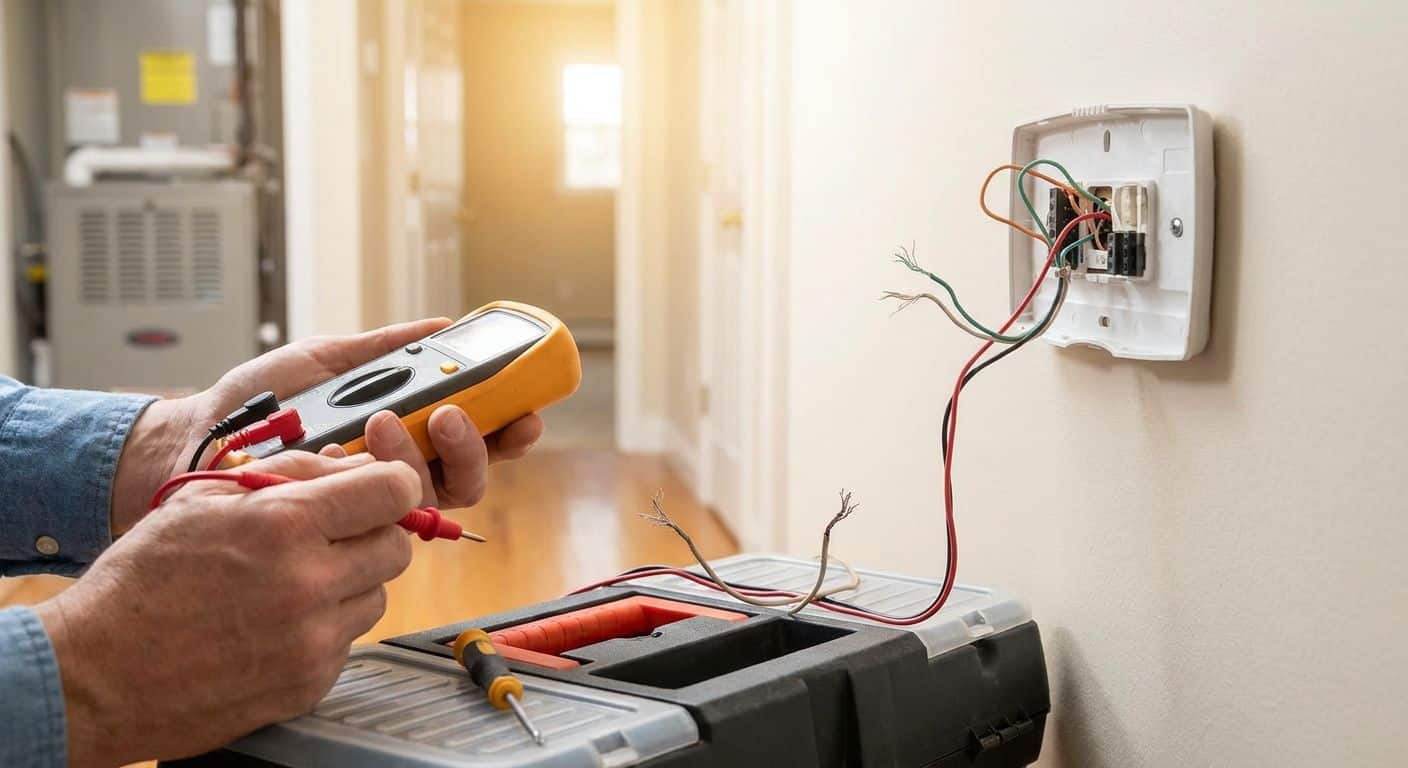
Thermostat Wiring Problems Stopping Your HVAC? Fix It (2026)
August 29th, 2026
Thermostat wiring problems are the most common reason a furnace or air conditioner refuses to turn on, and most trace back to a loose wire, a tripped low-voltage fuse, or a wire seated in the wrong terminal on the thermostat base. A quick fix restores power in minutes once you cut the breaker and pull the thermostat off its wall plate, but wiring that's melted, corroded, or missing a C-wire calls for a licensed technician before you flip anything back on.
- Loose or miswired thermostat wires cause most HVAC no-power problems — reseat wires and match colors to terminals.
- A blown low-voltage fuse on the furnace control board kills thermostat power and needs the breaker off first.
- Older Utah homes without a C-wire lose power to smart thermostats — a C-wire adapter or extra wire run fixes it.
- Corroded or rodent-damaged wiring beyond the thermostat base needs a licensed technician, not a weekend fix.
Why this matters
A dead thermostat looks like a dead HVAC system, and that leads a lot of Utah homeowners to call for a furnace replacement or AC install they don't need in 2026. The thermostat is a 24-volt control device — it doesn't run your heat pump, furnace, or condenser directly, it just tells the equipment when to fire. When that low-voltage signal breaks down anywhere between the wall unit and the furnace board, the whole system reads as dead even though the blower motor and gas valve are fine.
That distinction matters for your wallet. A furnace that won't turn on is sometimes a wiring fault, not a failed component, and ruling out the cheap fix first saves a service call.
How do you fix thermostat wiring problems that stop your HVAC?
Follow this order every time — skipping the breaker step is the single most common mistake homeowners make in 2026 when troubleshooting a dead thermostat.
- Cut power at the breaker for the furnace or air handler, not just the thermostat switch.
- Pull the thermostat faceplate off the wall plate and photograph the wire-to-terminal layout before touching anything.
- Check every terminal for a loose wire. Standard letters are R (power), W (heat), Y (cool), G (fan), and C (common).
- Match wire color to terminal letter. A wire in the wrong slot is the number two cause of a thermostat that shows a blank screen or won't call for heat or cool.
- Inspect the low-voltage fuse on the furnace control board — it's a small glass or blade fuse, usually rated 3 amps, and it blows when wires short against each other or against the metal cabinet.
- Restore breaker power and test heat, cool, and fan independently before buttoning the faceplate back on.
- If the screen still won't power up, check for a C-wire. Its absence is the most common reason smart thermostats fail after a DIY swap.
| Symptom | Likely wiring cause | DIY fix? |
|---|---|---|
| Blank thermostat screen | Blown low-voltage fuse or dead C-wire | Yes, if fuse is accessible |
| HVAC runs constantly | Wire in wrong terminal (often Y/G swap) | Yes, with photo reference |
| No heat, AC works fine | Loose W wire at thermostat or furnace board | Yes |
| Thermostat resets or flickers | Corroded or frayed wire insulation | No — call a technician |
| System short-cycles | Damaged wire run inside a wall or attic | No — call a technician |
Loose or corroded wire connections
A wire that's backed out of its terminal screw, or one whose copper has gone green from years of humidity in a furnace closet, is the single most repeated fault behind a dead thermostat. Verdict: reseat or strip and reconnect — a 10-minute fix with the breaker off. If the copper crumbles when you strip it, replace that wire run rather than twisting it back in.
Wires seated in the wrong terminal
A DIY thermostat swap that puts the Y wire on the G terminal (or vice versa) produces a fan that never stops or an AC that never kicks on. Verdict: fix with the terminal photo from before you disconnected anything — five minutes, no parts needed. Without that photo, match wire color to the manufacturer's terminal diagram printed inside the thermostat base.
Blown low-voltage transformer fuse
The furnace control board carries a small fuse that protects the 24-volt transformer. A short anywhere in the thermostat wire run — including a staple driven through the cable — blows that fuse and kills every mode at once. Verdict: replace the fuse with the breaker off, then find and fix the short before the new fuse blows too.
Missing C-wire for smart thermostats
Homes wired before smart thermostats existed often ran only four wires (R, W, Y, G) with no common wire to keep the display powered continuously. Verdict: install a C-wire adapter or run a fifth wire — skip this and the smart thermostat will drop offline or reset on its own. This is the top wiring complaint tied to 2026-era smart thermostat installs in older Northern Utah housing stock.
Why thermostat wiring problems vary
- Home age — houses wired before the mid-1990s often lack a dedicated C-wire, which forces workarounds for any smart thermostat installed since.
- DIY smart thermostat swaps — skipping the wire diagram photo step is the most common cause of a Y/G terminal mix-up.
- Rodent activity in attics and crawlspaces — chewed insulation on thermostat wire runs is a recurring call in Utah homes with unsealed attic access.
- Furnace closet humidity — corrosion builds on exposed copper faster in unventilated mechanical rooms.
- Panel age and breaker reliability — a flaky breaker can mimic a wiring fault by cutting power intermittently; if breakers trip often elsewhere in the house, get a circuit breaker repair evaluation before blaming the thermostat.
- Multi-stage or dual-fuel systems — these need extra wire runs (W2, O/B) that increase the number of terminals that can be miswired during an install.
A thermostat that won't power on after a fresh fuse and clean terminals almost always points to a wiring fault further down the line, not the thermostat itself.
Why does my thermostat screen stay blank?
A blank screen means the unit isn't getting 24-volt power, which traces to a blown low-voltage fuse, a missing C-wire, or a fully disconnected wire at either end of the run. Check the furnace board fuse first since it's the fastest thing to rule out.
Can bad thermostat wiring damage the furnace or AC unit?
A short from crossed wires can blow the low-voltage fuse repeatedly and, left unresolved, stress the transformer on the furnace control board. It won't damage the compressor or gas valve directly, but a technician should trace the short before it recurs.
Is it safe to rewire a thermostat yourself?
Reseating a loose wire or swapping two terminals is safe once the breaker is off, since thermostat wiring runs at 24 volts, not household voltage. Anything involving the furnace's line-voltage side, a damaged wire inside a wall, or a system that keeps blowing fuses is a job for a licensed technician.
Most of these fixes stop at the thermostat base. When the fault runs into wire hidden inside a wall or the furnace's own control board, that's where a same-week visit from a licensed technician beats another hour with a multimeter — Expert Services techs carry the low-voltage fuses and C-wire adapters that solve this on the first trip in most Northern Utah homes.
Get thermostat wiring diagnosed today
A licensed HVAC technician can trace and fix the fault in one visit.
FAQ
What’s the most common thermostat wiring problem in 2026?
A loose or miswired terminal connection is the most common cause of a dead HVAC system tied to thermostat wiring. Reseating the wire and matching color to terminal letter fixes it in most cases.
How much does it cost to fix thermostat wiring?
A loose wire or blown fuse is a same-visit fix for most licensed technicians, while wiring buried in a wall costs more due to the added labor. Get a quote before work starts since every home’s wire run is different.
Is a blown thermostat fuse the same as a blown furnace fuse?
Yes — the low-voltage fuse that protects thermostat wiring lives on the furnace’s own control board, not inside the thermostat itself. It typically blows when a wire shorts against bare metal or another wire.
Do all thermostats need a C-wire?
Smart and Wi-Fi thermostats need a C-wire for continuous power, while older mechanical thermostats generally don’t. Missing a C-wire in a home wired before smart thermostats existed is one of the most common 2026 upgrade snags.
Can a bad thermostat wire trip a circuit breaker?
A short in thermostat wiring blows the low-voltage fuse on the furnace board rather than tripping the home’s main breaker, since it runs on a separate 24-volt circuit. If your breakers trip elsewhere in the house, that’s a separate electrical issue worth checking.
Why does my HVAC run constantly after I installed a new thermostat?
A constantly running fan or AC after a new thermostat install usually means the Y and G wires were swapped at the terminal block. Match wire color to the terminal diagram printed inside the thermostat base to fix it.
How do I know if it’s the thermostat or the furnace itself?
If the furnace’s indicator lights are on and the blower runs when you jump the R and G terminals with a screwdriver, the furnace itself is fine and the fault sits in the thermostat wiring. No lights or no blower response points to the furnace board instead.
One last thing
The fastest diagnostic anyone can run before calling for service: pull the thermostat, touch a screwdriver across the R and G terminals for two seconds, and see if the blower kicks on. If it does, your furnace is fine and the fault is entirely in the wiring or the thermostat itself — that one test alone rules out a much more expensive repair call.
Related guides
- Electrical panel upgrade signs
- Signs your furnace needs replacing
- Best home HVAC systems for Utah homes
- Flickering lights repair for older electrical systems