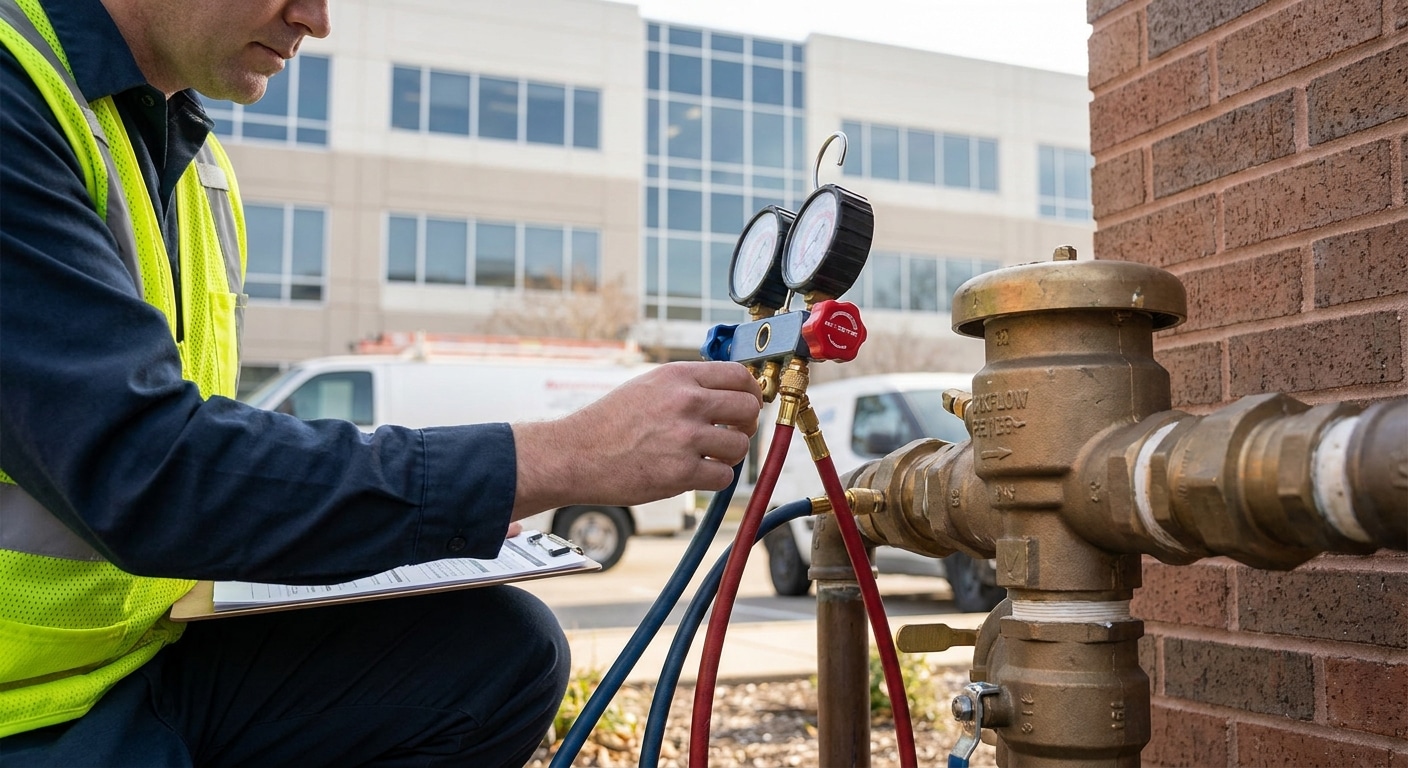
Backflow Testing Commercial Properties: 2026 Guide
August 10th, 2026
Commercial properties in Northern Utah with irrigation systems, fire suppression lines, or connections to a municipal water supply need an annual backflow test to stay in compliance and keep the water safe for everyone downstream. This guide breaks down what to check for, who should do the testing, and which property types carry the highest risk if a test gets skipped.
- Backflow testing commercial properties requires a state-certified tester and typically happens every 12 months under local water authority rules.
- Restaurants and medical offices carry the highest cross-connection risk and should test annually, not on a multi-year cycle.
- A failed test needs same-week repair, not a callback in three weeks, or the water district can shut off service.
- Property managers with multiple buildings should centralize testing dates instead of tracking each device separately.
Why this matters
A backflow preventer stops contaminated water from siphoning backward into the public supply during a pressure drop. When that device fails on a commercial property, the liability sits with the owner, not the water district. Most cities along the Wasatch Front, including Salt Lake City, Sandy, South Jordan, and Provo, require annual testing for any commercial account with an irrigation system, fire line, or boiler connection, and they will flag or restrict water service for a property that misses its window.
The cost of skipping a test is rarely the fine. It's the shutdown notice that arrives mid-lease, or the insurance claim that gets denied because the fire suppression backflow device hadn't been certified in over a year. Getting ahead of the testing calendar in 2026 costs far less than fixing a compliance gap after the fact.
Who this is for
This guide is built for property managers, restaurant owners, and facilities directors overseeing commercial buildings in Salt Lake City, Provo, Sandy, South Jordan, or West Valley City that have irrigation systems, fire sprinklers, boilers, or any connection where water could flow backward into the main supply. If your property has more than one water meter or a lease that puts compliance responsibility on you rather than the landlord, this applies directly.
What to look for in backflow testing for commercial properties
State certification, not just a plumbing license
A general plumbing license doesn't automatically qualify someone to test backflow devices. Utah requires a separate backflow tester certification, and the water district will reject a report submitted without it. Ask for the certification number before scheduling, not after the test is done.
A full device inventory before the first test
A property with an irrigation system, a boiler, and a fire line likely has three separate backflow preventers, sometimes more if there's a commercial kitchen. Testing one device and assuming the property is covered is the most common gap property managers walk into. The tester should map every cross-connection point on the property, not just the one the water bill references.
Testing frequency tied to your local water authority, not a generic annual reminder
Most municipalities in Northern Utah require testing every 12 months, but some high-risk classifications, like properties with commercial kitchens or medical gas lines, get flagged for more frequent checks. Confirm the exact requirement with your water district rather than defaulting to a calendar reminder that might be wrong for your property class.
Same-visit repair capability
A backflow device that fails its test needs a repair, and a tester who can only report the failure leaves you scheduling a second contractor and a second delay. Look for a provider who tests and repairs on the same visit, since most water districts give a short window, often 30 days, to correct a failed device before restricting service.
Documentation that goes straight to the water district
A passed test means nothing if the paperwork sits in an email inbox instead of reaching the water authority. Confirm the tester files the report directly with your city or district, not just with you.
Scheduling that doesn't shut down the business
A restaurant or retail property can't have its irrigation or fire line testing scheduled during peak hours. A tester who works around your business hours, not the other way around, keeps the disruption to a device check, not a half-day closure.
Top picks by property type
Restaurants and commercial kitchens — the highest-risk pick
A commercial kitchen typically runs a dedicated backflow device on its grease interceptor line in addition to the building's main preventer, and a single missed test can trigger a health inspection flag on top of a water district violation. Kitchens generate the most cross-connection risk of any commercial category because of the chemical and grease exposure at the drain line. Verdict: Test Now — bundle it with a 24-hour plumbing check for the kitchen rather than treating backflow as a separate appointment.
Medical and dental offices — the non-negotiable pick
Offices with medical gas lines or sterilization equipment carry cross-connection risk that most standard commercial buildings don't. A failed backflow device here isn't just a compliance issue, it's a patient safety issue. Verdict: Test Now, and confirm the tester's certification covers medical-grade cross-connection control specifically.
Multi-family and mixed-use buildings — the coordination pick
A property with 40 units and a shared irrigation system usually has two or three backflow devices covering the whole site, not one per unit. The failure point here is coordination, not device count: managers lose track of which device was last tested. Verdict: Bundle Annually — set one calendar date for the entire property instead of tracking devices separately.
Industrial and irrigation-heavy sites — the volume pick
Warehouses and properties with landscaped grounds often run larger-diameter backflow assemblies that take longer to test and cost more to replace if they fail. These devices see more wear from irrigation cycling through spring and summer. Verdict: Test Before Spring Startup — a failed device found in April costs less to fix than one discovered mid-irrigation season in July.
Property management portfolios — the systems pick
A management company running eight or ten commercial buildings across the Wasatch Front needs a single testing partner tracking every device's due date, not eight separate vendor relationships. Missing one property's window is the most expensive mistake in this category, since it's the one no one notices until the shutoff notice arrives. Verdict: Consolidate — one provider covering commercial sewer line maintenance and backflow testing on the same schedule cuts the coordination load significantly.
What to avoid
- A tester without a same-visit repair option. A report that only says "failed" leaves you scrambling for a second contractor while the compliance clock runs.
- Assuming residential backflow rules apply. Commercial classifications carry stricter frequency requirements and higher device counts than a typical home.
- Treating backflow testing as separate from drain and grease-trap maintenance in a kitchen. A restaurant drain cleaning visit and a backflow test on the same schedule catches issues a standalone test misses.
Book commercial backflow testing
Certified testing and same-visit repair across Northern Utah.
Verdict comparison
| Property type | Testing frequency | Main risk | Verdict |
|---|---|---|---|
| Restaurants / commercial kitchens | Annual, minimum | Grease line + main device | Test Now |
| Medical / dental offices | Annual, stricter oversight | Medical gas cross-connection | Test Now |
| Multi-family / mixed-use | Annual, per building | Device tracking gaps | Bundle Annually |
| Industrial / irrigation-heavy | Annual, before spring startup | Larger assembly wear | Test Before Spring |
| Management portfolios | Annual, staggered by property | Missed windows across sites | Consolidate |
FAQ
How often does backflow testing commercial happen in Utah?
Most Utah municipalities require annual backflow testing for commercial properties in 2026, though some high-risk classifications like medical offices or commercial kitchens may face more frequent city-mandated checks. Confirm the exact interval with your local water district since requirements vary by city.
Who is qualified to test a commercial backflow device?
Only a tester holding a state-recognized backflow certification, separate from a standard plumbing license, can legally submit a passing or failing report. Water districts reject reports filed by uncertified testers, so confirm the certification number before scheduling.
What happens if a commercial backflow device fails its test?
Most water districts give a short repair window, often around 30 days, before restricting or shutting off water service to the property. A provider who repairs on the same visit as the failed test avoids a second scheduling delay during that window.
Does every commercial property need backflow testing?
Any commercial property with an irrigation system, fire sprinkler line, boiler, or other cross-connection point needs annual testing under most Utah water authority rules. Properties without any of these connections may be exempt, but that exemption should be confirmed with the water district directly.
How long does a commercial backflow test take?
A single device test typically takes 30 to 45 minutes, but a property with multiple devices, like a restaurant with both an irrigation and grease line backflow preventer, takes longer. Scheduling around business hours keeps the disruption limited to the device check itself.
Can a property manager combine backflow testing with other maintenance visits?
Yes, and it’s the more efficient approach for kitchens and multi-building portfolios. Pairing backflow testing with drain cleaning or sewer line maintenance on the same schedule reduces vendor coordination and catches related issues in one visit.
Who is responsible for backflow testing costs on a leased commercial property?
Responsibility depends on the lease terms, but many commercial leases assign compliance testing to the tenant or property manager rather than the building owner. Checking the lease language before the water district’s deadline avoids a last-minute dispute over who schedules it.
One last thing
The device most property managers forget entirely is the one on the fire sprinkler riser, not the irrigation line. Fire marshals and water districts both track that device separately, which means it can fail compliance on two fronts at once if it's skipped during an annual backflow testing commercial cycle.
Related guides
- Commercial drain cleaning for restaurants and offices
- Commercial sewer line maintenance for property managers
- 24-hour plumber for restaurants and commercial kitchens
- Commercial water heater installation for restaurants