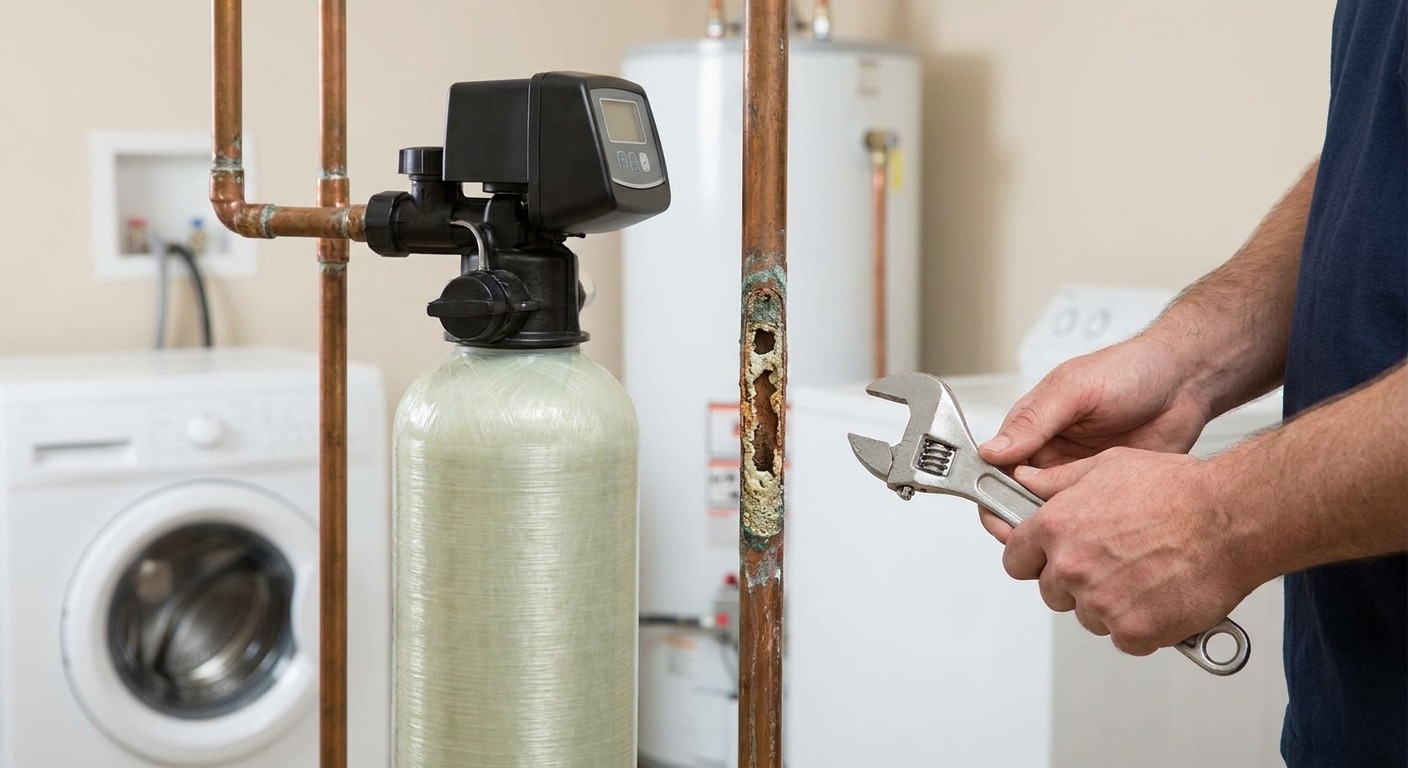
Prevent Hard Water Damage to Pipes: 2026 Guide
August 15th, 2026
Utah tap water runs 15 to 20 grains per gallon in most Wasatch Front cities, hard enough to coat pipes, water heaters, and appliances in mineral scale within a few years of installation. Here's how to stop the damage before it costs you a water heater or a repiping job.
- Utah water averages 15-20 grains per gallon (gpg), classified as "very hard" by USGS standards.
- A whole-house water softener is the only fix that stops scale at the source rather than treating symptoms.
- Unsoftened water can cut water heater lifespan from 12-15 years down to 6-8 years.
- Flushing your water heater every 6 months and descaling fixtures quarterly slows damage between bigger fixes.
- Expert Services installs water softeners and repairs the appliances hard water damages most in Northern Utah.
Why hard water wrecks pipes and appliances
Hard water carries dissolved calcium and magnesium that don't stay dissolved once water heats up or sits in a pipe. Those minerals precipitate out as scale, a chalky deposit that builds up layer by layer on the inside of pipes, heating elements, and valves.
A quarter-inch of scale inside a pipe can cut its effective diameter enough to drop water pressure noticeably. Inside a water heater, scale acts as insulation between the burner or element and the water, forcing the unit to work harder and burn more energy to hit the same temperature. That's the mechanism behind most premature water heater replacement calls in hard water regions like Salt Lake, Utah, and Davis counties.
The fix isn't a single product, it's a maintenance system: one primary intervention (a softener) plus a handful of habits that protect what the softener can't reach.
What you'll need
- A water hardness test kit or a call to a licensed plumber for a hardness reading (measured in gpg or ppm)
- A whole-house water softener installation sized to your household's daily water use
- White vinegar (food-grade, distilled) for descaling faucets and showerheads
- A garden hose and bucket for water heater flushing
- A soft brush or old toothbrush for aerator and showerhead cleaning
- 30-45 minutes every 6 months for maintenance tasks
- A calendar reminder system, because hard water damage is a scheduling problem as much as a plumbing problem
The steps
1. Test your water hardness first
You can't size a fix without knowing the problem's scale. A hardness test tells you whether you're at 12 gpg (hard) or 22 gpg (very hard), and that number determines what size softener you actually need.
Drugstore test strips give a rough reading in under 5 minutes. For an accurate number tied to your specific address and municipal supply, a licensed plumber's water test is more reliable, especially if you're on well water instead of city service.
Common mistake: skipping the test and buying a softener based on square footage alone. Undersized units regenerate too often and wear out faster; oversized units waste salt and water.
2. Install a whole-house water softener
A properly sized softener is the single intervention that stops scale formation at the point of entry, before water ever reaches a pipe, faucet, or appliance. Every other step on this list manages symptoms; this one removes the cause.
Most residential units in Northern Utah run a resin tank and a brine tank working together, exchanging calcium and magnesium ions for sodium or potassium ions as water passes through. Expect installation to take a half-day to a full day depending on your plumbing layout and whether a bypass loop already exists.
Common mistake: placing the softener downstream of the water heater instead of upstream. It has to treat water before it hits the tank, not after.
3. Flush your water heater every 6 months
Sediment and scale settle at the bottom of a tank-style water heater, and in hard water areas that layer builds fast. A 6-month flush schedule (versus the once-a-year that's fine in soft water regions) keeps that layer thin enough that it doesn't insulate the burner from the tank.
Shut off power or gas, connect a hose to the drain valve, and run water out until it flows clear, usually 10-15 minutes. Do this in spring and fall so it becomes routine rather than an afterthought.
Common mistake: flushing a water heater that's already showing rumbling or popping sounds without first assessing whether the tank has already sustained damage. At that point a flush won't undo the scale layer that's already hardened.
4. Descale faucets, aerators, and showerheads quarterly
These are the fixtures hard water attacks fastest because they're exposed to constant flow and air, which accelerates mineral deposition. White, crusty buildup around aerator screens and showerhead nozzles is visible proof scale is forming somewhere you can't see too, inside the pipe behind the wall.
Unscrew the fixture, submerge it in undiluted white vinegar for 30-60 minutes, then scrub with a soft brush. For showerheads you can't remove, tie a vinegar-filled bag around the head instead.
Common mistake: using abrasive scrubbers or metal brushes on chrome or brushed nickel finishes. Vinegar dissolves the mineral; scrubbing hard just scratches the fixture.
5. Watch appliance performance for early warning signs
Dishwashers, washing machines, and coffee makers all run water through internal lines and heating elements the same way a water heater does, just at smaller scale. Spotty dishes, stiff or gray-tinted laundry, and slower fill times are early signals scale is accumulating inside these units.
Run a monthly descaling cycle using a citric acid or vinegar-based cleaner formulated for the specific appliance. This is cheap insurance against the far more expensive fix: replacing an appliance 3-5 years early.
Common mistake: assuming a scale-damaged appliance just needs cleaner detergent. If the problem is mineral buildup inside the lines, no amount of detergent change fixes it.
6. Schedule an annual professional inspection
A licensed technician can spot scale accumulation inside a water heater tank, check softener resin and salt levels, and catch a slow leak caused by scale-weakened valve seals before it becomes a burst pipe. This is also the point to evaluate whether a tankless water heater installation makes more sense than replacing a tank-style unit again, since tankless units handle softened water more efficiently over the long run.
Book this inspection at the same time each year, ideally paired with your fall water heater flush, so it's one appointment instead of two.
Common mistake: waiting until a visible problem shows up. By the time you see rust-colored water or hear tank noise, scale damage has usually been building for a year or more.
Book a water softener install
Get scale damage under control before it hits your water heater or pipes.
Troubleshooting hard water problems
White, crusty buildup on faucets and showerheads. This is visible scale, the same mineral deposit forming inside your pipes just now showing where you can see it. Descale monthly and confirm your softener is actually cycling; a stalled unit lets hardness pass straight through.
Noticeably lower water pressure. Scale is narrowing the inside diameter of your pipes, especially in older galvanized steel lines common in pre-1980s Utah homes. A plumber can scope the line to confirm buildup versus a different cause like a partially closed valve.
Popping or rumbling sounds from the water heater. This means sediment and scale have hardened at the tank bottom and steam is escaping through the layer during heating cycles. A flush may help if caught early; if the noise is loud and constant, the tank likely needs replacement.
Softener producing hard water despite running. Check for a salt bridge, a hardened crust in the brine tank that stops salt from dissolving properly. Break it up with a broom handle and confirm resin hasn't reached the end of its 10-15 year service life.
Slow drains alongside hard water symptoms. Mineral scale narrows drain lines the same way it narrows supply lines. If snaking doesn't clear it, hydro jetting for drain clogs clears scale buildup that a standard cable can't touch.
Water heater failing well before its expected lifespan. A tank rated for 12-15 years failing at 6-8 years is the clearest sign hard water has been running unsoftened the whole time. Softening now protects the replacement unit; it won't undo damage to the old one.
Tools and resources
- Water hardness test strips or a plumber-administered test
- A softener sized to your gpg reading and household water use, installed and maintained on schedule
- Distilled white vinegar for fixture descaling
- A drain valve hose kit for water heater flushes
- A citric acid appliance cleaner for dishwashers and washing machines
- An annual inspection booked through a licensed Utah plumbing and HVAC provider
What to do next
Once a softener is installed, the next decision point is usually the water heater itself, especially if it's already shown scale damage. Read through the signs you need a water heater replacement, not a repair guide to figure out whether your current unit is worth saving or whether 2026 is the year to replace it with a softened-water-friendly system.
FAQ
What’s the best way to prevent hard water damage to pipes in 2026?
A whole-house water softener is the most effective fix, since it removes calcium and magnesium before they reach your pipes. Combine it with a twice-yearly water heater flush and quarterly fixture descaling for full coverage.
Is a water softener better than a water filter for hard water?
A softener treats hardness directly by exchanging minerals; a standard filter mainly removes sediment and chlorine taste, not calcium or magnesium. For scale prevention specifically, a softener is the right tool.
How much does hard water shorten a water heater’s lifespan?
A tank-style water heater rated for 12-15 years can fail in 6-8 years when running unsoftened hard water in Utah. Scale buildup on the heating element or burner is the main cause.
How often should I flush a water heater in a hard water area like Utah?
Every 6 months, versus the annual schedule that’s fine in soft water regions. Sediment and scale accumulate faster at 15-20 grains per gallon, which is typical along the Wasatch Front.
Can hard water damage a dishwasher or washing machine?
Yes, scale builds inside internal water lines and heating elements the same way it does in a water heater. Spotty dishes and stiff laundry are early signs; a monthly citric acid or vinegar cleaning cycle slows the damage.
What grain per gallon (gpg) counts as hard water?
USGS classifies 7-10.5 gpg as hard and above 10.5 gpg as very hard. Most Northern Utah municipal water tests between 15 and 20 gpg, putting it firmly in the very hard category.
Do I need a plumber to install a water softener or can I DIY it?
A licensed plumber ensures correct sizing, proper bypass loop placement ahead of the water heater, and code-compliant drain connection for the brine tank. Incorrect placement is a common DIY mistake that reduces effectiveness.
Does vinegar actually remove hard water scale?
Yes, the acetic acid in distilled white vinegar dissolves calcium and magnesium deposits on contact. Soak fixtures for 30-60 minutes for visible buildup; heavier scale inside pipes needs professional descaling or replacement.
One last thing
Most homeowners notice hard water through fixture staining long before they notice the bigger problem: the same scale forming inside a water heater tank they can't see into. By the time popping sounds start in 2026, the tank has usually been losing efficiency for a year or more, quietly running up utility bills before it fails outright.
Related guides
- Signs you need a water heater replacement, not a repair
- Tankless water heater installation for new construction
- Water heater repair for rental properties