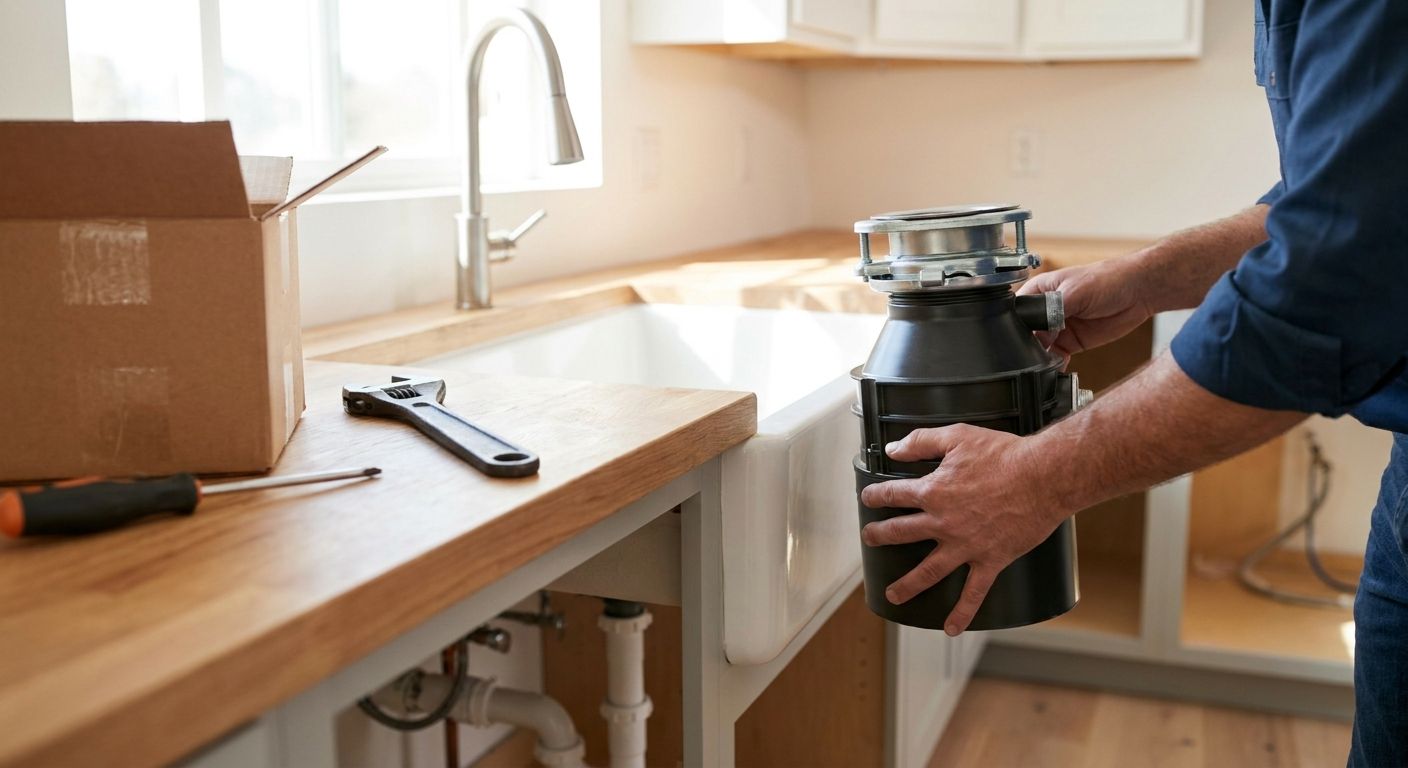
Garbage Disposal Installation for Remodels: 2026 Guide
August 19th, 2026
Swapping in a garbage disposal during a kitchen remodel means matching horsepower, electrical capacity, and drain-line layout to how your household actually cooks — get one of those wrong and you're pulling the sink base apart again before 2027.
- A 3/4 HP continuous-feed disposal is the right call for most Northern Utah family kitchens in 2026 — buy that tier.
- Skip 1/3 HP units on any remodel with a double-bowl sink or a dishwasher tie-in; they jam under daily load.
- Every garbage disposal installation needs its own dedicated 15-amp circuit, not a shared outlet under the sink.
- Northern Utah’s hard water scales grind rings faster than soft-water regions, so plan for that in your pick.
Why this matters
A disposal picked for a quick hardware-store swap is not the same purchase as one specified during a full kitchen remodel. Remodels change the sink configuration, move the dishwasher drain, sometimes relocate the outlet entirely, and that changes what the disposal has to handle.
Get the horsepower or the electrical spec wrong at rough-in and you're opening finished cabinetry again in 2026 to fix it. Crews at Expert Services see this most often on remodels where the disposal got picked last, after the sink and cabinets were already ordered — the unit doesn't fit the new flange size or the circuit wasn't planned for it.
Who this is for
This guide is for homeowners in the middle of a kitchen remodel in Northern Utah — new cabinets, a new sink, possibly a moved dishwasher — who need to spec a disposal as part of the project instead of just replacing a broken one in place. If you're doing a like-for-like swap on an existing sink with the same drain layout, most of the electrical and flange questions below don't apply to you.
What to look for in a garbage disposal for a kitchen remodel
Horsepower and feed type
Horsepower decides whether the unit clears fibrous scraps — celery, corn husks, potato peels — without jamming. A 1/3 HP motor is built for light, occasional use; a 3/4 HP or 1 HP motor is built for a household cooking daily. Continuous-feed units run while the switch is on; batch-feed units only run with the stopper in place, which matters if kids use the kitchen.
Dedicated electrical circuit
Disposals draw enough current on startup that they need their own 15-amp circuit, not a shared run with the dishwasher or an outlet strip. During a remodel this is the easiest spec to get right because the walls are already open — get it wrong and it means a return trip with drywall repair. Kitchen remodels almost always trigger other electrical work too, and GFCI outlet installation for kitchens and bathrooms is required by code near any sink, so plan the disposal circuit alongside it rather than as an afterthought.
Drain line and dishwasher connection
If the remodel moves the dishwasher or switches from a single-bowl to a double-bowl sink, the drain plumbing under the sink changes shape entirely. Confirm the disposal's dishwasher inlet knockout lines up with the new dishwasher drain hose before the plumber sets the trap, because re-routing after the cabinet is installed costs real labor.
Sink flange size and mounting hardware
Most disposals use a standard 3.5-inch sink opening, but some remodel sinks — especially undermount stainless or farmhouse styles — ship with a different flange depth. Check the mounting assembly against the new sink cutout spec sheet before ordering the disposal, not after.
Hard water resistance
Northern Utah runs hard water in most valley cities, often well above 15 grains per gallon, and that scale buildup coats grind rings and shortens motor life faster than in soft-water markets. A disposal rated for years of service under normal conditions can need replacement sooner without water treatment in place.
Top picks by remodel scenario
1/3-1/2 HP continuous feed — the light-use pick. Spec: roughly 2,600 RPM, single-stage grind. Works fine for a single occupant or a rarely-used second kitchen, but stalls on anything fibrous under daily cooking load. Consider only if the kitchen sees light use; Skip for a family remodel.
3/4 HP continuous feed — the safe pick. Spec: around 2,700 RPM, stainless steel grind components, handles daily scraps from a family of four to six without jamming. This is the tier most Northern Utah remodels should spec in 2026 unless the household is unusually small. Buy.
1 HP batch feed — the wildcard. Requires the stopper to be seated before it runs, which adds a safety layer in households with kids in the kitchen. Grinds tougher scraps than the 3/4 HP tier but costs more to install because the stopper mechanism needs clearance under the sink. Consider if child safety at the sink is a priority; Buy otherwise for heavy-use kitchens.
Septic-rated disposal — the specialty pick. Homes on septic systems around Northern Utah need a disposal built not to overload the tank with solids; look for a septic-safe designation on the spec sheet. Buy if the property is on septic; otherwise this tier is unnecessary cost.
Get your disposal specced right the first time
Book a remodel walkthrough before you order cabinets or the sink.
What to avoid
- Undersized units on double-bowl sinks. A 1/3 HP disposal looks like it saves money on the remodel budget, but paired with a double-bowl sink and a dishwasher tie-in it jams within months and gets replaced anyway — you pay for the swap twice.
- Skipping water treatment on hard water. If the remodel budget already includes plumbing work, add water softener installation for Utah's hard water to the scope — scale buildup on an unprotected disposal is one of the fastest ways to shorten its service life in this region.
- Reusing the old outlet and switch wiring. A remodel is the one time the wall is already open. Reusing a shared, non-dedicated circuit because it's already there just moves the same electrical problem into new cabinetry.
Verdict comparison
| Tier | Motor | Best for | Verdict |
|---|---|---|---|
| 1/3-1/2 HP continuous feed | ~2,600 RPM | Light-use, single occupant | Consider |
| 3/4 HP continuous feed | ~2,700 RPM | Family kitchens, daily cooking | Buy |
| 1 HP batch feed | Higher torque | Households with kids at the sink | Consider |
| Septic-rated disposal | Varies | Homes on septic systems | Buy (septic only) |
FAQ
What size garbage disposal do I need for a kitchen remodel?
Most family kitchens need a 3/4 HP continuous-feed disposal in 2026. Single-occupant or light-use kitchens can go down to 1/3-1/2 HP, but that tier jams under daily cooking load.
Does a garbage disposal installation need its own electrical circuit?
Yes, a disposal needs a dedicated 15-amp circuit separate from the dishwasher or any shared outlet. Sharing a circuit is one of the most common mistakes caught during kitchen remodel inspections.
Is batch feed or continuous feed better for a remodel?
Continuous feed is faster for daily use and fits most family kitchens. Batch feed adds a safety step by requiring the stopper before it runs, which matters more in households with young kids at the sink.
Can I install a garbage disposal on a septic system?
Yes, but choose a septic-rated disposal built to limit solids load on the tank. A standard disposal on septic can overload the system faster than expected.
Why does hard water shorten disposal life in Utah?
Northern Utah’s water often runs above 15 grains per gallon, and that mineral content coats grind rings and motor components with scale over time. Homes with a whole-home softener typically see longer service life from the same unit.
Do I need to change the sink flange when installing a new disposal?
Most disposals use a standard 3.5-inch sink opening, but undermount and farmhouse sink styles sometimes use a different flange depth. Confirm the mounting hardware matches the new sink cutout before ordering.
Should the disposal be picked before or after the sink during a remodel?
Pick the disposal alongside the sink, not after. Ordering the sink first without confirming the flange and dishwasher knockout compatibility is the most common reason for rework mid-remodel.
One last thing
The disposal is almost never the part of a kitchen remodel that fails first — the wiring and drain-line assumptions around it are. A 3/4 HP unit installed on a shared circuit or an unprotected hard-water line will underperform its rating regardless of how good the motor is, so the electrical and water-treatment decisions matter as much as the horsepower number on the box.
Related guides