Water Line Installation for Refrigerator Ice Makers 2026
August 26th, 2026
Running a water line to a refrigerator ice maker looks like a five-minute job until the fridge is halfway pulled out and you're staring at a saddle valve someone installed in 2004. This guide covers what actually holds up in Northern Utah homes, what to skip, and when to call a licensed plumber instead of guessing.
- Braided stainless steel line is the safe pick for water line installation for refrigerator ice maker jobs in 2026 — buy it over plastic tubing.
- Saddle valves fail more than any other connection type; skip them on any job you want to last past year one.
- Utah’s hard water clogs ice maker inlet valves faster than soft water regions — a softener loop tie-in extends valve life.
- PEX tie-ins work well for finished basements and additions where copper runs aren’t practical.
- Expert Services recommends a dedicated shutoff at the fridge line on every install, no exceptions.
Why this matters
A bad ice maker line doesn't fail loudly. It weeps behind the fridge for months, soaks the subfloor, and shows up as a warped floorboard or a mold smell nobody can trace. Expert Services sees more of these calls in older Salt Lake County and Davis County homes than almost any other plumbing repair, usually because the original line was a quarter-inch plastic tube pushed onto a saddle valve decades ago.
Getting the water line installation for refrigerator ice maker right the first time means picking the correct material, tapping the supply line correctly, and accounting for Utah's hard water before it wrecks the fridge's inlet valve. This isn't a job where cheaper materials save money long-term.
Who this is for
This guide is for homeowners installing a new refrigerator with an ice maker, remodeling a kitchen, or replacing a failed line that's already leaked once. It's also for anyone whose current line is a saddle valve tap, since that's the single most common cause of ice maker line failures in homes built before 2010.
What to look for in a refrigerator ice maker water line
Line material
Copper, braided stainless steel, and PEX are the three materials worth considering in 2026 — plain plastic tubing is not. Plastic degrades under UV and heat exposure behind the fridge and is the top cause of slow leaks reported to plumbers.
Connection point, not a saddle valve
A proper tee fitting or dedicated shutoff beats a self-piercing saddle valve every time. Saddle valves partially block the pipe interior and corrode at the piercing point, which is exactly where failures start.
Water pressure at the tap
Ice makers need consistent flow to fill the tray without long cycle times. If the kitchen already has low pressure, the ice maker line will be the first thing to show it — slow ice production or a valve that never fully closes.
Hard water exposure
Northern Utah's water hardness is high enough that mineral buildup inside ice maker valves is a routine repair call. A line fed from the softened side of the plumbing system extends the life of the fridge's internal valve significantly.
Route length and freeze risk
Lines routed through unconditioned crawlspaces, garages, or exterior walls need insulation or rerouting. A frozen quarter-inch line splits fast and thaws into a flood.
Code compliance
Most jurisdictions in Northern Utah require an accessible shutoff valve for any appliance water connection. Skipping this isn't just a code issue — it means a future leak has no easy way to stop without shutting off the whole house.
Top picks for the connection
Braided stainless steel line — the safe pick. These lines have a woven metal jacket over reinforced rubber, rated for higher burst pressure than plastic tubing, and they're the standard recommendation for any ice maker install in 2026. Buy.
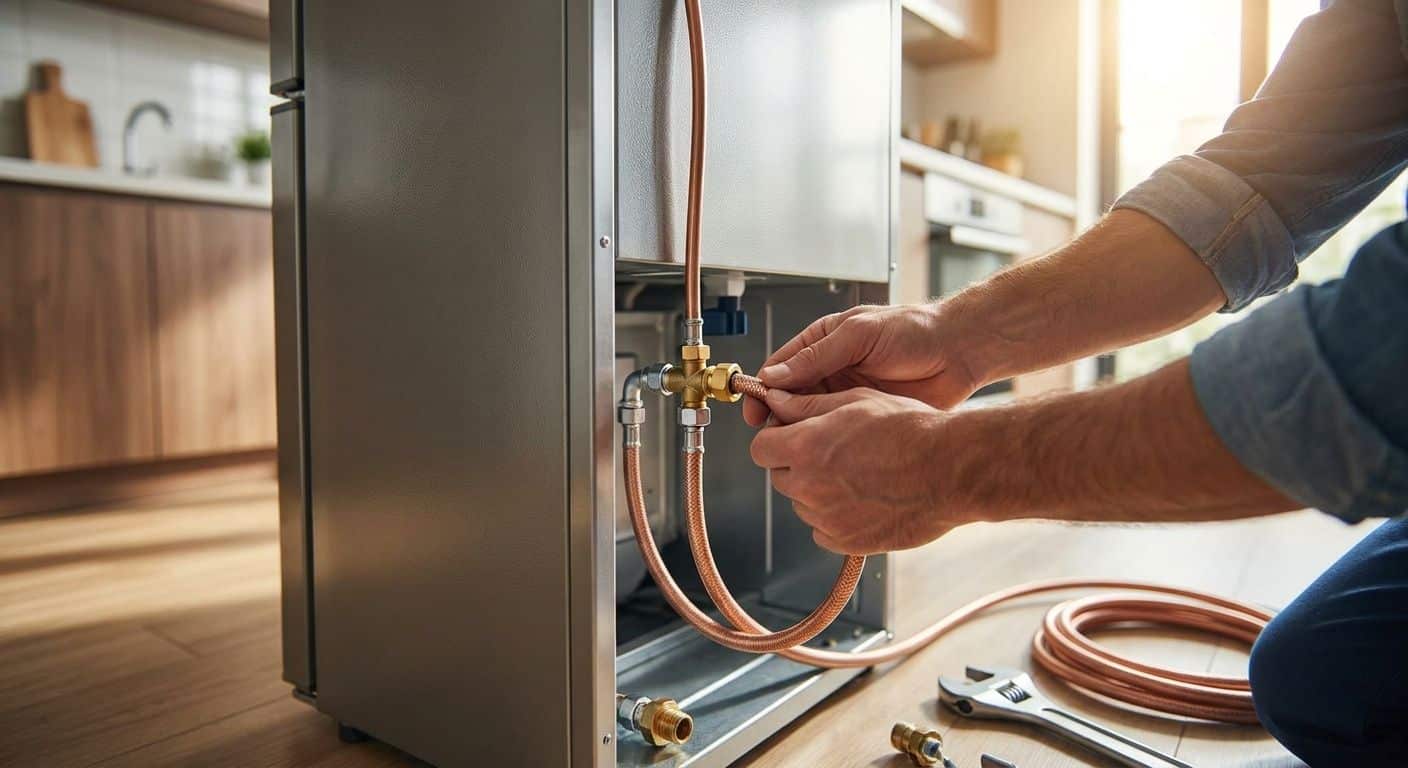
1/4" copper line tied to a dedicated tee — the traditional pick. Copper doesn't degrade, doesn't kink, and lasts decades when installed with a proper compression fitting instead of a saddle valve. It costs more in labor to run than braided line but it's the choice most licensed plumbers still default to for exposed runs. Buy.
PEX tie-in through a finished wall or basement ceiling — the flexible pick. PEX bends around obstacles without extra fittings, which matters in additions or basements where a straight copper run isn't possible. Homes already going through a broader PEX repiping upgrade can extend the ice maker line off the same material. Consider.
Saddle valve tap — the wildcard everyone regrets. It's the fastest install and the cheapest parts, which is exactly why it's still sold at every hardware store. The piercing needle never seals as well as a proper tee, and it's the single most common failure point plumbers find on service calls. Skip.
Softener-fed line for hard water homes — the Utah-specific pick. Tapping the ice maker line off the softened side of a water softener reduces the mineral scale that clogs inlet valves and shortens ice maker lifespan. This adds a step to the install but pays off within a couple of years on hard water systems. Buy.
What to avoid
- Saddle valves on any line that matters. They look like a five-minute fix and turn into a callback within 18 to 24 months on average service history.
- Plastic tubing behind a fridge that gets moved often. Every time the fridge slides out for cleaning, plastic tubing kinks a little more until it splits.
- Tapping the hot water line by mistake. It happens more than people admit, and it sends warm water into the ice tray, which slows freezing and can trip the fridge's internal sensors.
Get the ice maker line installed right
Licensed plumbers for Northern Utah kitchens, remodels, and repairs.
Verdict comparison
| Option | Material cost | Durability | Hard water protection | Verdict |
|---|---|---|---|---|
| Braided stainless line | Low-moderate | High | None built in | Buy |
| Copper tee tie-in | Moderate | Very high | None built in | Buy |
| PEX tie-in | Low-moderate | High | None built in | Consider |
| Saddle valve tap | Very low | Low | None built in | Skip |
| Softener-fed line | Moderate | High | Built in | Buy |
If low water pressure at the kitchen is already an issue before the ice maker install, fix that first — see how to fix low water pressure at home for the usual causes before adding another fixture to the line.
Before any tie-in work starts, know where the main shutoff is. Review how to shut off your home's main water valve in an emergency so a mid-project drip doesn't turn into standing water on the kitchen floor.
FAQ
What’s the best water line for a refrigerator ice maker?
Braided stainless steel or copper are the best choices in 2026 — both outlast plastic tubing and resist kinking behind a fridge that gets moved regularly. Saddle valves and plain plastic tubing are the two most common causes of ice maker line leaks.
Is copper better than PEX for an ice maker line?
Copper is more rigid and holds up slightly longer under repeated fridge movement, while PEX is easier to route through finished walls and additions. Either works well when installed with a proper tee fitting instead of a saddle valve.
How much does ice maker water line installation cost?
Cost depends on the length of run, wall access, and whether a new shutoff valve is needed, and it varies by home. A licensed plumber can give an exact quote after seeing the existing supply line and fridge location.
Can I use a saddle valve for my ice maker?
You can, but it’s the least reliable option and the leading cause of ice maker line failures reported to plumbers. A proper tee fitting with a dedicated shutoff lasts significantly longer.
Why does my ice maker line keep clogging?
Hard water mineral buildup inside the inlet valve is the most common cause in Northern Utah homes. Tying the ice maker line into a water softener loop reduces the scale buildup that causes slow ice production.
Do I need a plumber to install an ice maker water line?
You don’t legally need one for a straightforward tie-in, but incorrect connections are a top cause of hidden water damage behind refrigerators. A licensed plumber ensures the shutoff, tee fitting, and line material meet code and hold up long term.
Where should the ice maker shutoff valve be located?
The shutoff should be accessible without pulling the fridge fully away from the wall, typically in a cabinet or wall box beside the fridge location. This lets you stop water flow quickly if the line ever leaks.
One last thing
Most homeowners never think about the ice maker line again until it fails, and by then it's usually soaked into the subfloor. Tying the line into the softened side of the plumbing system in 2026 is a small addition to any install and it's the single change that most reduces future ice maker valve repairs on Utah's hard water.
Related guides
- Water softener installation for Utah's hard water
- How to prevent hard water damage to pipes and appliances
- PEX repiping for whole-home plumbing upgrades
- Low water pressure repair for older Utah homes
- Gas appliance hookup for kitchen and laundry upgrades