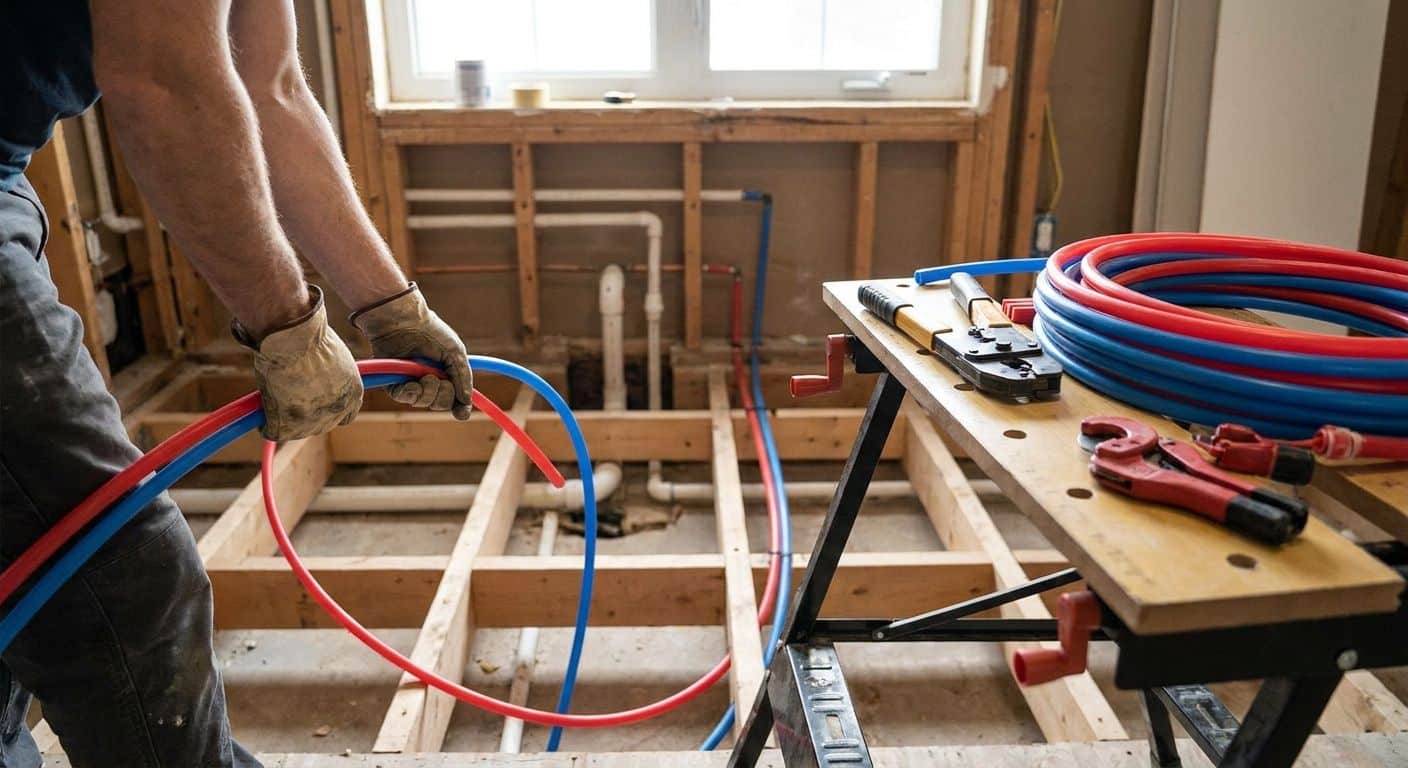
PEX Repiping Whole Home: 2026 Buying Guide & Verdict
August 21st, 2026
Whole-home PEX repiping replaces every water line in a house in one project, and for Northern Utah homes built before 1985, it's usually the difference between one clean job and a decade of emergency plumber calls.
- PEX-A with a manifold system is the safe pick for pex repiping whole home projects in Northern Utah’s hard water: Buy.
- Whole-home PEX repiping in 2026 runs $4,000 to $15,000 and finishes in 2 to 4 days for most single-family houses.
- Galvanized steel pipe installed before 1985 with rust-colored water at multiple fixtures means repipe now, not later.
- Full copper repipe without a water softener is a Skip in hard-water Northern Utah homes prone to mineral buildup.
Why this matters
Galvanized steel pipe corrodes from the inside out, and the process speeds up in areas with the mineral-heavy water common along the Wasatch Front. By the time you see rust at the faucet, the inside diameter of that pipe has often narrowed enough to choke off pressure at every fixture in the house.
Homes built between 1978 and 1995 carry a second risk: polybutylene supply lines, a plastic pipe that became infamous for splitting at the fittings years after install. Neither problem gets better with age. Expert Services licenses plumbers across Northern Utah who see both conditions weekly, and in 2026 PEX has become the standard replacement material for both.
Who whole-home PEX repiping is for
This is for the homeowner with a house built before 1985, galvanized or polybutylene supply lines still in the walls, and a pattern of low pressure, discolored water, or small leaks that keep reappearing in different rooms. It's also for anyone gutting a kitchen or bathroom down to the studs who doesn't want to reopen the same wall in three years for a pipe failure.
It is not for a house under 15 years old running copper or PEX with no history of leaks. If your only symptom is one slow drain or one drippy faucet, that's a repair call, not a whole-home repipe.
What to look for in PEX repiping for a whole-home upgrade
1. Pipe type: PEX-A, PEX-B, or PEX-C
PEX-A is the most flexible of the three and expands enough to survive a freeze without splitting, which matters during Northern Utah's cold snaps. PEX-B is stiffer and slightly cheaper per foot, but it doesn't have the same expansion recovery. PEX-C is rarely used for whole-home work and mostly shows up in short repair runs.
2. Manifold (home-run) system vs. trunk-and-branch
A manifold system runs one dedicated line from a central manifold to each fixture, so a shutoff at the manifold isolates a single sink or toilet without killing water to the rest of the house. Trunk-and-branch splits off a main line at tee fittings, which costs less in material but means more fittings hidden behind drywall. For a full repipe, that's the tradeoff worth pricing both ways.
3. Fitting type and code compliance
PEX-A uses expansion fittings; PEX-B uses crimp or cinch rings. Whatever the fitting, it needs to meet ASTM F1807 or ASTM F2159 standards, and the installer should be pulling a permit in your city. A repipe without a permit becomes a disclosure problem the day you list the house.
4. Hard water and mineral scale resistance
PEX doesn't corrode or pit the way copper can under hard water conditions, and it doesn't develop the pinhole leaks that show up in copper systems fed by mineral-heavy supply. If your home already shows scale buildup on fixtures, that's a second data point pointing toward PEX over a copper repipe.
5. Permit requirements and inspection
Utah plumbing code requires a permit and inspection for a whole-home repipe in most municipalities. Skipping this step to save time creates a liability that surfaces later, usually during a home sale when a buyer's inspector asks for permit history that doesn't exist.
Top picks for whole-home PEX repiping
The safe pick: PEX-A with a home-run manifold system. Each fixture gets its own dedicated line back to a central manifold, so there's no fitting hidden inside a wall between the manifold and the faucet. PEX-A's expansion memory means a frozen line is far less likely to split compared to rigid pipe. Verdict: Buy for any whole-home repipe in a house with a history of freeze events or hard water.
The budget pick: PEX-B trunk-and-branch. Material costs less per foot, and the layout follows a similar path to the pipe already in the walls, which can shorten labor time on some jobs. The downside is more fittings buried in the framing, each one a potential future access point if something fails. Verdict: Consider if budget is the deciding factor and the plumber backs the fittings in writing.
The wildcard: hybrid repipe with PEX supply lines and copper stub-outs at fixtures. This keeps a copper look at exposed connections while running PEX through the walls and under the floor where it's never seen. It costs more than a straight PEX job because it uses two materials and two labor processes. Verdict: Consider only if a specific fixture or code requirement calls for exposed copper.
The pairing pick: PEX repipe plus a water softener. PEX solves the pipe-corrosion side of hard water, but it doesn't stop scale from building up inside water heaters, fixtures, and appliances. Pairing a whole-home repipe with a water softener installation addresses both problems from the same renovation. Verdict: Buy for any Northern Utah home showing white scale on fixtures or hard-water damage to appliances.
Get a whole-home repipe estimate
Licensed plumbers evaluate your pipe material and quote the job in one visit.
What to avoid when repiping a whole home
- Full copper repipe with no water softener in a hard-water home. Copper is more prone to pinhole leaks under mineral-heavy water over time, and a repipe is the wrong moment to reintroduce that risk.
- Non-certified crimp rings or off-brand fittings. If a fitting doesn't carry ASTM F1807 or F2159 certification, it doesn't belong in a whole-home job, no matter what it saves on the invoice.
- Skipping the permit to save a week. An uninspected repipe is a red flag for any buyer's inspector and can complicate insurance claims if a leak happens later.
“If your home still has galvanized pipe from before 1985, the question is not if it fails, it is when.”
Verdict comparison: PEX-A vs. PEX-B vs. hybrid vs. copper
| Approach | Cost tier | Freeze resistance | Hard water fit | Verdict |
|---|---|---|---|---|
| PEX-A manifold | Mid-high | Best (expands without splitting) | Strong | Buy |
| PEX-B trunk-and-branch | Lowest | Moderate | Strong | Consider |
| Hybrid PEX/copper | Highest | Moderate | Moderate | Consider |
| Full copper repipe | High | Weak in freeze events | Weak without softener | Skip |
FAQ
What is pex repiping whole home and how does it work?
Whole-home PEX repiping replaces every water supply line in a house with flexible cross-linked polyethylene pipe in a single project. Most single-family homes finish in 2 to 4 days, running new lines through existing wall and floor cavities.
How long does a whole-home PEX repipe take?
Most single-family homes take 2 to 4 days for a full repipe in 2026, depending on square footage and the number of fixtures. Multi-story homes or finished basements can add a day or two for wall access.
Is PEX repiping better than copper for Utah’s hard water?
Yes, PEX resists the mineral scale buildup and pitting that hard water can cause inside copper pipe over time. Copper repipes are still an option but usually need a water softener to hold up as well as PEX in hard-water homes.
How much does whole-home PEX repiping cost in 2026?
Whole-home PEX repiping typically runs $4,000 to $15,000 in 2026, depending on home size, number of fixtures, and wall access. A manifold system with a home-run layout usually costs more upfront than trunk-and-branch.
Can I repipe just part of my home instead of the whole house?
Yes, partial repipes are common for a single bathroom or kitchen remodel. A whole-home repipe makes more sense when galvanized or polybutylene pipe runs through most of the house rather than one isolated section.
Does PEX repiping require a permit in Utah?
Most Northern Utah municipalities require a permit and inspection for a whole-home repipe. Skipping the permit can create problems with insurance claims and home sale disclosures later.
What is the difference between PEX-A and PEX-B?
PEX-A uses expansion fittings and has more freeze resistance because it stretches and recovers its shape. PEX-B uses crimp or cinch fittings, costs slightly less per foot, and is stiffer with less expansion memory.
Will repiping fix low water pressure?
Repiping fixes low water pressure caused by corroded or scaled-up galvanized pipe restricting flow. It won’t fix pressure problems coming from the municipal supply line or a failing pressure regulator, which need separate diagnosis.
One last thing
PEX-A's real advantage shows up during a hard freeze, not on a spec sheet: the pipe expands as water freezes inside it and contracts back afterward instead of splitting. That single property is why more Northern Utah repipe jobs specify PEX-A over PEX-B or copper going into 2026, especially in unheated crawl spaces and garage runs.
Related guides