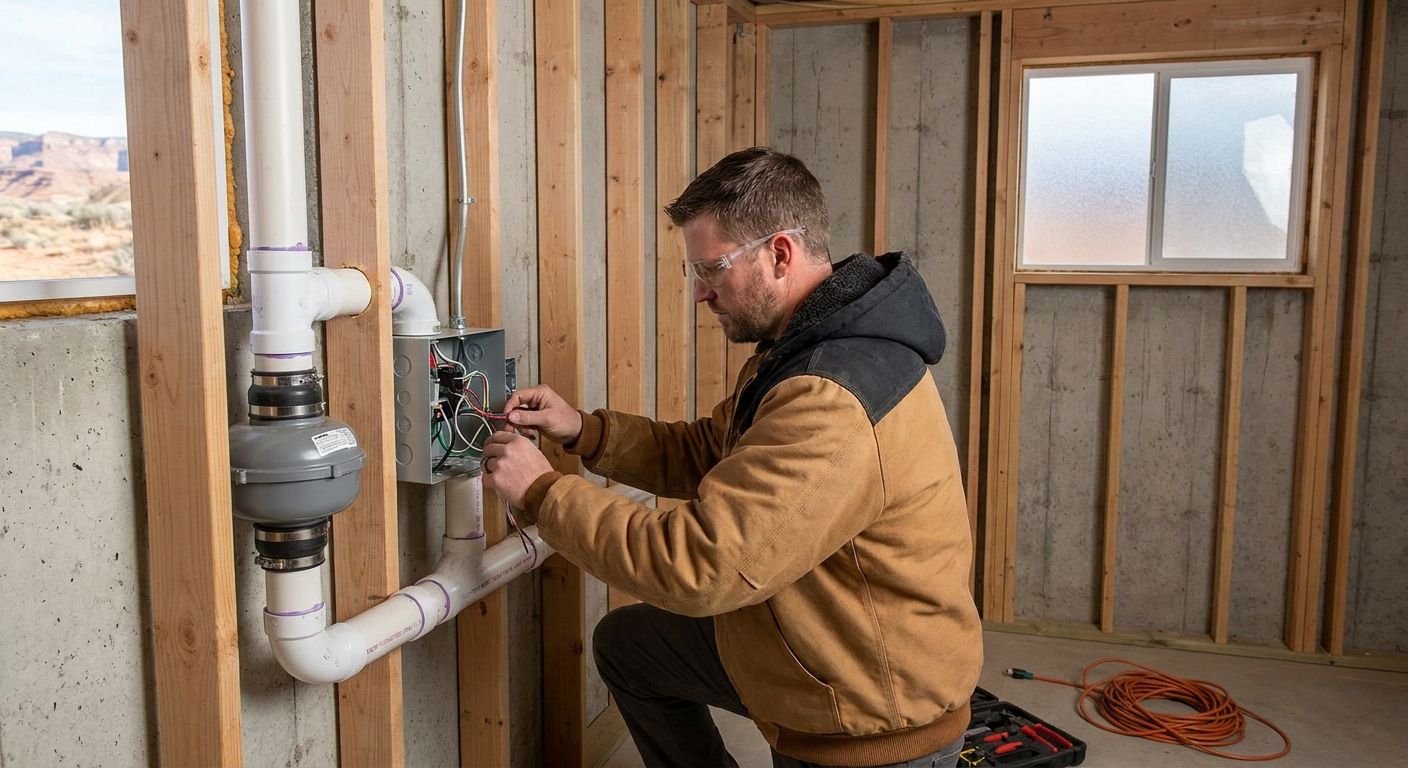
Radon Mitigation Electrical Hookup for Utah Basements 2026
September 2nd, 2026
Utah basement radon mitigation system electrical hookup is the dedicated 120-volt circuit, disconnect switch, and code-compliant labeling that lets a sub-slab depressurization fan run continuously without tripping a breaker shared with the sump pump or furnace. Wasatch Front homes test above the EPA's 4 pCi/L action level often enough that mitigation systems are a common retrofit in 2026, and most go into basements that are already finished, which changes how the wiring gets routed compared to new construction.
- Radon fans in Utah basements need a dedicated 15-20 amp circuit, not a shared sump pump outlet.
- A local disconnect switch near the fan is standard practice under AARST/ANSI RMS-Rn mitigation guidance.
- GFCI protection applies when the fan sits in a garage, exterior wall, or damp location per NEC 210.8.
- Licensed electrical work is the faster, code-verified path once fan location and circuit routing are decided.
Why radon mitigation electrical hookup matters for Utah basements
Utah sits largely inside the EPA's highest-risk radon zone designation, and a meaningful share of Wasatch Front basements test above the 4 pCi/L action level that triggers a mitigation recommendation. The fan that fixes that reading only works if the electrical hookup behind it is sized and protected correctly.
Basements are where the fan usually lives, whether inline in a mechanical room or mounted against the exterior foundation wall, and both spots sit within reach of sump pumps, furnaces, and other 120V loads already pulling on the same panel legs. If your panel is already maxed out, an electrical panel upgrade needs to happen before a new dedicated circuit goes in, not after. Get the circuit wrong and the fan cycles off exactly when radon levels spike overnight – the opposite of what the system exists to do.
Read the fan's electrical nameplate first
Every radon fan ships with a nameplate that tells you exactly what the circuit needs to deliver. Skip this step and every downstream decision is a guess.
- Check the listed voltage (almost universally 120V for residential radon fans)
- Note the amp draw and whether the manufacturer specifies a dedicated circuit
- Confirm mounting orientation – inline attic fans vs. exterior wall mounts change wire routing
- Photograph the nameplate for the electrician and for the inspector's file
Map your panel before you run any wire
A panel schedule that's out of date is how radon fans end up sharing a leg with the sump pump by accident.
- Open the panel and identify open slots vs. used legs
- Label existing circuits if they aren't already, on a printed schedule
- Confirm the sump pump, furnace, and any dehumidifier are not sharing the leg you plan to use
- If the panel is full or undocumented, resolve that before touching the fan circuit
Decide whether GFCI protection applies
GFCI requirements depend on where the fan physically sits, not just what room it's in.
- Exterior-mounted fans need GFCI protection under NEC 210.8 for outdoor receptacles
- Attic or crawlspace fans in damp conditions often need it too
- Basement mechanical room fans on a dry, conditioned wall typically don't require it unless local amendments say otherwise
- When the location is borderline, wiring in GFCI outlet installation removes the ambiguity for a home inspector later
Add a local disconnect switch
A disconnect is what lets a technician kill power to the fan without hunting through the panel first.
- Mount a visible, lockable disconnect within sight of the fan
- ANSI/AARST RMS-Rn mitigation guidance treats a readily accessible disconnect as standard practice
- Keep it clear of ductwork, shelving, or storage boxes
- Label it "Radon Fan – Do Not Turn Off"
Label the circuit at the panel
An unlabeled breaker is the single most common reason a working radon system gets shut off by accident.
- Write "Radon Mitigation Fan" on the panel schedule and on the breaker itself
- Flag the circuit clearly for any future electrician working in the panel
- Note the labeling in real estate disclosure paperwork if the home ever sells
- Keep a copy of the schedule with your mitigation system documents
Route and terminate the wiring to code
Wire gauge and sealed penetrations matter as much as the circuit itself.
- Match wire gauge to breaker size (12 AWG for 20A, 14 AWG for 15A)
- Seal any wall or slab penetration the cable passes through so the radon barrier stays intact
- Use weatherproof boxes and connectors on any exterior run
- Keep the run as short and direct as practical to limit voltage drop
Test and confirm after energizing
Wiring that passes inspection isn't the same as a system that's actually working.
- Run the fan and confirm steady airflow at the manometer or U-tube gauge
- Verify the breaker holds under normal household load, including the sump pump cycling on
- Schedule a post-mitigation radon test 24-48 hours after fan startup
- Keep the test results filed with your mitigation system paperwork
Schedule your radon fan wiring
Get the circuit, GFCI, and disconnect installed correctly in one visit.
Comparing your options for the electrical hookup
| Option | Best for | Key limitation |
|---|---|---|
| DIY dedicated circuit | Homeowners comfortable pulling a permit and reading NEC basics | Utah requires a licensed electrician for new circuits in most jurisdictions – DIY often fails inspection |
| General handyman | Minor fixes, not new panel-connected circuits | Usually not licensed for circuit work; liability and code risk |
| Licensed electrician | Getting the circuit, GFCI, and disconnect installed correctly the first time | Requires scheduling a visit |
| Mitigation company's electrical add-on | Bundling fan install and wiring in one appointment | Electrical work quality varies by contractor – verify licensing separately |
Verdict: a licensed electrician wins on a radon mitigation system electrical hookup because the disconnect, GFCI decision, and labeling all need to pass inspection on the first try, not the second.
Common mistakes Utah homeowners make with radon fan wiring
- Wiring the fan into the same outlet as the sump pump, so one nuisance trip kills both systems at once
- Skipping the disconnect switch, which fails inspection under many county mitigation permit reviews
- Drilling new cable penetrations through the sealed slab or rim joist without resealing them, reopening the exact path the system was built to close
- Mounting the fan and its wiring inside living space instead of an attic, garage, or exterior wall, ignoring the clearances printed on the nameplate
- Leaving the breaker unlabeled, so it gets shut off during an unrelated remodel and nobody notices for weeks
If a finished basement remodel is already on the calendar, sequence the electrical rough-in before drywall goes back up – run the radon fan circuit, disconnect, and GFCI protection while the walls are open instead of cutting into finished surfaces later. The same logic behind planning mitigation before a basement remodel applies here: sequencing electrical work ahead of finish work turns two visits into one.
FAQ
Does a radon fan need its own dedicated circuit?
Yes, a radon mitigation fan should run on its own dedicated circuit, not shared with a sump pump, furnace, or other appliance. A shared circuit means one nuisance trip shuts down both systems at the same time.
Is GFCI protection required for radon mitigation fans in Utah?
GFCI protection is required when the fan is mounted outdoors or in a damp location under NEC 210.8. Fans mounted in a dry, conditioned basement mechanical room typically don’t need it unless a local code amendment says otherwise.
Can a radon fan share power with a sump pump?
No, sharing a circuit between a radon fan and a sump pump is one of the most common wiring mistakes in Utah basements. A single overload or nuisance trip disables both systems during exactly the moment they’re needed most.
Where should the electrical disconnect for a radon fan go?
The disconnect should be mounted within sight of the fan, in a location clear of storage or ductwork so a technician can reach it without hunting through the panel. Labeling it clearly prevents it from being switched off by accident.
Does Utah require a licensed electrician for radon fan wiring?
Most Utah jurisdictions require a licensed electrician and a permit for any new panel-connected circuit, which includes a radon fan hookup. DIY circuit work commonly fails inspection on GFCI or disconnect requirements.
What breaker size does a radon mitigation fan need?
Most residential radon fans run on a standard 15 or 20 amp, 120-volt dedicated circuit, matched to 14 or 12 AWG wire respectively. The fan’s nameplate confirms the exact amp draw for your specific model.
What happens if a radon fan keeps tripping the breaker?
A radon fan that repeatedly trips its breaker usually means it’s sharing a circuit with another load or the wire gauge doesn’t match the breaker size. Moving it to a properly sized dedicated circuit resolves most recurring trips.
One last thing
Utah's attics swing from below freezing to well over 100 degrees within the same year, and a lot of radon fans end up wired inside exactly that space. Standard interior-rated electrical boxes crack or trap condensation under that swing – spec a damp-location box even for an "indoor" attic install, and the wiring outlasts two Utah winters without a callback.
Related guides
- Circuit breaker repair for homes with frequent trips
- Best dehumidifiers for Utah basements
- How to map and label your home's electrical panel