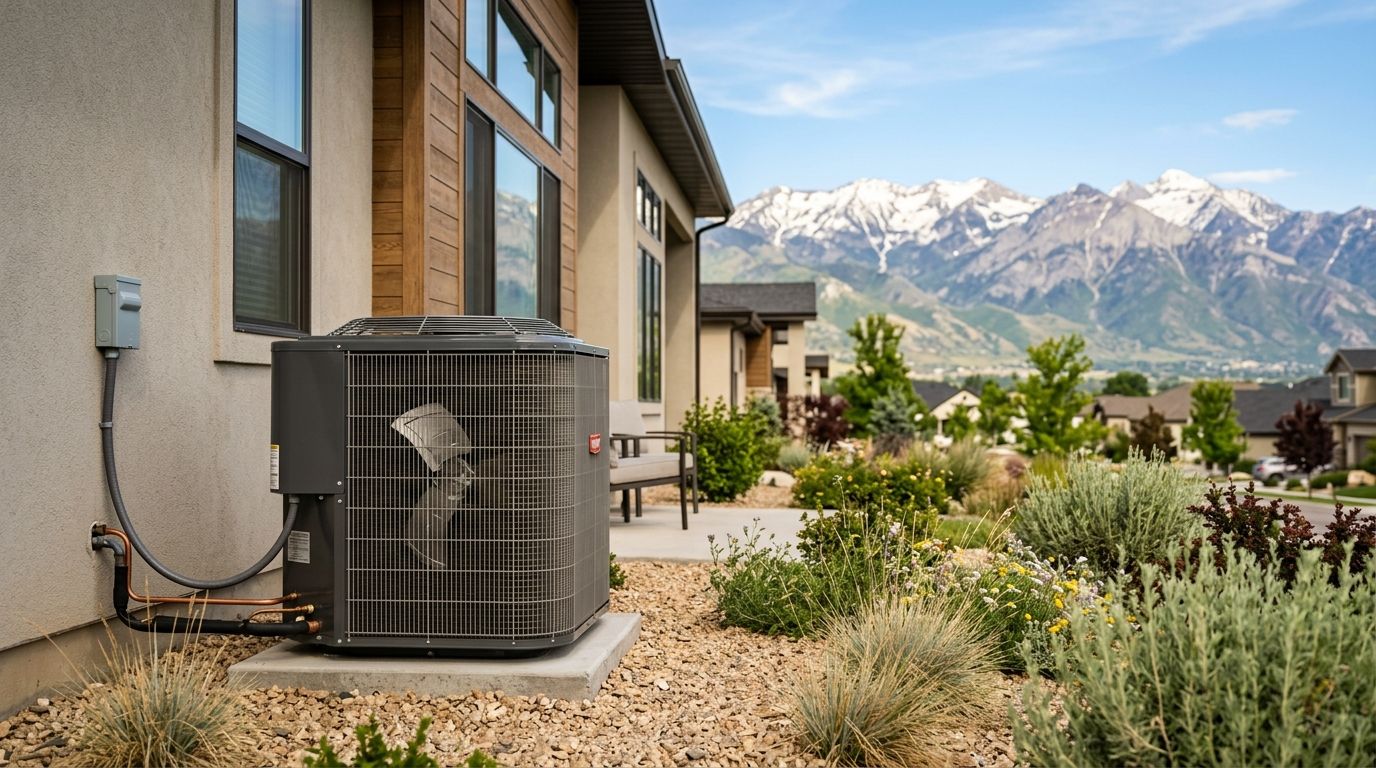
Best Air Conditioners for Utah Homes 2026: Central AC Wins
September 7th, 2026
Utah summers push AC systems past 95degF for weeks at a time along the Wasatch Front, and picking the wrong system means a unit that runs constantly or one that short-cycles and leaves rooms sticky. Central split-system AC wins for most existing single-family homes in Northern Utah in 2026, but heat pumps, ductless mini-splits, variable-speed systems and packaged units each solve a different problem.
- Central split-system AC is the best air conditioner for Utah homes with existing ductwork in 2026.
- Heat pumps win on year-round efficiency by handling both heating and cooling from one outdoor unit.
- Ductless mini-splits are the fix for additions, garages, and rooms without ducts.
- Variable-speed AC controls humidity and dust better in multi-story Utah homes.
- Packaged units suit condos and homes with no yard space for a full split system.
Why this matters
Utah's climate is dry heat, not humid heat, which changes what actually matters in an AC. High summer temperatures paired with low humidity and elevation swings mean oversized units short-cycle without ever pulling moisture out of the air, and undersized units run around the clock without catching up. Northern Utah homes also swing from freezing winters to 95-plus summers, which is why a lot of homeowners here end up comparing air conditioners against heat pumps rather than just AC-to-AC. Get more detail on the full range of options in best home HVAC systems for Utah homes before locking in a pick.
The right choice in 2026 depends less on brand and more on three things: whether the home already has ductwork, how many stories it has, and whether the goal is cooling only or year-round comfort.
What makes the best air conditioner for a Utah home
- SEER2 efficiency rating — higher-efficiency units cost less to run through July and August peak-demand months.
- Correct sizing (Manual J load calc) — an oversized unit cools fast but never removes humidity; an undersized one runs nonstop.
- Ductwork condition — leaky or undersized ducts waste capacity no matter how good the outdoor unit is.
- Humidity and dust handling — dry Utah air still carries fine dust and wildfire smoke in late summer, so airflow control matters.
- Noise level — matters more in tighter suburban lots common across Salt Lake, Davis, and Utah counties.
- Year-round use — a heat pump earns its keep in Utah's cold winters in a way a cooling-only AC never will.
Air conditioner options for Utah homes: at a glance
| Type | Best for | Standout feature | Key limitation |
|---|---|---|---|
| Central split-system AC | Whole-home cooling with existing ducts | Even cooling across every room | Needs functional, sealed ductwork |
| Heat pump | Year-round heating and cooling | One system replaces AC and furnace | Loses some efficiency in deep cold snaps |
| Ductless mini-split | Additions, garages, rooms without ducts | No ductwork required | Only cools the zones with an indoor head |
| Variable-speed AC | Multi-story homes, humidity/dust control | Runs longer at lower speed for steadier air | Higher upfront complexity to install correctly |
| Packaged unit | Condos, small lots, limited yard space | Everything in one outdoor cabinet | Fewer efficiency tiers than split systems |
1. Central split-system AC: best air conditioner for whole-home cooling
A central split system pairs an outdoor condenser with an indoor coil that ties into existing ductwork, cooling every room from one thermostat. For a Utah home built with forced-air ducts already in place, this is still the default answer in 2026 because it distributes air evenly without adding indoor units room by room.
Central split-system AC pros:
- Cools the whole house from a single thermostat
- Wide range of SEER2 efficiency tiers to match budget and usage
- Familiar technology for local technicians, which keeps repair turnaround fast
- Works with existing ductwork, no structural changes needed
Central split-system AC cons:
- Only as good as the ducts it's attached to — leaky or crushed ductwork cuts real-world efficiency
- Cooling only, unless paired with a separate furnace
- Requires outdoor space for the condenser unit
Best for: single-family Utah homes with existing, intact ductwork.
Verdict: Buy if ducts are in good shape; get them inspected first if the house is older.
2. Heat pump: best air conditioner for year-round efficiency
A heat pump moves heat instead of generating it, cooling the house in summer and reversing to heat it in winter from the same outdoor unit. In Utah's shoulder seasons, spring and fall, a heat pump does most of its work far more efficiently than a gas furnace pairing with a separate AC.
More detail on sizing and installation is covered in heat pump installation for energy-efficient Utah homes.
Heat pump pros:
- Handles both heating and cooling from one system
- Strong efficiency in mild and moderate temperatures
- Reduces reliance on a separate furnace for most of the year
- Fits homes already looking to cut gas usage
Heat pump cons:
- Efficiency drops in extended sub-freezing stretches, common in Northern Utah's coldest weeks
- Often paired with backup heat for the coldest days, adding a second system to maintain
- Higher upfront installation complexity than a straight AC swap
Best for: homeowners replacing an aging furnace and AC at the same time who want one system for both jobs.
Verdict: Buy for year-round efficiency; pair with backup heat for January cold snaps.
3. Ductless mini-split: best air conditioner for additions and rooms without ducts
A ductless mini-split runs refrigerant lines from an outdoor compressor to one or more wall-mounted indoor heads, cooling specific rooms without any ductwork. This is the answer for finished basements, garage conversions, sunrooms, and additions built after the original ductwork was sized.
See ductless mini-split systems for home additions for how zoning works room by room.
Ductless mini-split pros:
- No ductwork required, minimal wall penetration
- Each zone runs independently, so unused rooms don't cost anything to condition
- Fast install compared to extending existing ducts
- Works as a standalone system or supplement to central AC
Ductless mini-split cons:
- Only cools rooms with an indoor head installed
- Indoor units are visible on the wall, which some homeowners don't want
- Whole-home coverage requires multiple heads, adding cost and complexity
Best for: additions, garages, and rooms the main system doesn't reach.
Verdict: Buy for targeted zones; Skip if the goal is whole-home cooling from one system.
4. Variable-speed AC: best air conditioner for humidity and dust control
Variable-speed and two-stage compressors run longer at lower output instead of blasting full-speed and shutting off, which pulls more moisture and fine dust out of the air over a cooling cycle. In multi-story Utah homes, this also evens out the temperature gap between upstairs and downstairs that single-stage units struggle with.
Zoning multi-story homes gets a full breakdown in zoned HVAC systems for multi-story Utah homes.
Variable-speed AC pros:
- Steadier indoor temperature with fewer swings
- Better humidity and dust control during smoke-heavy late summer stretches
- Quieter operation since it rarely runs at full blast
- Pairs well with zoning for multi-story homes
Variable-speed AC cons:
- Costs more upfront than single-stage equipment
- Needs a technician familiar with variable-speed controls for proper setup
- Diagnosing issues takes more expertise than a standard single-stage unit
Best for: two- and three-story Utah homes with uneven floor-to-floor temperatures.
Verdict: Buy for multi-story comfort problems; Hold if a single-story home already cools evenly.
5. Packaged unit: best air conditioner for condos and tight lots
A packaged unit combines the compressor, coil, and blower into one outdoor cabinet, usually mounted on a roof or slab, instead of splitting components between indoor and outdoor units. It's a common fit where there's no room for a separate condenser pad or when ductwork runs through a crawlspace instead of an attic.
Packaged unit pros:
- One cabinet handles cooling (and heating, in gas-pack versions), simplifying the footprint
- Good fit for condos, townhomes, and lots with limited side-yard space
- Keeps all major components accessible from one spot for service
Packaged unit cons:
- Fewer high-efficiency tiers available compared to split systems
- Outdoor exposure means more wear on components that would otherwise sit indoors
- Less common locally, which can mean fewer techs stock parts for every model
Best for: condos, townhomes, and homes with no side-yard space for a split condenser.
Verdict: Buy for space-constrained properties; Skip if a standard side yard is available for a split system.
Get the right AC sized for your home
A load calculation before you buy prevents an oversized or undersized system.
How this list was ranked
Each system was weighed against the six criteria above: efficiency rating, sizing accuracy, ductwork compatibility, humidity/dust handling, noise, and year-round usability. No two items compete for the same use case — each one owns a distinct job, from whole-home cooling to a single finished basement room.
Which air conditioner should you choose?
If the ductwork is sound and the goal is whole-home cooling, central split-system AC is still the default pick for Utah homes in 2026. If the furnace is also due for replacement, a heat pump does both jobs from one outdoor unit. For an addition or a room the main system never reaches, a ductless mini-split solves it without touching existing ducts, and a variable-speed system is the upgrade path for homes with uneven multi-story temperatures.
Whatever the pick, get it sized against the house, not against a generic square-footage chart. An oversized AC that's too big for the load cycles on and off constantly and never really dries the air out; guessing at tonnage is the single most common reason a new AC underperforms in its first Utah summer.
FAQ
What’s the best air conditioner for a Utah home in 2026?
Central split-system AC is the best fit for most Utah homes with existing ductwork in 2026 because it cools the whole house evenly from one thermostat. Homes without ducts or wanting year-round efficiency should look at ductless mini-splits or heat pumps instead.
Is a heat pump better than a regular AC in Utah?
A heat pump beats a standard AC on year-round value because it heats in winter and cools in summer from one system. It loses some efficiency in extended sub-freezing stretches, so many Utah installs pair it with backup heat.
Do ductless mini-splits work well in Utah’s dry heat?
Yes, ductless mini-splits handle Utah’s dry summer heat well since they cool specific zones directly without relying on ductwork. They’re the standard fix for additions, garages, and finished basements built after the original ducts were sized.
How do I know what size AC my Utah home needs?
AC sizing should come from a Manual J load calculation, not a square-footage rule of thumb. An oversized unit short-cycles and leaves humidity behind, while an undersized one runs nonstop without catching up.
What SEER2 rating should I look for in Utah?
Higher SEER2 ratings cut cooling costs during Utah’s peak demand months of July and August. The right tier depends on how many hours per day the system runs and how long you plan to stay in the home.
Can a variable-speed AC help with wildfire smoke and dust?
Variable-speed AC runs longer cycles at lower output, which filters more air over time than a single-stage unit blasting full speed and shutting off. That matters during late-summer smoke stretches common along the Wasatch Front.
Is a packaged AC unit a good fit for a condo?
Packaged units work well for condos and townhomes with no side-yard space for a split condenser, since everything sits in one outdoor cabinet. They come with fewer high-efficiency tiers than split systems, so weigh that against the space savings.
How often should an AC be serviced in Utah?
A yearly tune-up before peak summer heat catches worn parts before they fail during a 95-degree stretch. Skipping maintenance is one of the most common reasons an AC won’t turn on when it’s needed most.
One last thing
The detail most homeowners miss isn't the brand or the SEER2 number — it's that Utah's dry air means humidity removal matters less than in the Midwest or South, so a single-stage unit that cools fast without long run times is often fine for a single-story home, while multi-story houses genuinely need the longer, steadier cycles of a variable-speed system to fix the upstairs-downstairs temperature gap.
Related guides
- How to fix an AC that won't turn on
- AC repair in Sandy, Utah
- Best furnace filters for Utah air quality