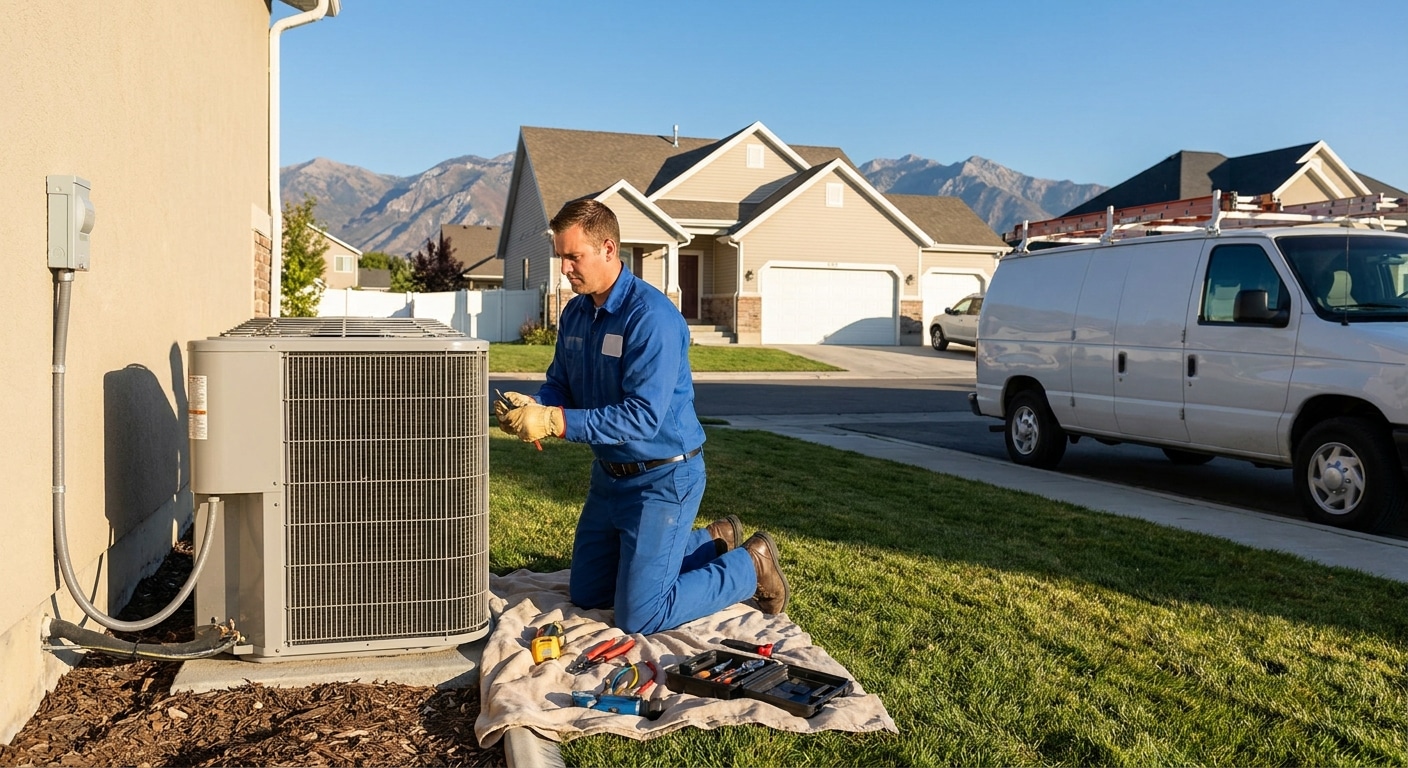
AC Repair in Sandy, Utah: 2026 Repair vs Replace Guide
August 12th, 2026
Summer highs above 95 degrees in Sandy hit hard when a compressor stalls or a capacitor blows, and knowing what separates a $150 fix from a $4,000 mistake saves you from calling three different contractors before someone tells you the truth.
- AC repair in Sandy, Utah costs less than replacement in most cases when the unit is under 10 years old — repair first.
- Capacitor and contactor failures cause the majority of no-cool calls in Sandy homes each July and August.
- R-22 systems installed before 2010 face rising refrigerant costs — plan for replacement, not repeated recharges.
- Expert Services flags compressor failure on units past 12 years as a replace signal, not a repair signal.
Why this matters
Sandy sits in the Salt Lake Valley heat pocket, and homes built before 2010 still run a mix of R-22 and early R-410A systems that behave differently under stress. A unit that limps along in June can fail outright during a July heat wave, and the difference between a same-day fix and a five-day wait often comes down to knowing what's actually broken before the technician arrives.
Misdiagnosis costs homeowners money twice: once for the wrong repair, again for the right one. Expert Services handles HVAC repair and installation across Northern Utah, and the pattern in Sandy is consistent — most no-cool calls trace back to three or four repeatable failures, not mystery problems.
Who this is for
This guide is for Sandy homeowners with a central AC system that's stopped cooling, is cooling unevenly, or is making noise it didn't make last summer. It applies whether your system is five years old and under warranty or fifteen years old and on its last refrigerant charge. If you're building new construction or adding a room addition, the calculus shifts toward installation guidance, not repair triage.
What to look for in AC repair for Sandy homeowners
Licensing and insurance specific to Utah
Utah requires HVAC contractors to hold a state license, and insurance coverage protects you if a technician damages ductwork or a roof unit during service. Ask for the license number before scheduling — a legitimate contractor gives it without hesitation.
Flat-rate diagnostics, not hourly guessing
A flat diagnostic fee tells you the total cost before work starts. Hourly billing on diagnostics creates an incentive to take longer, and in a market where every HVAC company in the valley competes for the same summer calls, transparent pricing is the difference-maker.
Same-week or same-day availability in peak season
July and August push demand past what most crews can handle same-day. A company that can commit to a 24-48 hour window during peak season, rather than a vague "we'll call you," is worth prioritizing over one with a lower quoted price and no timeline.
Experience with R-22 and mixed-refrigerant systems
Sandy has plenty of homes built in the 1990s and early 2000s still running R-22. Since the 2020 phase-out, virgin R-22 costs far more than R-410A, and a technician unfamiliar with legacy systems may recommend a full recharge when a seal repair would have solved the leak for less.
Manufacturer-backed parts and workmanship warranty
A repair without a written warranty is a bet. Ask what's covered and for how long — reputable HVAC work in Utah typically carries at least a one-year labor warranty, longer on major components like compressors.
Local reviews tied to your specific neighborhood
Sandy spans everything from older Fort Union-area homes to newer builds near Alta Canyon. A company with recent, verifiable work in your part of the city has already dealt with the specific ductwork quirks and HOA scheduling rules your neighborhood presents.
Get your AC diagnosed today
Licensed HVAC technicians serving Sandy and Northern Utah.
Most common AC problems in Sandy homes, and what they mean
The capacitor failure — the routine fix. A dual-run capacitor typically lasts 5-10 years, and in Sandy's heat cycle, that clock runs faster on units that cycle constantly through July and August. Symptom: the outdoor unit hums but the fan won't spin. Verdict: Repair now — this is a same-day, low-cost fix in most cases.
The refrigerant leak on an R-22 system — the judgment call. If your system is pre-2010 and low on charge, a technician has to weigh the cost of increasingly expensive R-22 against the age of the unit. A leak that recurs after a second recharge is a signal, not a coincidence. Verdict: Monitor closely, budget for replacement — see best home HVAC systems for Utah homes for what typically replaces an aging R-22 unit.
The failed contactor or relay — the silent killer. A stuck or burned contactor can leave your outdoor unit running nonstop even when the thermostat is satisfied, spiking your power bill before it fails completely. This part costs little but gets missed by homeowners who assume the whole system is dying. Verdict: Repair now.
The compressor failure on a unit past 12 years — the expensive one. A dead compressor is the single most common trigger for a replacement conversation instead of a repair conversation, because compressor replacement alone can run close to the cost of a new system once labor and refrigerant are factored in. Verdict: Replace, don't repair, especially if the unit is already past its typical 12-15 year service life.
“If your AC is over 12 years old and needs a compressor, replacement beats repair almost every time.”
If you're weighing repair against replacement and the numbers point toward a new install anyway, staying with central AC isn't the only route — for additions or rooms without existing ductwork, ductless mini-split systems solve the cooling problem without tearing into walls.
What to avoid
- The "we'll just top off your refrigerant" quote with no leak search. Refrigerant isn't consumed like oil — if it's low, it's leaking somewhere, and a top-off without finding the leak just delays the next service call.
- A quote that skips the diagnostic fee entirely. Free diagnostics sound generous but often come bundled into an inflated repair price. A flat, disclosed diagnostic fee is more honest than a "free" one that isn't.
- Same-day full-system replacement pitches on a first visit. A technician who diagnoses compressor failure and pivots straight to a full-system sales pitch, without discussing repair cost first, is optimizing for the bigger ticket, not your budget.
If you're building new or planning an addition rather than repairing an existing system, the calculus changes — AC installation guidance for new construction covers sizing and equipment selection instead of repair triage.
Verdict comparison
| Criteria | What good looks like | Red flag |
|---|---|---|
| Licensing | State HVAC license shown on request | Vague or refuses to share license number |
| Pricing | Flat diagnostic fee, itemized repair quote | Hourly billing with no upfront estimate |
| Availability | 24-48 hour window in peak season | "We'll call you back" with no timeline |
| Refrigerant expertise | Comfortable quoting R-22 and R-410A separately | Recommends recharge without leak search |
| Warranty | 1+ year labor warranty in writing | No warranty offered or verbal only |
Sandy homeowners searching for ac repair sandy utah in 2026 are mostly dealing with one of the four failures above — capacitor, refrigerant leak, contactor, or compressor. Matching the fix to the failure, not the other way around, is what keeps a repair bill under a few hundred dollars instead of climbing toward replacement cost.
For homeowners in the same city dealing with plumbing emergencies alongside HVAC issues, the emergency plumber in Sandy, Utah guide covers the same kind of triage for burst pipes and water heater failures.
FAQ
What’s the average cost of AC repair in Sandy, Utah?
Most routine AC repairs in Sandy, Utah — capacitors, contactors, and minor refrigerant leaks — fall well below the cost of a compressor replacement or full system swap. Major component failures on units past 12-15 years often push the cost calculus toward replacement instead.
Is it worth repairing an AC unit older than 12 years?
It depends on what failed. A capacitor or contactor is almost always worth repairing regardless of age, but a compressor failure on a unit past 12-15 years usually isn’t, since replacement cost approaches the price of a new system.
How long does AC repair take in Sandy during peak summer?
Simple fixes like capacitor or contactor replacement typically finish same-day once a technician is on site. Peak-season scheduling in July and August can push the appointment itself to a 24-48 hour window depending on demand.
Why is my Sandy home’s AC losing refrigerant every year?
Refrigerant doesn’t get consumed during normal operation, so an annual low-charge issue means there’s an active leak somewhere in the line set or coil. A repeat top-off without a leak search just delays the same call next summer.
Should I repair or replace an R-22 AC system?
R-22 was phased out of production in 2020, and virgin refrigerant for legacy systems costs significantly more than R-410A. A single small leak repair can still make sense, but a system with recurring leaks is a strong case for replacement.
What’s the most common reason an AC stops cooling in Sandy homes?
Capacitor failure is the most frequent cause of a no-cool call during Sandy’s peak summer heat, since constant cycling in 95-degree-plus weather wears capacitors faster than milder climates.
Do I need a licensed contractor for AC repair in Utah?
Yes. Utah requires HVAC contractors to hold a state license, and using an unlicensed technician removes the insurance protection that covers accidental damage during a repair.
Is ductless mini-split a good alternative to repairing central AC?
For room additions or spaces without existing ductwork, a ductless mini-split often solves the cooling gap without the cost of extending ducts, making it a common alternative when a central system repair doesn’t cover a new space.
One last thing
The detail most Sandy homeowners miss: a thermostat set too low doesn't cool the house faster, it just runs the compressor harder in 95-degree heat and shortens its life. If your AC is already stressed from age or a marginal repair, that habit alone can turn a five-year problem into a two-year problem.
Related guides