AC Won’t Turn On? Fix It in 2026 (Full Checklist)
August 30th, 2026
An air conditioner that won't turn on is almost always a power, thermostat, or safety-switch problem — not a dead compressor — and most homeowners can rule out three of the four common causes in under 10 minutes. The one cause people miss: a tripped condensate drain safety switch, which shuts the whole system down silently and leaves no obvious sign except a thermostat that just won't respond.
- AC won’t turn on: check thermostat batteries, breaker, and outdoor disconnect switch first — fixes most no-power cases in 2026.
- A tripped condensate float switch shuts down cooling with zero warning signs beyond a dead thermostat.
- Breakers that trip more than once after reset point to a wiring or capacitor problem, not a fluke.
- Expert Services diagnoses AC won’t-turn-on calls across Northern Utah when DIY checks don’t restore power.
Why This Matters
A no-start AC in the middle of a Utah summer heat wave isn't a maintenance item you can put off — it's a same-day problem. Most no-start calls trace back to something outside the compressor itself: a dead thermostat battery, a flipped breaker, or a safety switch doing exactly what it's designed to do.
Running the wrong diagnosis wastes a service call and delays the actual fix. Before assuming the compressor or blower motor failed, walk through the checks below — they cover the causes responsible for the vast majority of "AC won't turn on" situations in 2026, and they take less time than waiting on hold with a call center.
Why Won't My AC Turn On?
Work through these in order. Each one rules out a specific system before you move to the next.
- Check the thermostat. Confirm it's set to "Cool" with the target temperature below room temperature, and swap the batteries even if the display looks fine — a weak battery can power the screen but not the relay.
- Check the breaker panel. Look for a breaker in the middle position (neither fully on nor off) and reset it once. If a thermostat wiring problem is behind the fault, the breaker may trip again immediately.
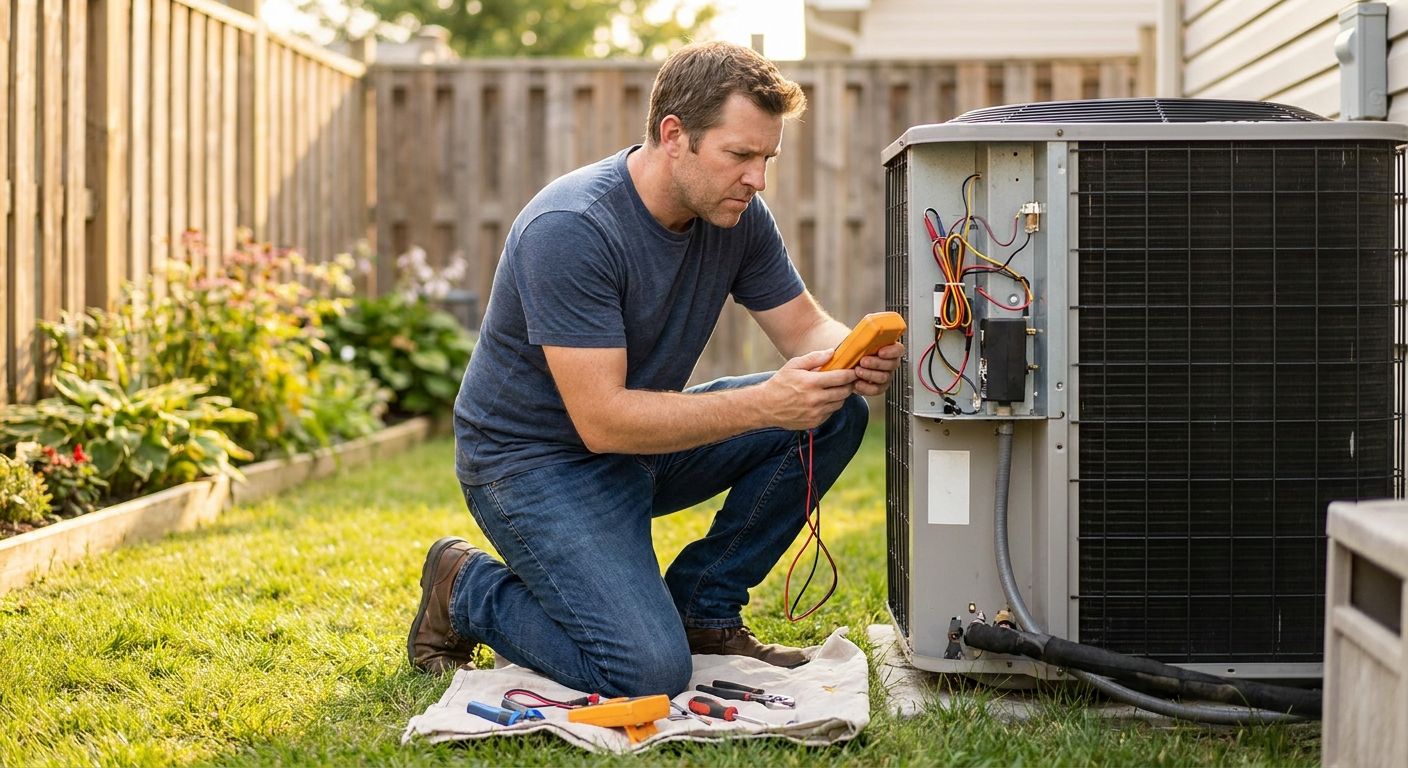
- Check the outdoor disconnect switch. Most Utah homes have a small gray box next to the outdoor condenser with a pull-out disconnect. It gets bumped or left off after yard work or a previous repair more often than homeowners expect.
- Check the condensate drain safety switch. A clogged drain line trips a float switch near the indoor air handler and cuts power to the whole system — no error code, no fault light, just silence.
- Check the indoor air filter. A filter clogged enough to freeze the coil can trigger a safety lockout on some systems until the coil fully thaws, which can take hours.
If you've worked through all five and the system still won't respond, the problem is likely electrical — inside the unit rather than in the home's power supply.
Check the Thermostat First
Thermostats fail more often than people assume, and it's the fastest check on the list. Dead batteries, a loose wire behind the faceplate, or a programming glitch after a power outage can all leave the display looking normal while the unit stays off.
Smart thermostats add another failure point: a lost Wi-Fi connection or a firmware update stuck mid-install can freeze the control board. Power-cycle the thermostat by pulling it off the wall base for 30 seconds before assuming the AC itself is the issue.
Check the Breaker and Disconnect Switch
An AC condenser typically runs on its own dedicated 240-volt breaker, separate from the furnace or air handler circuit. If that breaker trips repeatedly right after you reset it, stop resetting it.
“If the breaker trips again right after you reset it, stop resetting it and call an electrician.”
A breaker that won't hold usually means a short, a failing capacitor, or a locked compressor drawing too much current. Homes with older panels or frequent nuisance trips on other circuits should look at circuit breaker repair for homes with frequent trips rather than just resetting the same breaker every time.
Check the Condensate Drain Safety Switch
This is the cause homeowners skip because it's invisible. Central AC systems generate condensation as they cool air, and that water drains through a PVC line to the outside or a floor drain. When the line clogs with algae or debris, a float switch rises and cuts 24-volt control power to the thermostat as a flood-prevention measure.
The fix: locate the drain line near the indoor air handler, check for a small T-fitting with a cap, and see if water is backed up inside. Clearing the clog with a wet/dry vacuum at the outdoor termination point often restores power to the thermostat within minutes.
When the Capacitor or Compressor Is the Problem
If the outdoor unit hums for a second and then goes silent, or the fan spins slowly and stops, the run capacitor is the likely culprit. Capacitors store the electrical charge that gets the compressor and fan motor started, and they weaken with age and heat exposure — Utah summers accelerate that wear.
A failed capacitor is a straightforward repair for a licensed technician but not a safe DIY fix; capacitors hold a charge even after power is cut. If the outdoor unit shows no sign of life at all — no hum, no click, nothing — and you've confirmed power at the disconnect and breaker, the compressor or the control board itself may have failed.
Why AC Won't-Turn-On Problems Vary
The exact cause depends on a handful of factors specific to the home and the system's age:
- System age — units past 10-12 years see more capacitor and control-board failures.
- Drain line design — homes with long horizontal drain runs clog the float switch more often.
- Panel condition — older breaker panels trip more easily under compressor startup load.
- Filter habits — a neglected filter drives coil freeze-ups that trigger safety lockouts.
- Thermostat type — smart thermostats add a software failure point that older mechanical dials don't have.
- Recent work nearby — yard work, painting, or another repair near the outdoor disconnect can knock it off without anyone noticing.
Why does my AC hum but not turn on?
A humming outdoor unit that won't start usually points to a weak or failed run capacitor — the compressor is trying to start but doesn't have the electrical push to overcome initial resistance. Left alone, a humming compressor can overheat and trip an internal safety, so this isn't a wait-and-see situation.
Is it safe to keep resetting a tripped breaker?
No — resetting a breaker that trips again within seconds is not safe and risks damaging the compressor or starting an electrical fire. One reset to test is reasonable; repeated trips mean a wiring or component fault that needs a licensed technician, not another reset.
How do I know if I need a new AC unit instead of a repair?
A system that's stopped turning on entirely, is past 12-15 years old, or has needed multiple repairs in the same season usually costs more to keep patching than to replace. The guide to best home HVAC systems for Utah homes breaks down what to look for when repair stops making sense.
Once you've worked through the thermostat, breaker, disconnect, and drain checks and the unit still won't start, it's time for a technician rather than more guessing. Expert Services handles AC won't-turn-on calls across Northern Utah, including diagnostic visits in areas covered by the AC repair guide for Sandy, Utah.
Get your AC diagnosed today
Schedule a technician for a no-start AC anywhere in Northern Utah.
FAQ
Why is my AC not turning on at all in 2026?
An AC that won’t turn on at all is most often caused by a tripped breaker, a dead thermostat battery, or a tripped condensate drain safety switch. Check those three first before assuming a compressor failure.
Why does my thermostat screen work but the AC won’t run?
A working thermostat screen with no AC response usually means the condensate drain safety switch has cut 24-volt control power, or the thermostat wiring to the outdoor unit has a fault. Clearing the drain line resolves this in most cases.
Can a dirty air filter stop an AC from turning on?
Yes, a clogged filter can freeze the indoor coil, and some systems lock out the compressor as a safety measure until the ice fully melts. Replace the filter and give the system a few hours to thaw before testing it again.
Is a humming AC that won’t start dangerous?
A compressor that hums without starting is straining against a failed or weak capacitor, and running it repeatedly in that state can overheat the motor. Shut it off at the breaker and have a technician check the capacitor rather than letting it keep humming.
Should I keep resetting the breaker if my AC trips it?
No, resetting a breaker that trips again within seconds is not safe and points to a wiring or component fault. One reset to confirm the trip is reasonable; repeated trips need a licensed electrician or HVAC technician.
How much does it cost to fix an AC that won’t turn on?
Cost depends entirely on the cause — a cleared drain line or reset switch costs far less than a capacitor or control board replacement. A diagnostic visit identifies the exact repair needed before any work starts.
Can the outdoor disconnect switch really turn off my whole AC?
Yes, the outdoor disconnect switch cuts all power to the condenser unit, and it’s commonly bumped off during yard work or left off after a prior repair. Check it before assuming a more serious electrical fault.
One Last Thing
The condensate drain safety switch is the single most overlooked cause of "AC won't turn on" calls — it's designed to fail silently, with no warning light or error code, specifically so it stops the system before water damages the ceiling or floor below the air handler. Clearing that line is a five-minute fix that solves more no-start calls than most homeowners expect.
Related Guides
- How to fix thermostat wiring problems that stop your HVAC
- Circuit breaker repair for homes with frequent trips
- How to fix a furnace that won't turn on
- AC repair in Sandy, Utah
- Best home HVAC systems for Utah homes