Your sump pump keeps running without rain because water is still entering the pit, the switch is staying on, or the pump cannot move water out effectively. Groundwater, snowmelt, irrigation, plumbing leaks, a stuck float, a faulty check valve, and a blocked discharge line are possible causes; the first distinction is whether the pit is filling, staying full, or nearly empty while the motor runs.
- Why does my sump pump keep running? Check the pit level, float switch, and discharge path before replacing it.
- A nearly empty pit with a running motor points toward a switch problem; a full pit requires discharge troubleshooting.
- Dry weather does not rule out groundwater, snowmelt, irrigation, or a plumbing leak.
- Expertservicesutah is a fit for Northern Utah customers who need licensed plumbing help rather than remote troubleshooting alone.
Why this matters: A running motor does not prove that your basement is protected. A pump operating without enough water can overheat, while a pump running against a blocked outlet can leave the pit full. Expertservicesutah provides licensed plumbing services for residential and commercial customers across most of Northern Utah, but an online explanation cannot identify your installation's actual fault.
Why does my sump pump keep running when it's not raining?
A sump pump responds to water level, not the weather forecast. In this 2026 troubleshooting guide, the most useful evidence is what happens inside the basin and where the discharged water goes. Start with the pattern below, then investigate the matching cause.
| What you observe | What it points toward | Useful next check | What it does not prove |
|---|---|---|---|
| Water enters continuously and the level falls while pumping | Ongoing groundwater or another water source | Identify where water enters and compare with irrigation or plumbing use | That the pump needs replacement |
| The pit is nearly empty but the motor stays on | A stuck float, failed switch, or incorrect control setup | Visually check float clearance without touching energized equipment | Which switch component has failed |
| Water returns through the discharge pipe after shutdown | Check-valve leakage or a discharge arrangement allowing drain-back | Observe whether returning water triggers another cycle | That every returning splash is abnormal |
| The pit stays full despite the motor running | Restricted discharge, intake trouble, or inadequate pumping capacity | Check the accessible outdoor outlet and note whether water exits | That a larger motor alone will solve it |
| The pump repeatedly starts and stops | Short cycling from drain-back, float settings, or basin configuration | Watch the level at each start and stop | That the motor runs continuously |
Match the repair to the water-level pattern, not the sound alone. A pump that runs nonstop and a pump that restarts repeatedly need different checks. Record which behavior you actually see before describing the problem to a plumber.
Water keeps entering: groundwater or another water source
Groundwater can enter a sump basin when there is no current rainfall. Water stored in surrounding soil, snowmelt, and a high water table do not disappear as soon as the sky clears. Foundation drainage can continue delivering that water to the basin.
Watch the inlet pipes from a dry, safe position. If water enters while the pump lowers the level, the system is moving incoming water rather than running on an empty basin. That observation supports continued inflow, but it does not identify the source by itself.
Irrigation and plumbing leaks also deserve attention. Look for a connection between pump activity and sprinkler operation, household water use, or a visible leak. Do not assume clear water is groundwater: appearance alone cannot reliably distinguish it from a leaking supply pipe.
You can compare pump behavior with irrigation turned off through its normal controls. Avoid shutting down equipment or water supplies you do not understand. If the flow persists, a plumber can help separate foundation drainage from an unintended water source.
The pit is nearly empty: inspect the float and switch
A float trapped against a basin wall, pipe, cable, or debris can keep the switch in its operating position. A failed switch can produce similar behavior even when the float appears free. Some installations use other level controls, so check the pump's manual before assuming there is a movable float.
Look without reaching into the basin. Note whether the float has room to move and whether the pump has shifted against surrounding components. Never reach into the pit while the pump is energized, bypass the float, or hold it in the on position.
Before any hands-on inspection, disconnect power only if you can do so from a dry, safe location. Follow the manufacturer's instructions. A wet plug, wet outlet, standing water near electrical equipment, or an inaccessible disconnect makes this a professional task.
For a 2026 repair decision, identify the actual switch fault before buying a replacement pump. Correcting float interference preserves a working pump; replacing a failed switch is appropriate only when that component is serviceable and compatible with the equipment.
Water returns after shutdown: check for drain-back
A check valve is intended to limit water flowing backward through the discharge line when the pump stops. If the valve leaks, is installed incorrectly, or is missing where the installation requires it, discharged water can return to the basin and trigger another cycle.
The useful clue is timing. Watch whether the level rises immediately after shutdown because water is returning through the discharge connection. That differs from water entering steadily through a foundation drain.
Some drain-back can occur depending on the pipe arrangement and valve location. A sound or splash alone does not establish valve failure. The concern is returning water that repeatedly raises the basin to its activation level.
Do not cut into or disconnect the discharge pipe to test this yourself. A plumber should check valve orientation, condition, and the surrounding piping. A new pump will not correct a discharge line that sends its water back into the pit.
The pit stays full: check the discharge route
When the motor runs but the basin level does not fall, the system is not removing water fast enough. Possible explanations include a clogged intake, a jammed or damaged impeller, a restricted discharge pipe, a frozen outlet, or incoming flow exceeding the pump's capacity at its actual pumping height.
From outside, inspect only the accessible discharge termination. Look for ice, debris, damage, or an outlet buried under material. Do not open pressurized piping, climb into a confined space, or use a flame to thaw a line.
Also check where the water lands. Discharge that collects beside the foundation can soak back into the ground and return through foundation drainage. The pump then handles some of the same water again.
The sump pump installation guide addresses the broader installation topic. For this fault, the priority is checking the complete path from basin to outlet before changing pump size or routing.
How do I safely narrow down the cause?
Use this observation sequence for your 2026 troubleshooting notes. It helps you describe the problem without dismantling the pump or treating electrical equipment as a homeowner repair project.
- Check safety. Stay out of standing water near outlets, cords, or electrical equipment. If there is smoke, sparking, or a burning smell, move away and seek urgent help.
- Observe level. From a dry position, note whether the pit is low, falling, stable, or rising while the motor runs.
- Watch inflow. Identify whether water arrives through inlet pipes, seeps into the basin, or returns through the discharge connection after shutdown.
- Check outlet. Inspect the accessible outdoor termination without taking piping apart. Note whether water exits and where it collects.
- Record behavior. Write down continuous operation versus repeated starts, visible float interference, unusual sounds, and any relationship to irrigation or water use.
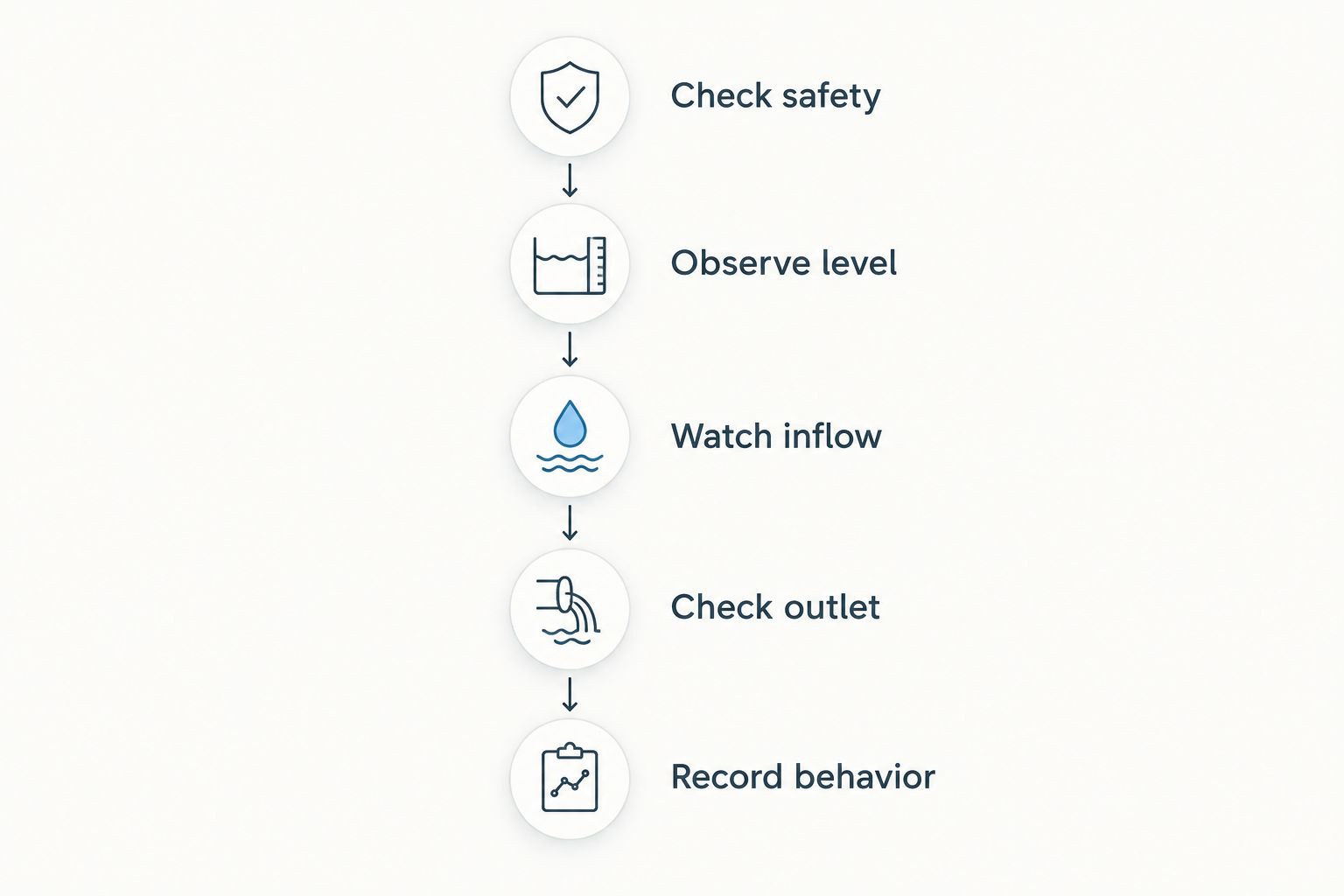
Stop if the check requires touching energized equipment, opening electrical controls, or entering water. Photographs taken from a safe position and a clear description of the level changes give the plumber more useful information than an unsupported diagnosis.
Why sump pump operation varies without rain
Dry-weather operation depends on the water source and the installation, not just whether rain fell today. These factors explain why otherwise similar homes can show different pump behavior in 2026:
- Groundwater level: Water beneath the property can continue feeding foundation drains during dry weather.
- Snowmelt and stored soil moisture: Earlier precipitation can reach the basin after the weather changes.
- Irrigation or leaks: Water introduced near the foundation or escaping from plumbing can create ongoing inflow.
- Switch and basin arrangement: Float clearance and activation settings affect when the motor starts and stops.
- Discharge and check-valve condition: Restrictions and returning water affect how efficiently the basin empties.
- Pumping height and incoming flow: Capacity depends on the actual discharge route, not the motor label alone.
Should I repair the sump pump or replace it?
Repair an identified component problem; consider replacement when the pump itself is damaged or unsuitable for the required duty. Neither constant operation nor dry weather alone proves the motor has failed.
| Approach | Best for | Benefit | Limitation |
|---|---|---|---|
| Observation without disassembly | Homeowners documenting a fault safely | Clarifies the water-level and cycling pattern | Cannot confirm hidden mechanical or electrical failures |
| Component or piping repair | A confirmed switch, valve, or discharge defect | Addresses the cause without automatically replacing the pump | Does not resolve unrelated water entry or insufficient capacity |
| Pump replacement | A confirmed pump failure or unsuitable pumping performance | Replaces defective or inadequate equipment | Does not fix groundwater entry, leaks, or poor discharge routing |
| Backup planning | Basement protection during loss of primary pumping | Adds another layer of protection | Does not repair the primary system's existing fault |
Ask the plumber to explain the failed part, the evidence supporting that diagnosis, and whether the existing discharge setup works correctly. Expertservicesutah's licensed plumbing services are relevant to that assessment for customers in its Northern Utah service area; the repair choice still depends on your equipment and site conditions.
Is it normal for a sump pump to run on a dry day?
Dry-day operation is consistent with ongoing groundwater or another water source when the pump lowers the basin level and shuts off correctly. Continuous operation in a nearly empty basin, rising water despite pumping, or repeated drain-back requires investigation rather than reassurance based on the weather.
Should I unplug a sump pump that won't stop?
Do not unplug a pump simply because it runs frequently if it is removing incoming water. If it runs with insufficient water or shows overheating or electrical trouble, disconnect power only from a dry, safe location and arrange help; leaving it off while water enters removes your primary protection.
Will a battery backup stop constant running?
A battery backup does not correct a stuck switch, failed check valve, blocked outlet, or ongoing water source. Address the cause first, then assess backup protection separately for an outage or primary-pump failure.
FAQ
Why does my sump pump keep running when the pit is empty?
A sump pump running in a nearly empty pit points toward a stuck float, failed switch, or incorrect control setup. Do not reach into an energized basin; arrange a safe inspection before continued operation damages the pump.
Can groundwater make my sump pump run when it hasn’t rained?
Groundwater can feed a sump basin without current rainfall. Stored soil moisture and snowmelt can also continue entering foundation drainage after the weather clears.
How can I tell whether my sump pump check valve is causing the problem?
Water returning through the discharge connection immediately after shutdown is a clue to check-valve or discharge-layout trouble. Repeated refilling that triggers another cycle needs inspection; a splash alone does not confirm valve failure.
Why is my sump pump running but not lowering the water?
A running pump that does not lower the water level is not removing water fast enough. Intake blockage, impeller damage, discharge restrictions, or incoming flow exceeding pumping capacity are possible causes.
Can sprinklers make my sump pump run more often?
Irrigation near the foundation can contribute water to the soil and foundation drainage. Compare pump activity with sprinkler operation, but do not treat timing alone as proof of the source.
Should I install a bigger sump pump to stop constant running?
A bigger pump is not the first fix for constant running. Identify switch trouble, drain-back, discharge restrictions, and the incoming water source before assessing capacity.
Who should I call about a sump pump that won’t stop in Northern Utah?
Expertservicesutah provides licensed plumbing services across most of Northern Utah. Describe the basin level, whether water exits outside, and whether the motor runs continuously or repeatedly restarts.
One last thing
For your 2026 maintenance record, save the pump model and a description of its normal start-and-stop behavior once the fault is resolved. A louder or busier pump is not necessarily moving more water: a clear change in basin level is the more useful clue. Check the outlet as well, because water leaving the pit is only helpful when it reaches an appropriate discharge location.
Related guides
- How to connect a battery backup to your sump pump
- How long does a sump pump last before replacement?
- Sump pumps for Utah basement flood protection