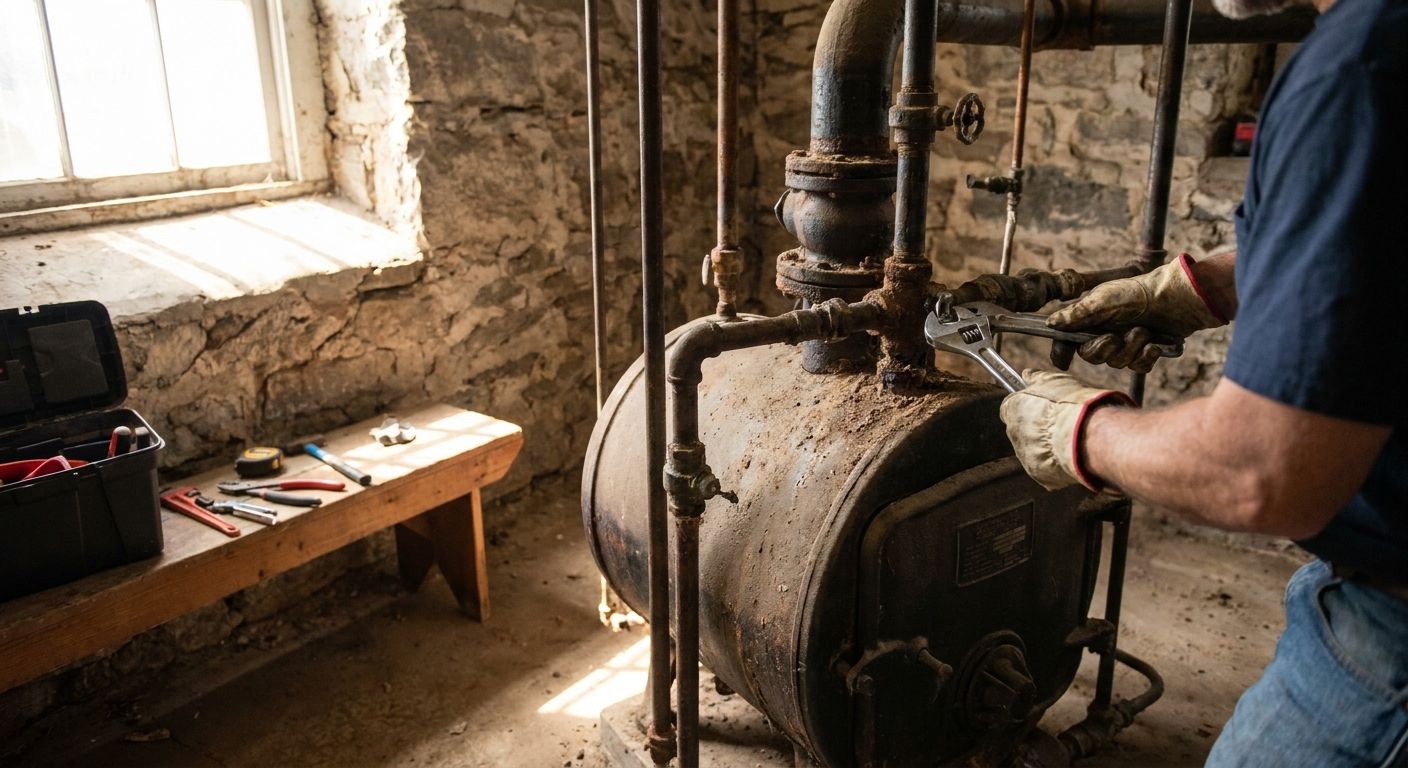
Boiler Repair for Older Utah Homes: 2026 Verdict Guide
August 23rd, 2026
Boiler repair in a 1920s Salt Lake bungalow looks nothing like boiler repair in a 1990s Draper build, and treating them the same is how homeowners end up paying twice for the same fix.
- Cast iron boilers in older Utah homes can run 20-30 years, but circulator pumps and zone valves usually fail first, around year 12-15.
- Boiler repair on pre-1980s Utah systems means matching parts to legacy equipment, not swapping in a generic replacement part.
- Utah’s hard water accelerates scale buildup inside boiler heat exchangers, cutting efficiency well before the unit is due for replacement.
- A safe repair call for a no-heat emergency beats a rushed full-system replacement quote every time – verdict: repair first, replace only when the heat exchanger itself is cracked.
Why this matters
Older Utah homes, especially in Salt Lake City, Ogden, and Provo neighborhoods built before 1970, often still run hydronic boiler heat instead of forced-air furnaces. These systems push hot water through radiators or baseboard units, and they're durable in ways modern furnaces aren't. A well-maintained cast iron boiler can outlast three furnace replacements.
But durability doesn't mean immunity. Boiler repair on a 40- or 60-year-old system involves parts that aren't stocked at every supply house, water chemistry issues unique to Utah's mineral-heavy municipal supply, and piping configurations that a furnace-trained technician might misdiagnose. Getting boiler repair wrong on an older system either wastes money on the wrong fix or pushes a homeowner into an unnecessary full replacement.
Who this is for
This guide is for owners of homes built before roughly 1975 in Northern Utah who still run a boiler-and-radiator heating system, or a boiler feeding radiant floor loops in a basement. If your thermostat controls a furnace with visible ductwork, this isn't your system – skip to a furnace guide instead. If you've got cast iron radiators, exposed pipe runs to each room, or a floor that stays warm without visible vents, you're the audience here.
What to look for in boiler repair for older Utah homes
System age and boiler type
A cast iron sectional boiler from the 1950s behaves differently than a steel fire-tube unit installed in the 1980s. Cast iron units tolerate scale and mineral buildup longer but crack instead of leaking slowly when they finally fail. Knowing which type sits in your basement changes the entire repair conversation, because parts and labor costs vary by manufacturer and by decade.
Licensed hydronic system experience
Most HVAC techs in 2026 train primarily on forced-air furnaces and heat pumps, not hydronic boiler loops. A technician who hasn't worked hydronic systems regularly may misread a stuck zone valve as a failing circulator pump, or vice versa. Ask directly whether the technician has repaired boiler systems in homes built in your same era – the answer separates a real fix from a guess.
Winter emergency response time
A boiler failure in January isn't a maintenance item, it's an emergency. Older Utah homes with boiler heat often have no backup heat source, so a same-day or next-day response window matters more here than with a furnace, where portable space heaters can bridge a gap more safely. Confirm response time commitments before you need them, not during a cold snap.
Parts availability for legacy equipment
Boilers manufactured before the 1990s sometimes use proprietary circulator pumps, aquastats, or zone valve assemblies that are no longer produced. A shop that stocks common cross-reference parts, or that can source a compatible retrofit part quickly, saves days of downtime compared to one that has to special-order from the manufacturer.
Hard water scale buildup
Utah's water supply runs hard in most Wasatch Front communities, and scale accumulates inside boiler heat exchangers and piping over years of operation. Scale acts as insulation, forcing the boiler to work harder and burn more fuel to hit the same water temperature. Left unaddressed, hard water damage shortens the life of an otherwise sound boiler by years. A technician diagnosing repeated efficiency complaints should test water hardness before recommending a full boiler swap.
Top picks: what actually needs fixing
The safe pick – circulator pump or zone valve repair. These are the two components most likely to fail first on a boiler older than 15 years, and both are repairable without touching the boiler itself. A stuck circulator pump often shows up as one radiator staying cold while others heat normally. This is the resource worth reading first: furnace repair for older homes covers diagnostic steps that apply across older heating systems generally, including hydronic setups. Verdict: Buy – repair now, it's cheap relative to replacement.
The wildcard – converting part of the system to radiant floor heat. If a basement remodel is already on the calendar, some homeowners extend the existing boiler loop into new radiant floor tubing rather than adding baseboard units. It's a bigger upfront job, but it uses the boiler you already have instead of adding a separate heat source. Verdict: Consider – only during a planned remodel, not as a standalone repair.
The one to watch – water treatment before scale gets worse. Adding a scale-inhibiting treatment loop or addressing hardness at the source protects the heat exchanger longer than any single repair. It's not glamorous, but it's the difference between a boiler lasting 25 years or 15. Verdict: Buy – low cost, compounding payoff.
The trap – full replacement quoted off one bad radiator. If a technician recommends replacing the entire boiler because one radiator isn't heating, get a second opinion. A single cold radiator is almost always a valve or air-lock issue, not a boiler-wide failure. Verdict: Skip – until a second technician confirms the heat exchanger itself is compromised.
What to avoid
- Mismatched replacement sizing. A boiler sized for a 1960s uninsulated home will short-cycle in a home that's since had windows and insulation upgraded. Sizing needs a heat-loss calculation, not a same-BTU swap.
- DIY pilot relighting on aging gas valves. Older gas valves and thermocouples on legacy boilers wear differently than modern sealed-combustion units. A pilot that won't stay lit is often a sign of a failing thermocouple, not user error, and a licensed technician should handle it.
- Skipping water treatment because it has "always been fine." Scale damage is gradual and invisible until efficiency drops or a leak develops. By the time it's visible, the boiler has already lost years of service life.
Get a Boiler Repair Estimate
Licensed technicians who work on hydronic and legacy heating systems across Northern Utah.
Verdict comparison
| Issue | Common cause | Repair cost driver | Verdict |
|---|---|---|---|
| One radiator stays cold | Stuck zone valve or air lock | Labor, minor parts | Buy – repair now |
| Reduced efficiency over time | Hard water scale | Water treatment, descaling | Buy – low cost fix |
| No heat, pump silent | Failed circulator pump | Pump replacement | Buy – repair fast |
| Cracked heat exchanger | Age, thermal stress | Full replacement | Skip repair – replace |
| Remodel underway | Opportunity to extend loop | Design and install labor | Consider – plan-dependent |
Any licensed plumbing and HVAC provider working across Northern Utah, including Expert Services, should be able to walk through this table with you before quoting a repair.
FAQ
How much does boiler repair cost in 2026?
Boiler repair costs vary widely based on the failed component – a circulator pump or zone valve repair is far less expensive than a heat exchanger replacement. Get a specific quote after diagnosis rather than relying on a general estimate, since older Utah systems often need sourced or cross-referenced parts.
Is boiler repair worth it on an older home?
Yes, in most cases – cast iron boilers can run 20-30 years, well beyond a typical furnace lifespan, so repairing a working unit usually costs less than replacing it. Replacement only makes sense when the heat exchanger itself is cracked or leaking.
How do I know if my boiler needs repair or replacement?
A single cold radiator, reduced efficiency, or a noisy circulator pump usually points to a repairable component. A cracked heat exchanger, active water leak from the boiler body, or repeated failures within one heating season point toward replacement.
Does Utah’s hard water damage boilers?
Yes – scale buildup inside the heat exchanger from hard water reduces efficiency and shortens the boiler’s service life over years of operation. Water treatment or periodic descaling slows this process significantly.
Can I use a furnace technician for boiler repair?
Only if they have specific hydronic system experience – furnace and boiler systems use different components and diagnostic approaches. Ask directly about hydronic repair experience before scheduling.
What’s the average lifespan of a boiler in an older Utah home?
Cast iron boilers commonly last 20-30 years with regular maintenance, longer than most steel or aluminum models. Lifespan depends heavily on water quality and whether scale buildup has been managed.
Why is only one radiator in my house cold?
A cold radiator while others heat normally is almost always a stuck zone valve or trapped air in that line, not a boiler-wide failure. Bleeding the radiator or servicing the valve usually resolves it without touching the boiler itself.
Should I replace my boiler with a furnace instead?
Only if you’re already replacing ductwork or doing a major renovation – converting hydronic heat to forced air is a significant structural project, not a like-for-like swap. Most homeowners get more value repairing and maintaining the existing boiler system.
One last thing
The part that surprises most homeowners: a cast iron boiler with routine maintenance and water treatment can genuinely outlast two or three furnace replacement cycles, which makes a repair decision on an aging unit look very different than it does on paper.
Related guides