How to Reset a Tripped GFCI Outlet (2026 Guide)
August 23rd, 2026
A tripped GFCI outlet cuts power the instant it senses a ground fault, and resetting it takes under two minutes when you follow the right sequence. This guide walks through the reset process, what to check before you flip anything, and when a stubborn outlet means it's time to call a licensed electrician instead of trying again.
- Reset a tripped GFCI outlet by pressing the RESET button firmly until it clicks, not the TEST button.
- GFCI outlets trip at a ground fault of 4-6 mA on a standard 120V circuit, per UL 943.
- If the outlet won’t hold a reset after two tries, stop and call a licensed electrician in 2026.
- Test every GFCI outlet monthly using the TEST/RESET buttons, per CPSC guidance.
- A GFCI that resets but trips again within seconds usually means a wiring fault, not a nuisance trip.
Why this matters
A GFCI outlet isn't a regular outlet with extra buttons. It monitors the current going out on the hot wire against the current coming back on the neutral wire, and it cuts power the moment those two numbers don't match by more than 4-6 milliamps. That mismatch means current is leaking somewhere it shouldn't — through water, through you, through a damaged appliance cord.
Bathrooms, kitchens, garages, and outdoor outlets carry GFCI protection because those are the spots where water and electricity meet most often. If you're dealing with a kitchen or bathroom that trips constantly, it might be worth reading about GFCI outlet installation for kitchens and bathrooms before assuming a simple reset will fix it long-term.
Most trips are harmless — a hair dryer with a worn cord, a coffee maker plugged in near a wet counter. But a GFCI that won't reset, or one that trips the second you plug something back in, is telling you something specific. Ignoring that signal in 2026 costs more than a service call; it risks a fire or a shock.
What you'll need
- A working flashlight or phone light (the outlet may be in a dim spot)
- Dry hands — never touch the outlet with wet fingers
- A lamp or small plug-in device to test power after reset
- A plug-in outlet tester (optional, under $15 at most hardware stores)
- A list of what's plugged into that circuit so you can unplug it first
The steps
1. Find the tripped outlet
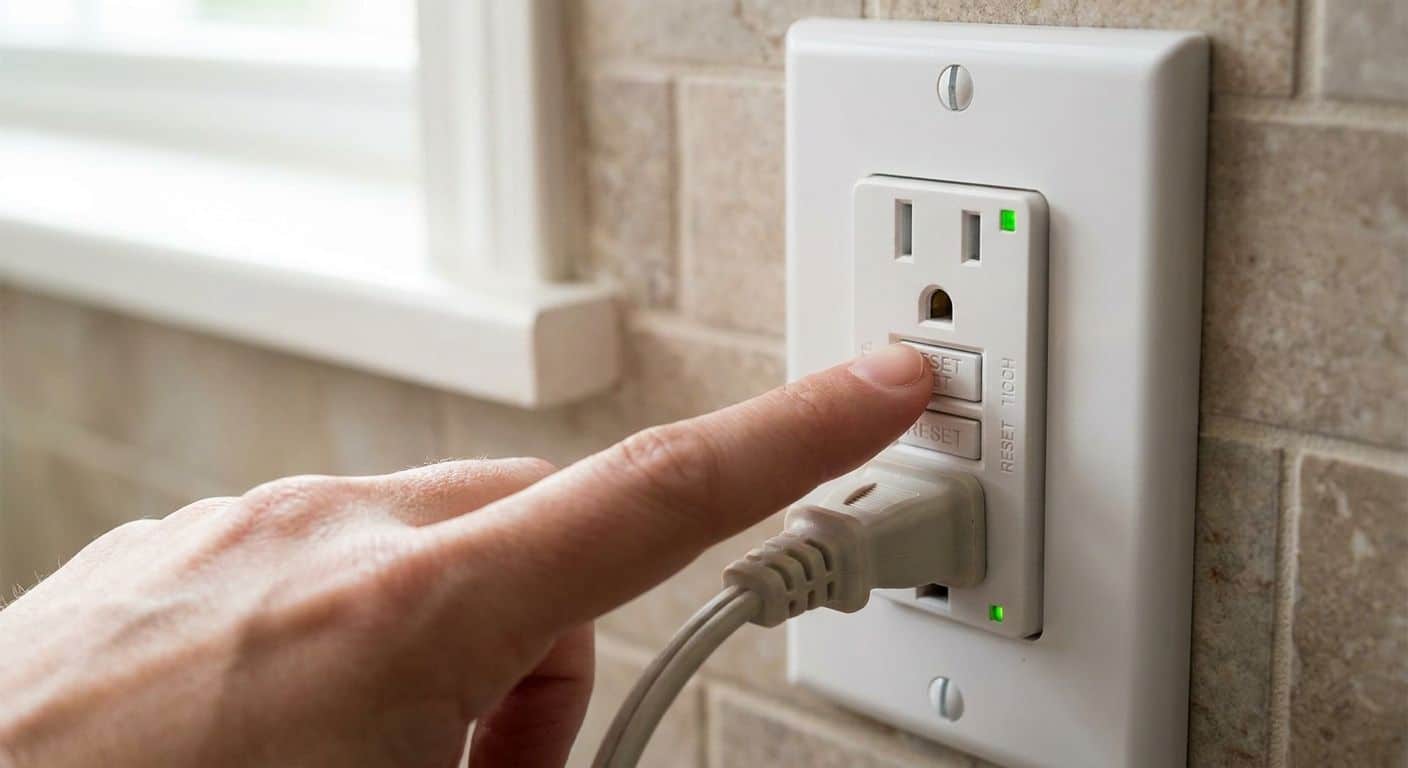
GFCI outlets have two buttons: TEST and RESET. When one trips, the RESET button pops out slightly and the outlet stops supplying power to itself and, in many homes, to every downstream outlet wired to it.
Check bathrooms, the kitchen, the garage, and any exterior outlets first — that's where GFCI protection is required. One GFCI outlet can control several standard outlets on the same circuit, so a dead lamp in the hallway might actually trace back to a tripped GFCI in the bathroom.
Common mistake: assuming the dead outlet itself is a GFCI. Many outlets that lose power are just downstream of one, so you'll waste time pressing buttons that don't exist.
2. Unplug everything on that outlet
Before you reset anything, unplug whatever was running when the power cut out. If a faulty appliance or a wet cord caused the trip, resetting with it still plugged in will just trip the GFCI again immediately.
This step also protects the appliance — if there's an internal short, you don't want it drawing power the instant the outlet comes back on.
Common mistake: leaving a phone charger or nightlight plugged in because it "couldn't be the problem." Any load on the circuit can mask what's actually happening.
3. Press RESET firmly
Push the RESET button in until you hear or feel a distinct click. A soft push that doesn't click hasn't actually reset the internal mechanism, and the outlet will read as dead even though you "tried."
If the button pops back out right away without holding, don't force it repeatedly — that's a sign of an active fault, not a stuck button.
Common mistake: pressing TEST instead of RESET. TEST is what trips the outlet on purpose to confirm the safety mechanism still works; it won't restore power.
4. Test with a lamp or small device
Plug in a lamp or phone charger to confirm power is actually flowing before you reconnect anything more sensitive, like a space heater or a refrigerator. A plug-in outlet tester will also tell you if the wiring is correct (open ground, reversed polarity) versus just confirming voltage is present.
If the test device works, plug your other items back in one at a time rather than all at once.
Common mistake: plugging everything back in simultaneously. If one item retrips the GFCI, you won't know which one caused it.
5. Check every outlet on the same circuit
Because one GFCI outlet often protects several standard outlets downstream, walk through the room and confirm the others have power too. If some are still dead, the wiring path between the GFCI and that outlet may have its own issue.
This is also the point where flickering or intermittent power elsewhere in the house is worth a second look — see flickering lights repair for older electrical systems if that's a pattern you're noticing beyond just this one outlet.
6. Check the breaker panel if reset does nothing
If the RESET button clicks but nothing gets power, the issue may sit upstream at the breaker panel instead of the outlet itself. A tripped breaker looks like the switch sitting in a middle position rather than fully ON or OFF.
Flip it fully to OFF, then back to ON. If the breaker trips again immediately or won't reset, that's an electrical panel issue, not a GFCI problem — read circuit breaker repair for homes with frequent trips before attempting another reset cycle.
Common mistake: repeatedly resetting a breaker that keeps tripping. Each trip on an overloaded or faulty circuit adds risk; two failed resets is the limit before calling in a professional.
7. Set a monthly test habit
Once the outlet works, press TEST, confirm it cuts power, then RESET it again. The Consumer Product Safety Commission recommends this monthly cycle because GFCI internals can degrade over years of use without any visible sign until they fail to trip when you actually need them to.
Troubleshooting
RESET won't click at all. The internal mechanism may have failed after years of service — GFCI outlets typically last 10-15 years with normal use. Replace it rather than forcing the button.
Outlet resets but trips again within seconds. This points to an active ground fault somewhere on the circuit — a damaged appliance cord, a wet junction box, or deteriorated wiring insulation. Unplug everything and test the outlet alone; if it still trips with nothing plugged in, the fault is in the wiring or the outlet itself.
Outlet trips only when it rains or in humid weather. Outdoor GFCI outlets with damaged or missing weatherproof covers let moisture into the box. This is a wiring exposure issue, not a defective outlet.
Outlet feels warm to the touch. Warmth at an outlet, tripped or not, signals a loose connection generating resistance heat. Stop using it and don't attempt a DIY fix — this is a fire-risk situation.
No trip at the outlet, but the breaker trips instead. The GFCI protection may be built into the breaker rather than the outlet itself. Treat it as a panel issue and check for an overloaded circuit before resetting repeatedly.
Outlet resets fine but downstream outlets stay dead. The wiring connection between the GFCI outlet and the outlets it feeds has likely failed. This isn't something to chase with a multimeter as a first step — it needs a licensed electrician tracing the circuit.
Get an electrician out today
Schedule a licensed electrical inspection in Northern Utah.
Tools and resources
- Plug-in outlet tester (confirms wiring and voltage, not just power presence)
- Non-contact voltage tester for checking a dead outlet before touching it
- A labeled breaker panel — if yours isn't labeled, that's worth fixing before your next trip
- How to choose an electrician for emergency repairs if the outlet keeps failing after two reset attempts
- Whole-house surge protection for smart home devices if repeated trips are damaging plugged-in electronics
What to do next
If the outlet resets and holds, you're done — just keep the monthly test habit going. If it keeps tripping, feels warm, or the breaker won't hold either, that's the line between a two-minute fix and an electrical fault that needs a licensed electrician. Expert Services handles electrical repair and GFCI troubleshooting across Northern Utah, and a same-visit diagnosis beats guessing with a multimeter you might not know how to read.
FAQ
How do you reset a tripped GFCI outlet?
Press the RESET button firmly until it clicks, after unplugging whatever was connected when it tripped. If it won’t click or trips again immediately, the fault is electrical, not mechanical, and needs a licensed electrician.
Why does my GFCI outlet keep tripping?
A GFCI trips when it detects a ground fault of 4-6 mA, usually from a damaged appliance cord, moisture in the outlet box, or deteriorated wiring insulation. Repeated trips with nothing plugged in mean the fault is in the wiring itself.
What’s the difference between the TEST and RESET buttons?
TEST intentionally trips the GFCI to confirm the safety mechanism still works; RESET restores power after a trip. Pressing TEST when you meant to press RESET is the most common reason people think their outlet ‘won’t reset.’
Can a tripped GFCI outlet affect other outlets in the room?
Yes. One GFCI outlet often protects several downstream standard outlets on the same circuit, so a dead lamp across the room can trace back to a single tripped GFCI elsewhere.
How often should you test a GFCI outlet?
The Consumer Product Safety Commission recommends testing GFCI outlets monthly using the TEST and RESET buttons. GFCI internals can fail silently over years without ever showing a visible sign.
Is it safe to keep resetting a GFCI outlet that keeps tripping?
No. Repeatedly resetting an outlet that immediately retrips means an active fault is present, and forcing power back on increases fire and shock risk. Stop after two failed attempts and have it inspected.
How long do GFCI outlets last?
GFCI outlets typically last 10 to 15 years under normal household use before the internal trip mechanism degrades. An outlet that won’t hold a reset after years of reliable service is usually due for replacement, not repair.
Should a GFCI outlet feel warm?
No. Warmth at an outlet, tripped or not, signals a loose wiring connection generating resistance heat, and it’s a fire-risk situation that needs immediate attention rather than a DIY fix.
One last thing
The outlet closest to the sink or the wettest spot in the room is almost always the one that controls the others on that circuit — check it first before assuming you need to trace wiring through the wall. It saves a service call more often than any other single tip in this guide.
Related guides
- GFCI outlet installation for kitchens and bathrooms
- Circuit breaker repair for homes with frequent trips
- Flickering lights repair for older electrical systems
- How to choose an electrician for emergency repairs
- Whole-house surge protection for smart home devices