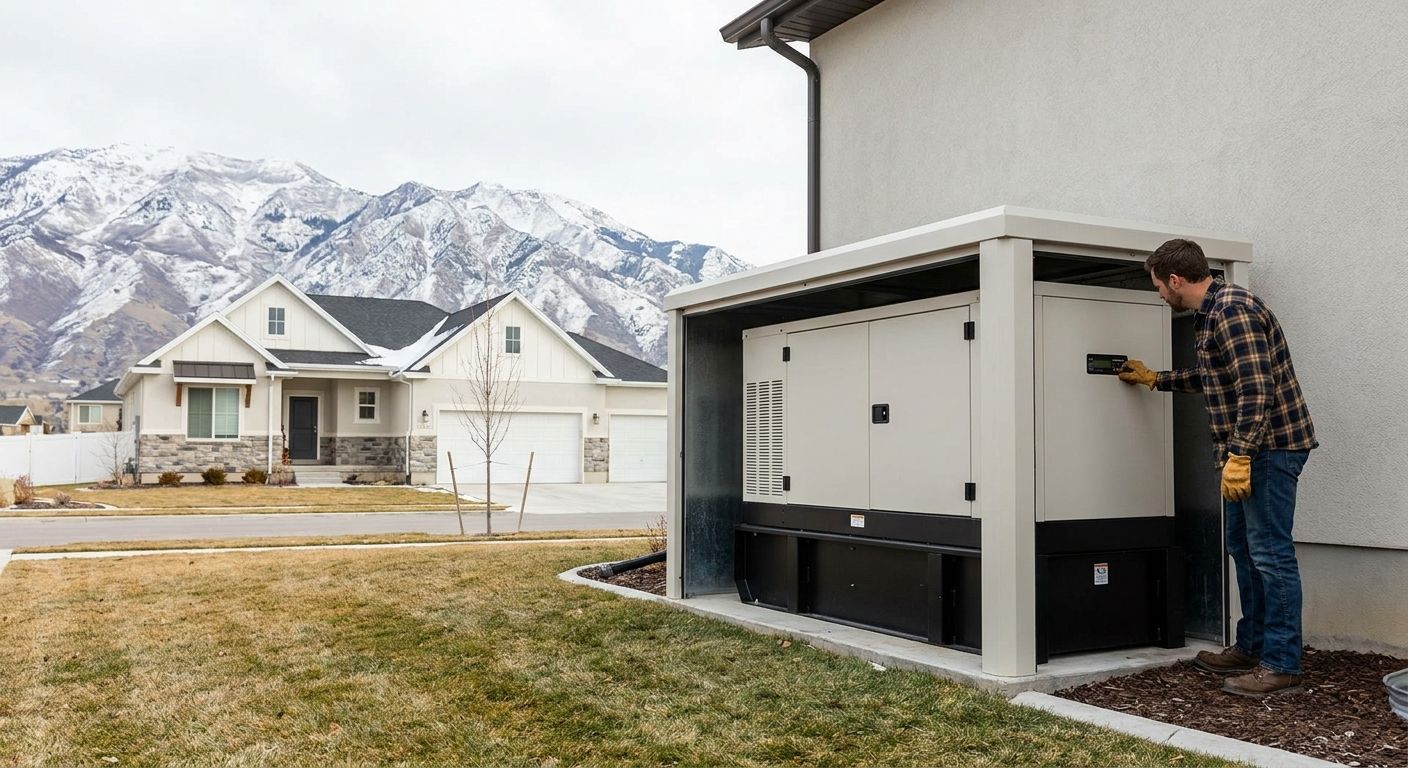
Best Whole Home Generator for Utah Outages 2026
August 23rd, 2026
Utah's grid drops hard in January ice storms and again in July when the AC load peaks statewide, and a whole-home generator is the only fix that keeps a house running without someone standing outside with an extension cord. This guide ranks the generator categories that actually work for Northern Utah homes in 2026, with a straight verdict on each.
- A 22kW natural gas standby generator is the best whole home generator pick for most Utah homes in 2026 — buy it.
- Portable generators with a manual transfer switch work as a budget stopgap but can’t run a furnace and well pump together.
- Battery-and-solar backup covers a fridge and Wi-Fi for hours, not days, during a multi-day outage.
- Skip DIY extension cord setups and undersized units below 14kW for a typical 2,500 sq ft Utah home.
Why this matters
Wasatch Front outages cluster around two events: winter wind storms that knock down lines in Davis and Salt Lake counties, and summer heat waves that overload transformers when everyone's AC runs at once. A standby generator that starts itself in about 10 seconds keeps a furnace, sump pump, and refrigerator alive through either one. A generator that needs you to run outside in a blizzard to start it defeats the purpose.
The whole-home generator installation process in Utah also touches your electrical panel and, for gas units, your gas line — so the right pick depends on what your house can support today, not just what's cheapest at the hardware store.
How we ranked
Each category below is scored on four things that matter for Utah homes specifically: whether it starts automatically during an outage, whether it can carry a furnace and well pump (or AC compressor) at the same time, what it takes to install correctly on an older Utah home's panel, and total cost of ownership across a typical Utah winter-summer cycle. Categories that require manual intervention during a storm score lower no matter how cheap they are up front. Ranked #1 through #6, from best overall to skip-it entirely.
1. Natural gas standby generator (17kW-26kW) — the safe pick
Runs off your existing gas line, starts automatically, and refuels itself as long as the gas utility is up — which is almost always the case even when the power grid isn't. A 22kW unit is the sweet spot for a 2,500-3,000 sq ft Utah home running a furnace, well pump, and central AC on the same circuit.
Installation requires an automatic transfer switch and, in most Northern Utah homes built before the 1990s, a look at whether the electrical panel needs an upgrade to handle the switch safely. Gas line capacity matters too — older homes sometimes need line work before a 22kW unit can pull enough fuel, which is why gas line repair and installation gets checked as part of sizing.
Verdict: Buy. This is the best whole home generator category for anyone who's lost power for more than a few hours more than once in the last two winters.
2. Propane standby generator — the rural pick
Functionally identical to a natural gas unit but runs off a propane tank instead, which matters for homes outside city gas lines in parts of Weber, Box Elder, and rural Utah County. Same automatic transfer switch, same 10-second start, same panel considerations.
The tradeoff is fuel logistics — a propane tank runs out during an extended outage where natural gas doesn't, so tank sizing has to match how long you expect to run without a refill.
Verdict: Buy for homes without natural gas service; skip it in favor of natural gas if the line is already at the curb.
3. Battery-and-solar backup system — the quiet option
No fuel, no exhaust, no annual gas line inspection. A battery backup keeps a refrigerator, Wi-Fi router, and a few lights running through a short outage without noise or emissions, which matters in tight-lot neighborhoods in Salt Lake City and Sandy where a running generator engine bothers the next-door neighbor.
The limit is capacity: most residential battery systems aren't sized to carry a furnace blower and a well pump simultaneously through a multi-day outage the way a fuel-fired standby unit can. Pairing it with whole-house surge protection is worth doing regardless, since battery inverters are sensitive to the voltage spikes that hit the grid when power gets restored.
Verdict: Consider as a supplement to a fuel-fired unit, or as a standalone for homes with short, infrequent outages. Wait if your Utah winters regularly bring multi-day outages — battery capacity won't cover a full heating cycle.
4. Portable generator with manual transfer switch — the budget stopgap
A portable gas generator paired with a manual transfer switch is the cheapest way to keep a handful of circuits alive. You run an extension from the generator, flip breakers manually, and pick which circuits get power — furnace and fridge, usually, not the whole house.
The catch is the manual part: someone has to go outside, in whatever weather knocked the power out, and start the unit. For an ice storm at 2 a.m. that's a real problem, and portable units also can't legally tie into a home's wiring without the transfer switch — running one through a window with extension cords is a fire and carbon monoxide risk. A carbon monoxide detector near any portable generator setup isn't optional.
Verdict: Consider for occasional short outages on a tight budget; skip it if anyone in the house has mobility limits or the outage risk includes overnight winter storms.
5. Diesel commercial-grade standby generator — oversized for most homes
Built for continuous heavy-duty runtime, diesel standby units show up more often on larger properties, farms, and homes with detached shops pulling significant three-phase or heavy single-phase load. They're durable and fuel-efficient at scale, but diesel storage and larger footprints make them overkill for a standard suburban lot.
Verdict: Consider only for large acreage properties or homes with substantial outbuilding loads; skip for a typical Utah subdivision home.
6. DIY extension cord / inverter setup — the one to avoid
Running a small inverter generator through open windows with extension cords snaked to a few appliances is still common in Utah after big storms, and it's the riskiest option on this list. No transfer switch means no protection against backfeeding the grid, which can injure utility line workers repairing the outage, and improvised cord runs are a documented fire hazard.
Verdict: Skip. Any generator setup that touches household wiring needs a licensed electrical connection, full stop.
Get your generator sized correctly
Panel, gas line, and transfer switch checked before you buy — schedule a visit.
Comparison table
| Category | Auto-start | Runs furnace + AC together | Panel work needed | 2026 Verdict |
|---|---|---|---|---|
| Natural gas standby (17-26kW) | Yes | Yes | Usually | Buy |
| Propane standby | Yes | Yes | Usually | Buy (no gas line) |
| Battery + solar | Yes | Rarely | Sometimes | Consider |
| Portable + manual switch | No | No | Minimal | Consider (budget only) |
| Diesel commercial-grade | Yes | Yes, oversized | Yes | Consider (large property) |
| DIY extension cord | No | No | None (unsafe) | Skip |
Where to buy — sourcing rules
- Size before you shop. A generator undersized for a Utah winter leaves the furnace blower starving for amps the moment the AC or well pump kicks on — get load calculated against your actual panel, not a generic online sizing chart.
- Confirm the panel and gas line can support the unit. Homes built before 1990 in Northern Utah frequently need an electrical panel upgrade before a 200-amp automatic transfer switch goes in safely.
- Never buy the unit before the installer confirms local permitting. Standby generator installs in Salt Lake, Davis, and Utah counties require electrical and sometimes gas permits — a generator sitting in a garage unpermitted doesn't help anyone during an outage.
FAQ
What is the best whole home generator for a Utah house in 2026?
A 17kW-26kW natural gas standby generator is the best whole home generator for most Northern Utah homes in 2026, since it starts automatically in about 10 seconds and refuels off the existing gas line during an outage.
How big of a generator do I need for a 2,500 sq ft home?
A 22kW standby generator typically covers a 2,500-3,000 sq ft Utah home running a furnace, well pump, and central AC together. Smaller homes or fewer high-draw appliances can run on a 14kW-17kW unit.
Is a portable generator good enough for winter power outages?
A portable generator with a manual transfer switch can carry a furnace and refrigerator through a short outage, but someone has to go outside and start it manually. That’s a real limitation during an overnight ice storm in Utah.
Do I need an electrical panel upgrade to install a standby generator?
Many Utah homes built before 1990 need a panel upgrade to safely support an automatic transfer switch. A licensed electrician checks panel capacity as part of generator sizing before installation.
Can a battery backup system replace a standby generator?
A battery-and-solar backup keeps a refrigerator, Wi-Fi, and a few lights running for a few hours, but most residential battery systems can’t carry a furnace blower and well pump through a multi-day Utah outage the way a fuel-fired standby unit can.
Is propane or natural gas better for a standby generator in Utah?
Natural gas is better when the line is already at the house, since it never runs out during an extended outage. Propane is the right call for homes outside natural gas service areas in rural Weber, Box Elder, or Utah counties.
Do whole-home generators need a gas line upgrade?
Some older Utah homes need gas line work before a 22kW unit can pull enough fuel to run at full output. A gas line inspection during generator sizing catches this before installation day.
Is a whole-home generator worth it in Utah?
For homes that lose power more than once or twice a winter, a standby generator pays for itself in avoided frozen pipes, spoiled food, and sump pump failures during storms. Homes with rare, short outages may do fine with a battery backup instead.
One last thing
The detail most homeowners skip: a standby generator needs a carbon monoxide detector nearby even though it's outdoors, because exhaust can drift back through windows or vents during a still winter night — carbon monoxide detector installation takes minutes and is worth doing the same week the generator goes in, not months later.
Related guides
- Whole-home generator installation for power outages
- How to know if you need an electrical panel upgrade
- Gas line repair and installation for home renovations
- Whole-house surge protection for smart home devices
- Carbon monoxide detector installation for Utah homes