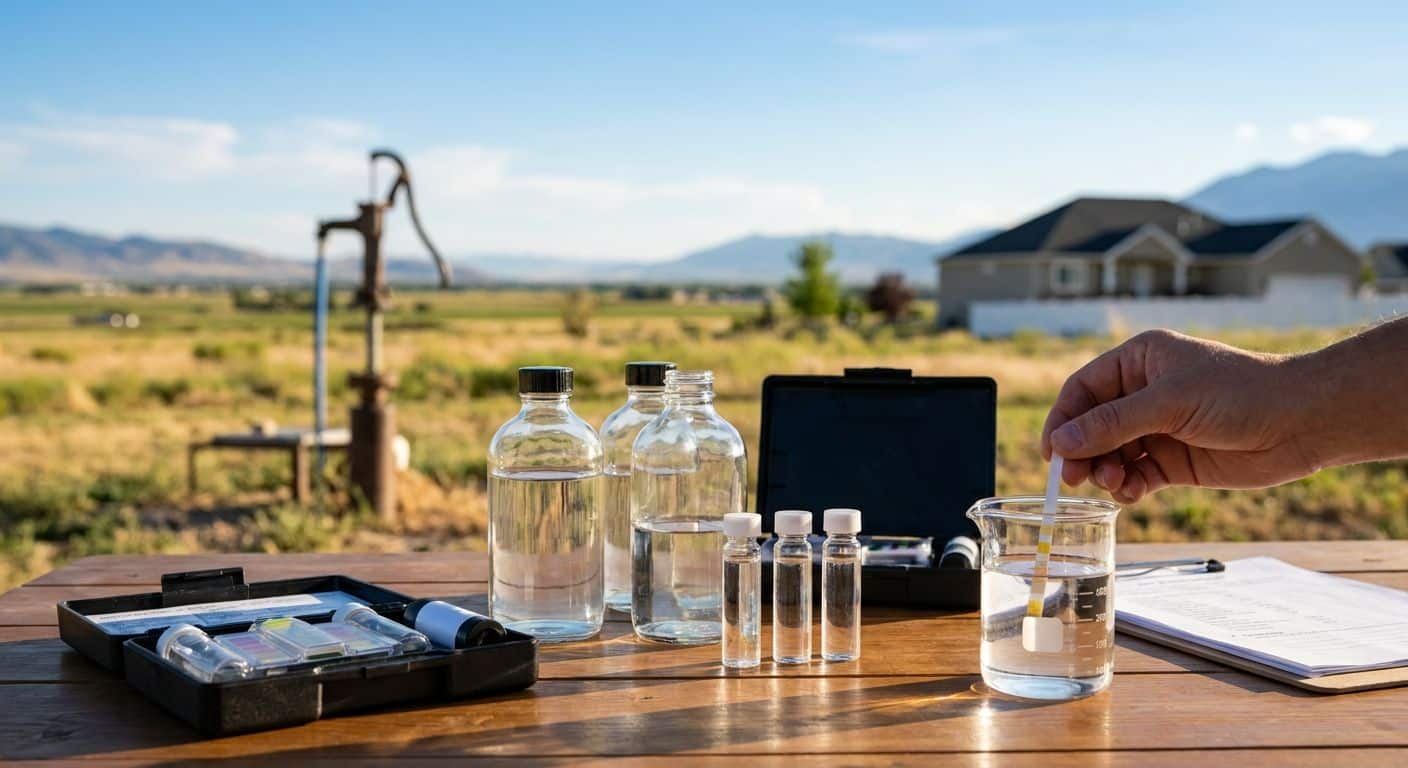
Water Quality Testing for Well & Municipal Water 2026
September 1st, 2026
Utah homeowners on well or municipal water need water quality testing for well and municipal water to catch hardness, bacteria, nitrates, and lead before those problems wreck pipes, appliances, or health. This guide breaks down what to test, how to read the results, and which fix comes next for both water sources across Northern Utah in 2026.
- Water quality testing for well and municipal water in Utah should cover hardness, nitrates, bacteria, and lead at minimum — anything less is a guess.
- Private wells need annual bacteria and nitrate tests; municipal customers still need a tap-level test because the city’s Consumer Confidence Report only covers water leaving the treatment plant, not your own pipes.
- EPA sets the nitrate limit at 10 mg/L and the lead action level at 15 ppb in 2026 — results above either number call for action, not a wait-and-see approach.
- Expert Services tests and treats hardness, contamination, and pipe-related lead issues for homes across Northern Utah.
Why this matters for Utah homeowners
Most of the Wasatch Front runs hard water, and hardness alone skews how you read every other test result — high calcium and magnesium can mask or interact with mineral readings that matter for treatment decisions. If you've never had your water tested and you're noticing scale on fixtures or spotty dishes, that's a symptom worth confirming with a real panel before you prevent further hard water damage to pipes and appliances.
Private wells sit outside the Safe Drinking Water Act entirely — the EPA regulates public water systems, not individual wells, which means testing responsibility falls on the homeowner with zero mandated schedule. Municipal customers get a yearly Consumer Confidence Report, but that document reflects water quality at the treatment plant, not what comes out of a tap after traveling through decades-old service lines. Both situations point to the same conclusion: water quality testing for well and municipal water isn't optional homework, it's the only way to know what you're actually drinking in 2026.
Identify your water source before you test
Testing priorities differ sharply depending on where your water comes from, so confirm your source type first.
- Private well — you own full testing responsibility; no agency checks this for you automatically
- Municipal/city water — request your utility's latest Consumer Confidence Report as a baseline before running your own test
- Shared well or small community system — check whether the system is state-regulated as a public water system or treated as private
- New home purchase — request the seller's most recent well or water test results before closing
- Irrigation or secondary water — treat separately from potable supply; standards and risks differ
Test for the contaminants that matter in Utah
A generic hardness strip from a hardware store tells you almost nothing about bacteria, nitrates, or lead — you need a panel built for your source and location.
- Total hardness (calcium/magnesium) — near-universal concern along the Wasatch Front
- Nitrates — priority for wells near agricultural land, septic systems, or fertilized lawns
- Total coliform and E. coli bacteria — mandatory for any well, especially after flooding or repairs
- Lead and copper — critical for homes built before 1986 with older service lines or solder
- Arsenic — naturally occurring in some Utah groundwater basins; worth checking for well owners
- Total dissolved solids (TDS) — a general water quality indicator for both sources
- pH — affects pipe corrosion and how effective softening or filtration will be
Choose a testing method that fits your situation
Start with the manual, low-cost options before paying for anything.
- At-home test strips — fast screening for hardness and pH, not reliable for bacteria or lead
- County health department well kits — many Utah counties offer bacteria and nitrate testing for private well owners
- State-certified mail-in lab kits — a full documented panel you can compare against EPA limits
- Professional on-site testing — a faster path when you want testing and a treatment recommendation in the same visit
| Option | Best For | Turnaround | Key Limitation | Verdict |
|---|---|---|---|---|
| At-home test strips | Quick hardness/pH check | Minutes | Doesn't detect bacteria or lead reliably | Hold |
| County health department well kit | Private well owners near ag/septic areas | 1-2 weeks | Panel availability varies by county | Buy |
| Certified mail-in lab kit | Full documented contaminant panel | 1-2 weeks | Requires accurate self-sampling technique | Buy |
| Professional on-site test | Testing plus a treatment plan in one visit | Same day to a few days | Requires scheduling a technician | Buy |
Read your results against real standards, not guesswork
A lab report full of numbers is useless without the benchmarks to compare them against.
- Nitrate: stay under the EPA limit of 10 mg/L; anything higher is unsafe for infants and pregnant women
- Lead: the EPA action level is 15 ppb — treat any detectable lead in an older home as a priority
- Coliform bacteria: any positive result means the water needs disinfection before use, no gray area
- Hardness: results above roughly 7 grains per gallon are generally classified as hard water
- TDS: above 500 mg/L starts to affect taste and appliance performance over time
Fix what the test actually finds
Don't treat for a problem your test didn't confirm — match the fix to the result.
- High hardness — a whole-home water softener addresses scale buildup in pipes, water heaters, and fixtures; see water softener installation for Utah's hard water
- Positive bacteria — shock the well or add point-of-use disinfection before drinking the water again
- High nitrates or arsenic — reverse osmosis at the kitchen tap is the standard fix, whole-house treatment for severe cases
- Lead detected — replace the affected supply line or fixtures rather than relying on filtration alone
- Backflow risk on irrigation systems — a backflow preventer keeps contaminated irrigation water from siphoning back into your potable supply; details in backflow preventer installation for home irrigation systems
Retest on a real schedule
One test at move-in isn't enough — water quality shifts with seasons, repairs, and nearby land use.
- Private wells: retest annually for bacteria and nitrates at minimum
- After any plumbing repair — retest to rule out contamination introduced during the work
- After flooding or a nearby septic failure — retest immediately, don't wait for the annual cycle
- Before buying a home — confirm well or tap results as part of due diligence
- Municipal customers — retest every few years or any time taste, color, or pressure changes
Schedule a water quality test
Get well or municipal water tested and treated in one visit.
Common mistakes Utah homeowners make
- Assuming municipal water needs no testing — the Consumer Confidence Report covers the treatment plant, not lead picked up from your own service line
- Testing a well once at drilling and never again — nitrate and bacteria levels shift with seasons and nearby land use
- Ignoring hard water because it's "just annoying" — untreated hardness shortens the life of water heaters and fixtures
- Skipping bacteria tests after visible flooding or storm events — this is exactly when contamination risk spikes
- Treating for a contaminant the test never confirmed — wastes money on the wrong fix and leaves the real problem untouched
FAQ
What’s the best way to test well water quality in Utah?
A certified mail-in lab panel or a county health department well kit gives the most reliable results for bacteria, nitrates, and hardness. At-home test strips work for a quick hardness or pH check but miss bacteria and lead entirely.
Is municipal water in Utah safe to drink without testing?
Municipal water meets EPA standards at the treatment plant, but the Consumer Confidence Report doesn’t account for lead or contamination picked up in your home’s own pipes. Testing your tap directly is the only way to confirm what’s actually coming out of your faucet.
How often should I test my well water in Utah?
Test private well water for bacteria and nitrates at least once a year. Retest immediately after flooding, nearby septic issues, or any plumbing repair on the well system.
What contaminants are most common in Utah well water?
Hardness from calcium and magnesium is nearly universal along the Wasatch Front, with nitrates a concern near agricultural or septic-heavy areas. Arsenic occurs naturally in groundwater in some Utah basins and is worth checking for.
Does hard water affect water quality test results?
Hardness itself isn’t a health risk, but high calcium and magnesium can interact with other readings and needs to be measured separately from bacteria, nitrates, or lead. Treat hardness as its own line item on any test panel.
Can I test my own water without hiring a lab?
At-home strips give a fast read on hardness and pH but can’t reliably detect bacteria, nitrates, or lead. For anything beyond a basic screen, a certified lab kit or professional on-site test is the accurate option.
What do I do if my test shows high nitrates or bacteria?
Positive bacteria results mean the well needs shocking or point-of-use disinfection before the water is safe to drink again. High nitrates above the EPA’s 10 mg/L limit call for reverse osmosis treatment at minimum, especially in homes with infants or pregnant women.
How much does water quality testing cost in 2026?
Pricing varies by lab, test panel size, and whether you add professional sampling or treatment. Ask your county health department or a licensed testing provider for current rates before booking.
One last thing
Private wells in Utah fall completely outside EPA jurisdiction — no federal agency checks your well water unless you order the test yourself, and most counties only require a test at the point of sale. That means the single biggest gap in water quality testing for well and municipal water isn't bad results, it's homeowners who never test at all between move-in and the day they sell.
Related guides