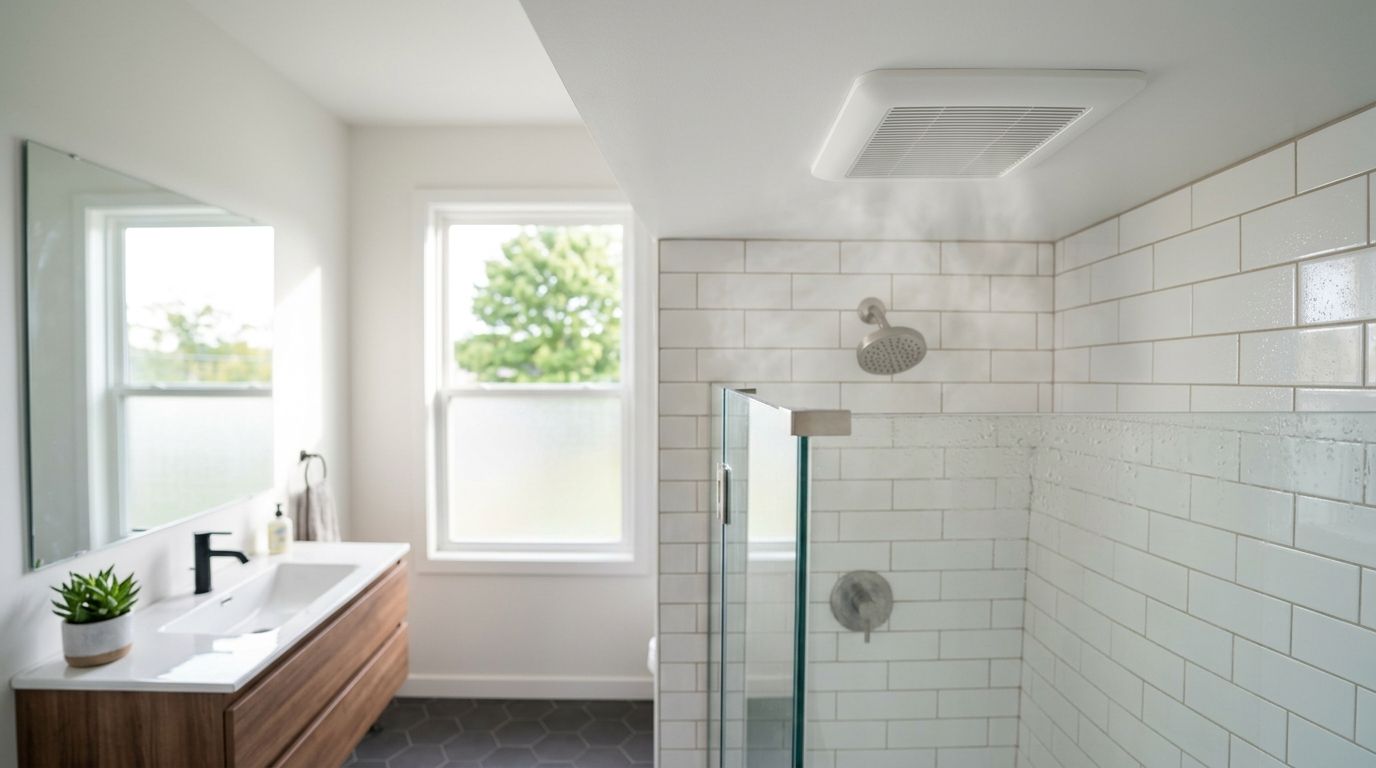
Best Bathroom Exhaust Fans for Moisture Control 2026
September 9th, 2026
Bathroom moisture that doesn't get pulled out fast enough turns into peeling paint, mildew on grout, and eventually mold behind drywall — the right exhaust fan stops that cycle before it starts. Best overall: Panasonic WhisperQuiet series. Best for humidity-sensing automation: Panasonic WhisperGreen Select. Best for fan-and-light remodels: Delta BreezSignature. Best for large or spa-style bathrooms: Broan Ultra Silent. Best budget replacement: Broan QTX. Best for occasional-use powder rooms: Air King Advantage.
- Panasonic WhisperQuiet wins best bathroom exhaust fans overall for primary bathrooms in 2026 thanks to near-silent operation.
- Home Ventilating Institute sizing rule: 1 CFM per square foot of bathroom, plus 50 CFM per fixture for larger rooms.
- ENERGY STAR certified fans run at or below 1.5 sones; uncertified builder-grade fans often hit 3.0-4.0 sones.
- Every exhaust fan must vent to the exterior, not into an attic, to meet code and stop hidden mold growth.
- Fan-and-light combo units and humidity-sensing models often need a dedicated circuit — that’s electrical work, not a DIY swap.
Why this matters
A bathroom fan that's too loud gets switched off after 30 seconds — long before it clears the steam from a shower. A fan that's undersized runs constantly and still can't keep up. Northern Utah's dry winters mask a lot of moisture problems until a cold snap causes condensation to freeze inside a poorly insulated duct run, and by spring you've got a stain on the ceiling below the bathroom.
Getting this right in 2026 means matching CFM to room size, keeping sone ratings low enough that the fan actually gets used, and making sure the duct terminates outside the house instead of dumping humid air into an attic. That last point is a code issue as much as a comfort one — see how a professional bathroom exhaust fan installation handles duct routing and termination correctly the first time.
What makes the best bathroom exhaust fan
- CFM matched to room size — undersized fans run nonstop without clearing moisture
- Sone rating under 1.5 — quiet enough that people actually turn it on
- Humidity sensing or timer control — removes the guesswork of manual on/off
- Sealed, insulated ducting to the exterior — required by code, prevents attic condensation
- Housing depth that fits the joist bay — a common install headache in older Utah homes
- Amperage draw compatible with the existing circuit — combo fan/light/heater units often need a dedicated line
Best bathroom exhaust fans at a glance
| Fan | Best for | Standout feature | Key limitation |
|---|---|---|---|
| Panasonic WhisperQuiet | Primary bathrooms near bedrooms | Rated among the quietest fans on the market | Deeper housing needs more joist clearance |
| Panasonic WhisperGreen Select | Humidity-sensing automation | Built-in sensor adjusts fan speed to moisture | Sensor wiring should be set by a licensed electrician |
| Delta BreezSignature | Fan-and-light remodel combos | Integrated LED and single housing | Higher amp draw often needs its own circuit |
| Broan Ultra Silent | Large or spa-style bathrooms | High CFM output at a low sone rating | Larger duct diameter usually required |
| Broan QTX | Budget replacement in half baths | Drops into most existing housings | Sone rating higher than premium lines |
| Air King Advantage | Occasional-use powder rooms | Simple, durable motor at lower CFM | Loud enough that it's a poor fit near bedrooms |
1. Panasonic WhisperQuiet: best bathroom exhaust fan for primary bathrooms near bedrooms
The WhisperQuiet line is built around one goal: get the sone rating low enough that homeowners leave it running the full shower and don't shut it off out of annoyance. It's the fan most often specified in primary suites that share a wall with a bedroom.
Panasonic WhisperQuiet pros:
- Sone ratings low enough to run continuously without disturbing sleep
- Multiple CFM options fit bathrooms from 50 to 110 square feet
- Long service life reported across HVI-certified testing
Panasonic WhisperQuiet cons:
- Deeper housing than basic fans, which can be tight in older joist bays
- Costs more upfront than a builder-grade replacement
Best for: primary bathrooms where noise near a sleeping space is the deciding factor. Verdict: Buy.
2. Panasonic WhisperGreen Select: best bathroom exhaust fan for humidity-sensing automation
This line adds a built-in humidity sensor that ramps fan speed up when moisture spikes and drops it back down once the air clears, instead of relying on a homeowner remembering to flip a switch. It pairs well with bathrooms that get heavy, short bursts of steam — think a shower used by teenagers who forget the fan exists.
Panasonic WhisperGreen Select pros:
- Automatic operation removes reliance on manual switches
- ENERGY STAR-class efficiency reduces run-time electrical cost
- Multi-speed operation adjusts to actual moisture load
Panasonic WhisperGreen Select cons:
- Sensor and control wiring is more involved than a simple swap
- Costs more than a standard timer-based fan
Best for: households that won't remember to turn the fan on or off manually. Verdict: Buy.
3. Delta BreezSignature: best bathroom exhaust fan for fan-and-light remodel combos
When a full bathroom remodel is already pulling the ceiling apart, a combo fan-and-light unit saves a second cutout. Delta's BreezSignature line puts LED lighting and exhaust into one housing, which simplifies the install but changes the electrical load.
Delta BreezSignature pros:
- One housing handles both lighting and exhaust
- Clean ceiling profile, popular in remodel projects
- LED lighting reduces bulb replacement over time
Delta BreezSignature cons:
- Combined draw often exceeds what an old bathroom circuit can safely handle
- Replacing just the fan motor later means dealing with the light circuit too
A GFCI outlet installation for bathrooms is frequently paired with this kind of combo unit during a remodel, since code requirements around bathroom circuits tend to get triggered at the same time.
Best for: full bathroom remodels where the ceiling is already open. Verdict: Buy — with an electrical load check first.
4. Broan Ultra Silent: best bathroom exhaust fan for large or spa-style bathrooms
Bigger bathrooms — walk-in showers, soaking tubs, double vanities — push past what a standard 80 CFM fan can clear. The Ultra Silent line scales CFM up while keeping sone ratings in check, which matters once you're moving more air through a bigger duct run.
Broan Ultra Silent pros:
- Higher CFM options handle 100+ square foot bathrooms
- Sone ratings stay low even at higher airflow
- Multiple duct diameter options for longer exterior runs
Broan Ultra Silent cons:
- Larger duct diameter can mean reworking existing ductwork
- Higher CFM units draw more power, worth checking against the circuit
Best for: spa-style primary bathrooms with multiple moisture sources. Verdict: Buy.
5. Broan QTX: best bathroom exhaust fan for budget replacement in half baths
When a builder-grade fan finally dies in a secondary bathroom, the QTX line is a straightforward swap that fits most existing housings without touching the framing. It won't win on quiet, but it moves air and it's an easy retrofit.
Broan QTX pros:
- Fits into most existing housing cutouts without reframing
- Lower cost path to replacing a failed builder-grade fan
- Adequate CFM for standard half-bath and hall-bath sizes
Broan QTX cons:
- Sone rating noticeably higher than the premium lines above
- Not the right pick for a bathroom next to a bedroom
Best for: secondary bathrooms where budget matters more than noise. Verdict: Buy for the right room, skip for primary suites.
6. Air King Advantage: best bathroom exhaust fan for occasional-use powder rooms
A half-bath that gets used a few times a day doesn't need a premium fan — it needs something that reliably moves air and doesn't fail in three years. Air King's Advantage series is a basic, workhorse motor built for exactly that.
Air King Advantage pros:
- Simple, durable design with a long track record
- Adequate for low-moisture, low-frequency use
Air King Advantage cons:
- Louder operation makes it a poor fit near living spaces
- Fewer CFM options for larger rooms
Best for: powder rooms and guest half-baths with light use. Verdict: Hold — fine for its narrow use case, skip everywhere else.
“A fan people switch off because it’s loud does zero moisture control no matter what the CFM rating says.”
How we ranked
Each fan on this list was placed against the criteria above — CFM relative to typical room sizes, published sone ratings, automation features, and how the unit fits real installation conditions in older and newer Utah homes. No two entries compete for the same use case, so the ranking works as a decision tree: match your bathroom type to the row, not to whichever name sounds most familiar.
Get your exhaust fan sized and installed right
Licensed sizing, venting, and electrical work for Northern Utah bathrooms.
Which bathroom exhaust fan should you choose?
For most Northern Utah primary bathrooms in 2026, Panasonic WhisperQuiet is the default pick — low sone ratings mean it actually gets used, and CFM options scale to most room sizes. Step up to Panasonic WhisperGreen Select if nobody in the house remembers to flip the switch. Choose Broan Ultra Silent for a spa-style bathroom with a soaking tub and walk-in shower, and drop to Broan QTX for a secondary bathroom where cost matters more than noise. Whatever model you land on, sizing it to the HVI 1-CFM-per-square-foot rule and venting it to the exterior determines whether it actually solves the moisture problem or just moves it into the attic.
Bathrooms sitting next to a laundry room or basement often have a related moisture issue worth checking at the same time — a dehumidifier for Utah basements handles ambient humidity the exhaust fan can't reach.
FAQ
What’s the best bathroom exhaust fan for moisture control in 2026?
Panasonic WhisperQuiet is the best overall pick for 2026 because its low sone rating means homeowners actually run it during and after showers. Larger or spa-style bathrooms do better with a higher-CFM option like Broan Ultra Silent.
How many CFM do I need for my bathroom fan?
The Home Ventilating Institute recommends at least 1 CFM per square foot of bathroom for rooms up to 100 square feet, plus 50 CFM added for each fixture like a toilet, tub, or shower. A 60 square foot bathroom with a tub and toilet needs roughly 160 CFM minimum.
Is a quieter bathroom fan better than a louder one?
Yes, in practice, because a fan people switch off due to noise provides zero moisture control regardless of its rated CFM. ENERGY STAR certified fans cap sound at 1.5 sones, well below the 3.0-4.0 sones common on uncertified builder-grade units.
Can I install a bathroom exhaust fan myself?
A basic swap into an existing housing is manageable for an experienced DIYer, but combo fan-light units, humidity sensors, and any new circuit run should go to a licensed electrician. Duct routing to the exterior also needs to meet local code, which is easy to get wrong in a finished attic.
How much sound is too much for a bathroom fan (sones)?
Anything above 1.5 sones starts to feel loud enough that people avoid running the fan the full length of a shower. ENERGY STAR sets 1.5 sones as its ceiling, while many older builder-grade fans run 3.0 to 4.0 sones.
Do bathroom exhaust fans need to vent outside?
Yes, residential code requires exhaust ducting to terminate outside the structure rather than into an attic or soffit cavity. Venting into an attic just relocates the moisture problem and creates a much harder mold issue to find.
How often should a bathroom exhaust fan be replaced?
Motors typically show reduced airflow and rising noise after years of continuous humidity exposure, and a fan pulling noticeably less air than its rated CFM is a sign it’s due. Persistent condensation on mirrors or walls despite the fan running is the clearest signal to replace it.
What causes a bathroom fan to stop working?
Motor failure from years of moisture exposure is the most common cause, followed by a tripped circuit or a failed switch. If the fan hums but the blades don’t spin, the motor bearing has usually seized.
One last thing
The HVI sizing rule catches most homeowners off guard: a 60 square foot bathroom with a tub and a separate shower needs closer to 160 CFM once you add the per-fixture allowance, not the 50 CFM units still common in older Utah housing stock. If your fan has been in place since before 2010, run the math against your actual fixtures before assuming a like-for-like replacement will fix the moisture problem.
Related guides
- Professional bathroom exhaust fan installation for moisture control
- GFCI outlet installation for kitchens and bathrooms
- Best dehumidifiers for Utah basements
- Attic fan installation for summer cooling
- Duct cleaning for allergy relief at home