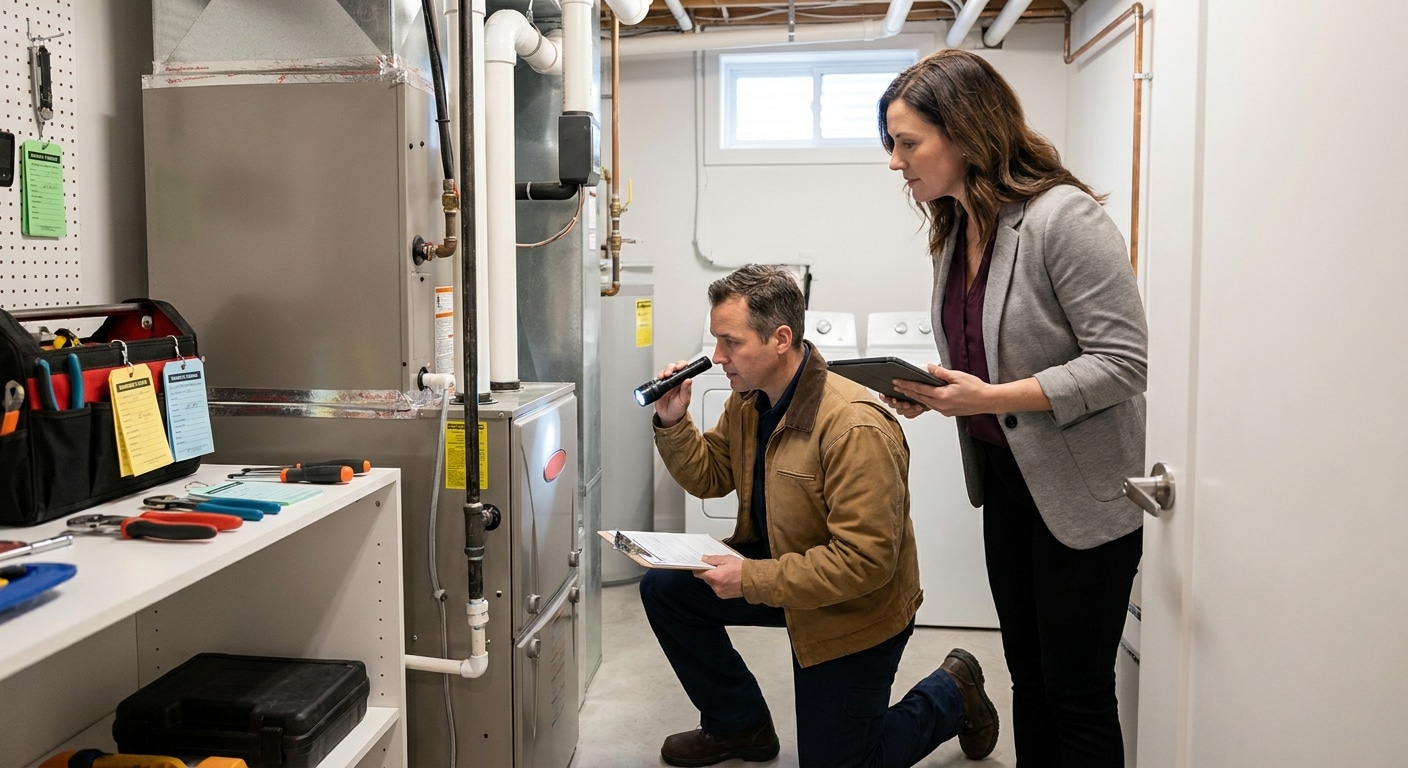
Furnace Maintenance Plan for Landlords: 2026 Verdict
August 10th, 2026
Landlords managing three units and property managers overseeing forty face the same furnace problem: a no-heat call at 11 PM during a cold snap, and no record of when the unit was last serviced. This guide breaks down what a real furnace maintenance plan for landlords should cover in 2026, which plan structures hold up across a rental portfolio, and which ones look good on paper but fall apart the first time a tenant misses a scheduled visit.
- A per-door annual maintenance agreement is the safest structure for a furnace maintenance plan for landlords with 2+ units.
- Single-visit tune-ups without documentation are a liability risk during eviction or insurance disputes in 2026.
- Tenant-scheduled maintenance fails at a high rate across Utah rentals because access coordination breaks down.
- Bundled portfolio contracts cut per-unit cost but only work with 5+ properties on one service provider.
Who this is for
This is written for landlords with two or more rental units and property managers responsible for HVAC uptime across a portfolio they don't personally occupy. If you're fielding tenant complaints about a cold bedroom in January, coordinating access schedules across multiple addresses, or trying to prove a furnace was serviced before a security deposit dispute, the plan structure you pick determines whether 2026 is a year of predictable line items or emergency invoices. Homeowners maintaining a single furnace in a house they live in don't need this level of structure — that's a different best home HVAC systems for Utah homes conversation.
Why this matters
A furnace that fails mid-January in Northern Utah isn't a maintenance inconvenience — it's a habitability issue. Utah landlords carry legal exposure when heat fails and tenants can't stay in the unit, and unplanned furnace replacement runs several times the cost of an annual tune-up. Property managers juggling multiple addresses lose more money to emergency dispatch fees and after-hours labor rates than they ever would to a structured plan. The math only works if the plan actually gets executed, which is where most landlord maintenance falls apart.
What to look for in a furnace maintenance plan for landlords
Per-unit scheduling, not a single annual reminder
A plan that treats a four-plex as "one furnace visit" instead of four separate service records won't hold up when you need proof a specific unit was inspected. Each door needs its own service date, its own filter change log, and its own inspection report — otherwise you can't answer "was Unit B's furnace checked before the tenant moved in" with anything but a guess.
Priority response during cold-weather calls
Ask whether the plan includes priority scheduling during December through February, when every HVAC company in Northern Utah is fielding no-heat calls simultaneously. A maintenance agreement that doesn't move you ahead of walk-in customers during peak season isn't actually protecting your tenants — it's just a filter change with extra paperwork.
Documentation you can hand to an insurer or a court
Every visit needs a dated, written record: what was inspected, what was replaced, what condition the heat exchanger and ignition system were in. This matters during eviction disputes, insurance claims after a carbon monoxide incident, and lease renewals where a tenant claims the unit was never maintained.
Access logistics that don't depend on the tenant
The best plans coordinate access through the property manager or landlord, not through a tenant who may ignore a text reminder or be unavailable during business hours. If the plan's scheduling model requires tenant cooperation to get the technician inside, expect a missed-visit rate that defeats the purpose of having a plan at all.
Cost structure that scales with your portfolio
A per-visit rate makes sense for two units. It stops making sense at ten. Look for per-door annual pricing or a portfolio-wide contract once you cross five or six properties — the savings compound and the billing becomes one line item instead of a dozen scattered invoices.
Coverage that extends past the furnace itself
A furnace failure in a rental is rarely isolated — gas line issues, ductwork problems, and electrical panel age all interact with heating performance. A provider that only touches the furnace and ignores a failing gas line connection is handing you a callback in six months.
Get a furnace maintenance plan built for rentals
Per-door scheduling and documented visits across Northern Utah rental portfolios.
Top picks: plan structures that actually work
Per-door annual maintenance agreement — the safe pick. One scheduled visit per unit per year, billed and documented separately, with priority scheduling during peak winter months. This is the structure that holds up for portfolios of 2 to 15 units where each furnace has its own service history. Buy if you manage rentals directly and need a defensible paper trail.
Portfolio-wide bundled contract — the scale pick. A single contract covering every furnace across five or more properties, with one consolidated invoice and one point of contact for scheduling. Cuts per-unit cost noticeably compared to individual visits, but only makes sense once you're managing enough doors to justify the volume. Buy for property managers running larger portfolios; Skip if you're under five units — the per-door plan is simpler and cheaper at that size.
Single-visit tune-up with no contract — the reactive pick. You call, someone comes out, the furnace gets checked once. No recurring schedule, no documentation trail beyond that one invoice. Fine as a stopgap before a lease turnover inspection. Consider for a one-time pre-move-in check; Skip as your ongoing rental maintenance strategy.
Tenant-scheduled maintenance — the risky pick. The plan technically exists, but the tenant is responsible for calling to book the visit. This structure has a high failure rate across rental properties because tenants deprioritize maintenance calls until something breaks. Skip. If a plan puts scheduling in the tenant's hands, it isn't really a landlord maintenance plan — it's a suggestion.
No plan, reactive repairs only — the expensive pick. You wait for the no-heat call and dispatch emergency service when it happens. This costs more per incident in after-hours labor and puts you in a worse legal position if a tenant argues the unit was never maintained. Skip, especially heading into the 2026-2027 heating season.
If a furnace failure happens alongside a plumbing issue during a cold snap — frozen or burst lines are common in the same weather that stresses a furnace — the coordination problem gets worse for landlords managing this without a documented plan. That's covered in more detail in emergency plumbing for rental property landlords.
What to avoid
- A "maintenance included in rent" verbal agreement with no schedule attached. It sounds landlord-friendly but produces zero documentation and zero accountability when something fails.
- Filter-only service plans marketed as full maintenance. Changing a filter isn't inspecting a heat exchanger, checking ignition components, or testing carbon monoxide levels. A plan that stops at the filter is a marketing label, not maintenance.
- Bundling furnace checks with unrelated home warranty add-ons. These often exclude the exact repairs landlords need most — heat exchanger cracks, blower motor failure — behind fine print that only surfaces after a claim is denied.
“If a plan’s scheduling depends on the tenant remembering to call, it isn’t a maintenance plan — it’s a suggestion.”
Verdict comparison
| Plan structure | Documentation | Response priority | Best portfolio size | Verdict |
|---|---|---|---|---|
| Per-door annual agreement | Full record per unit | High during winter | 2-15 units | Buy |
| Portfolio bundled contract | Full record, consolidated billing | High during winter | 5+ units | Buy |
| Single-visit tune-up | One-time invoice only | Standard | Any (as a stopgap) | Consider |
| Tenant-scheduled plan | Inconsistent | Standard | Not recommended | Skip |
| No plan / reactive only | None | Emergency queue | Not recommended | Skip |
Water heaters follow a nearly identical logic for rental portfolios — same access problems, same documentation gaps, same seasonal risk. If you're structuring a furnace plan in 2026, it's worth reviewing water heater repair for rental properties at the same time, since both systems often get bundled into one service visit for efficiency.
For commercial or multi-tenant buildings where sewer and mechanical systems interact with heating infrastructure in shared basements, the maintenance logic extends further — see commercial sewer line maintenance for property managers for how the two get coordinated on larger properties.
FAQ
What is a furnace maintenance plan for landlords?
It’s a scheduled, documented service agreement that inspects and services a rental property’s furnace on a recurring basis, typically annually, with a written record per unit. It differs from a single tune-up by including priority scheduling and a paper trail landlords can use for legal or insurance purposes.
How much does furnace maintenance cost for a rental property in 2026?
Per-door annual agreements typically cost less per unit than one-off emergency calls once you factor in after-hours labor rates during peak winter demand. Portfolio-wide contracts reduce the per-unit cost further once you’re managing five or more properties.
Is an annual furnace tune-up required for rental properties in Utah?
Utah doesn’t mandate a specific maintenance schedule, but landlords carry habitability obligations that make documented heat maintenance a practical necessity, especially during winter months when heat failure can trigger a legal dispute.
Who is responsible for furnace maintenance, the landlord or the tenant?
The landlord or property manager is responsible for structural and mechanical system upkeep, including the furnace. Relying on tenants to schedule maintenance is a common failure point in rental HVAC plans.
How often should a rental furnace be serviced?
Once per year at minimum, with filter changes on a more frequent cycle depending on occupancy and pet presence. Multi-unit buildings benefit from staggering service visits so not every furnace goes down for inspection at once.
What happens if a furnace isn’t maintained and it fails during winter?
You’re looking at emergency dispatch costs, a habitability complaint from the tenant, and in some cases a legal obligation to provide alternative heating or temporary housing until it’s fixed. A documented maintenance history is your best protection if a dispute follows.
Can one maintenance plan cover multiple rental properties?
Yes. Portfolio-wide bundled contracts consolidate scheduling and billing across multiple addresses under one provider, which works well once a landlord or property manager is handling five or more units.
Does furnace maintenance include gas line or electrical checks?
A complete plan should include a check of gas line connections and ignition electrical components, since furnace failures are often tied to one of these adjacent systems rather than the furnace unit itself.
One last thing
The detail most landlords miss: the furnace visit is the cheapest time to catch a gas line connection problem, because the technician is already inside the mechanical closet with the panel open. Skipping that five-minute check to save on a slightly cheaper filter-only plan is how a $200 furnace visit turns into a $2,000 gas line repair discovered mid-winter.
Related guides
- Emergency plumbing for rental property landlords
- Water heater repair for rental properties
- Commercial sewer line maintenance for property managers
- Best home HVAC systems for Utah homes