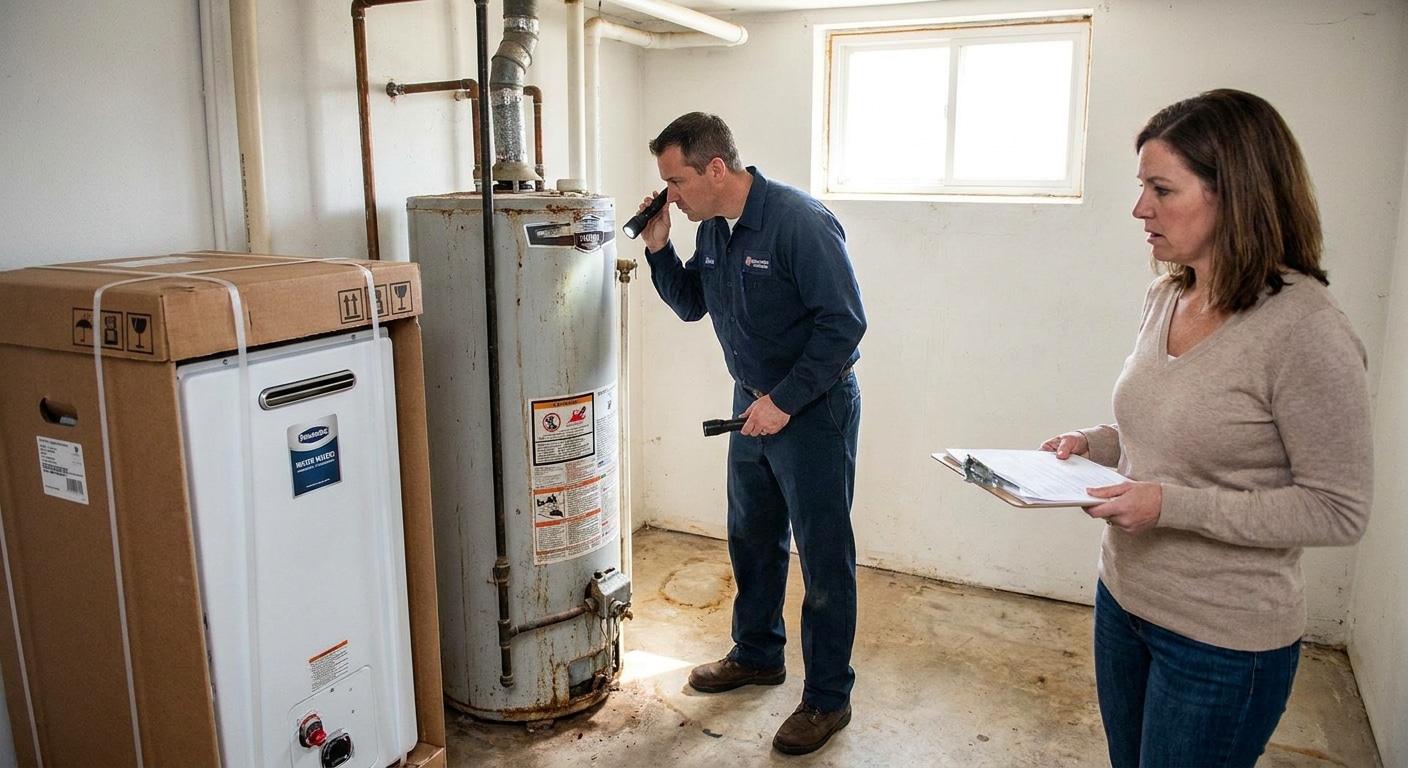
Water Heater Replacement vs Repair: 2026 Signs to Know
August 8th, 2026
A leaking tank, rusty water, or a repair bill that keeps climbing all point to the same question: fix it again or replace the water heater for good. This guide breaks down the exact signs that separate a fixable problem from a unit that's done, plus the steps to make the call yourself before you spend money on a repair that won't hold.
- A water heater over 10 years old with rust-tinted water needs replacement, not another repair, in 2026.
- Repair costs above 50% of a new unit’s installed price mean replacement wins the math every time.
- Rumbling or popping noises mean sediment has hardened on the tank floor — that’s not a repairable condition.
- A leak at the tank’s base signals a cracked steel shell, and no patch or part fixes that.
- Commercial units in restaurants fail faster under constant demand and usually need replacement sooner than home units.
Why this matters
A water heater lasts 8 to 12 years on average, and once it passes that window, every repair is a bet against the tank itself, not just the part that broke. Utah's hard water accelerates sediment buildup inside the tank, which shortens that lifespan for a lot of homes in Northern Utah specifically. Get the water heater replacement call wrong and you're either paying for a repair that fails again in six months, or replacing a unit that had a few good years left in it.
The difference between water heater replacement vs repair usually comes down to three things: the age of the unit, the location of the failure, and whether the tank itself (not just a part) is compromised. Get those three answers and the decision makes itself.
What you'll need
- The manufacture date on the unit's rating plate (not the install date — check the serial number if the plate is worn)
- A flashlight to check the base of the tank and surrounding floor for moisture
- Your last 12 months of utility bills if you're comparing energy costs
- A repair quote in hand, if you've already had a tech look at it
- 15-20 minutes to run through the diagnostic steps below before calling anyone
The steps
1. Check the age stamped on the unit
The serial number on most tanks encodes the manufacture date — the first two digits are usually the year, sometimes a letter-month code precedes it. A tank built before 2016 is already past the median lifespan for 2026, and any major failure at that age should push you toward replacement, not repair.
The common mistake here: homeowners check the install date on a sticker instead of the manufacture date, which can be a year or more off. If you can't decode the serial, the unit's warranty card or the plumber's original invoice usually has the manufacture year printed on it.
2. Look at the water itself
Run the hot water for two minutes and check the color and smell. Rust-colored or muddy water signals the tank's interior lining is corroding, and once that starts, it doesn't reverse — it's a sign the steel shell itself is breaking down from the inside out.
A sulfur or rotten-egg smell is different: that's usually the anode rod reacting with sediment, and that part is replaceable. Rust-colored water is a replacement signal. A sulfur smell is a repair signal. Don't confuse the two.
3. Listen for sediment noise
Turn the unit on and listen for popping, rumbling, or cracking sounds from inside the tank. That noise is water boiling underneath a hardened layer of mineral sediment on the tank floor, and it means efficiency has already dropped noticeably — some units lose 10-15% efficiency once sediment builds up this far.
Flushing the tank can quiet this down temporarily if it's caught early, but once the sediment has calcified into a hard layer (which takes years, not months), flushing won't remove it and the noise comes back within weeks.
4. Inspect the base for moisture
Get the flashlight and check the floor around the tank's base, plus the seam where the tank body meets the bottom. Any dampness here — not condensation, actual pooling or a wet stain on the floor — means the tank shell has a crack or the seam has failed.
This is the single clearest sign in this whole list: a leak from the tank body itself cannot be repaired. A leaking valve or fitting can be swapped out; a leaking tank cannot.
5. Run the 50% rule on the repair quote
If a technician has already quoted a repair, compare that number to the installed cost of a new unit — most standard tank water heaters run $1,200 to $2,500 installed in 2026, depending on size and venting. If the repair quote is more than half that number, replacement is the better math almost every time, because you're paying near-replacement cost for a unit that's already aged past the point of reliability.
Common mistake: comparing the repair quote only to the price of the water heater unit itself, not the installed cost. Installation, permits, and haul-away of the old tank add real cost on both sides of that comparison.
6. Factor in what the unit serves
A water heater in a rental property or a commercial kitchen carries different stakes than one in an owner-occupied home. Commercial water heater installation for restaurants deals with far higher recovery demand than residential units, and a marginal unit that limps along in a house will fail outright under a commercial load. If you manage a restaurant or high-demand commercial space, don't wait for a full failure — a unit already showing two or more signs above should get replaced on a planned schedule, not an emergency one.
Get a same-day water heater assessment
A licensed technician tells you replace or repair before you spend a dollar.
Troubleshooting
Water heater is under 5 years old but leaking. This is usually a fitting, valve, or the temperature-pressure relief valve, not the tank itself — get it inspected before assuming replacement, since a unit this young is still within its expected service window.
No hot water at all, unit is under 8 years old. Check the thermostat and heating element (electric) or the pilot/igniter (gas) first — total failure at this age is often a single component, not the whole tank.
Water is lukewarm but never fully hot. A failing heating element or a sediment layer insulating the burner from the water are both repairable, but if the unit is past 10 years old, factor in the age before paying for the part.
Popping noise returns within weeks of a flush. The sediment has hardened past the point a flush can remove — this is a replacement signal, not a sign the flush was done wrong.
Pilot light won't stay lit (gas units). Usually a failing thermocouple, a low-cost part on units under 10 years old — but on older units, this can also mean the gas control valve itself is failing, which pushes the cost calculation toward replacement.
Burst tank or major flooding. Stop water flow at the shutoff valve immediately and treat this as an emergency, the same way you would a burst pipe in winter — a burst tank means immediate replacement, no diagnostic needed.
Tools and resources
- Flashlight and a phone camera to document the base of the tank and any rust color in the water
- Manufacturer's rating plate or original install invoice to confirm the manufacture year
- A written repair quote, so you can run the 50% rule against replacement cost
- Licensed inspection, especially for commercial water heater installation for restaurants where downtime costs more than the unit itself
What to do next
If you landlord a rental property, the calculation shifts again — a tenant call about lukewarm water at 11pm is a different problem than the same issue in your own home. The guide on water heater repair for rental properties walks through how to triage tenant reports before dispatching a technician, which matters when you're managing more than one unit at a time.
FAQ
How do I know if I need a water heater replacement vs repair?
Check the unit’s age, the water color, and any leak at the tank base — a unit over 10 years old with rust-colored water or a base leak needs replacement, not repair. Anything younger with a single failed part, like a thermocouple or heating element, is usually a repair.
What’s the average lifespan of a water heater?
A standard tank water heater lasts 8 to 12 years on average. Hard water regions, including much of Northern Utah, tend to push units toward the lower end of that range due to faster sediment buildup.
How much does water heater replacement cost in 2026?
A standard tank water heater replacement runs $1,200 to $2,500 installed in 2026, depending on tank size, venting type, and whether code upgrades are needed. Commercial units for restaurants or high-demand buildings cost more due to recovery capacity requirements.
Is a leaking water heater always a replacement?
Not always — a leak from a fitting, valve, or the temperature-pressure relief valve is repairable. A leak from the tank body itself, especially at the base seam, means the steel shell has failed and requires full replacement.
Why does my water heater make popping or rumbling noises?
That noise is water boiling under a layer of hardened mineral sediment on the tank floor. Early sediment buildup can sometimes be cleared with a flush, but once it hardens, the noise returns and replacement is the more reliable fix.
Should I repair or replace a water heater in a rental property?
Weigh the repair cost against the unit’s age and how soon you’d need to replace it anyway — a unit over 8 years old with a costly repair quote in a rental usually isn’t worth fixing twice. Landlords managing multiple units benefit from replacing on a planned schedule rather than reacting to each tenant call.
What’s the 50% rule for water heater repair costs?
If a repair quote exceeds half the cost of a new installed unit, replacement is the better financial decision in almost every case. This rule accounts for the fact that an aging unit needing an expensive repair is likely to fail again soon after.
Does rust-colored water always mean the tank is failing?
Rust-colored water usually means the tank’s interior lining is corroding, which is not repairable and signals replacement. A rotten-egg smell without rust color is a different issue, usually the anode rod, and that part can be replaced.
One last thing
The anode rod inside most tanks is a $30-$50 part that, if replaced every 3-5 years, extends tank life significantly — and it's the single most skipped piece of water heater maintenance in 2026. If your unit is under 8 years old and showing early sediment noise, ask about anode rod replacement before assuming the whole tank needs to go.
Related guides
- Water heater repair for rental properties
- Emergency plumber for burst pipes in winter
- Commercial water heater installation for restaurants
- Emergency plumber in Salt Lake City