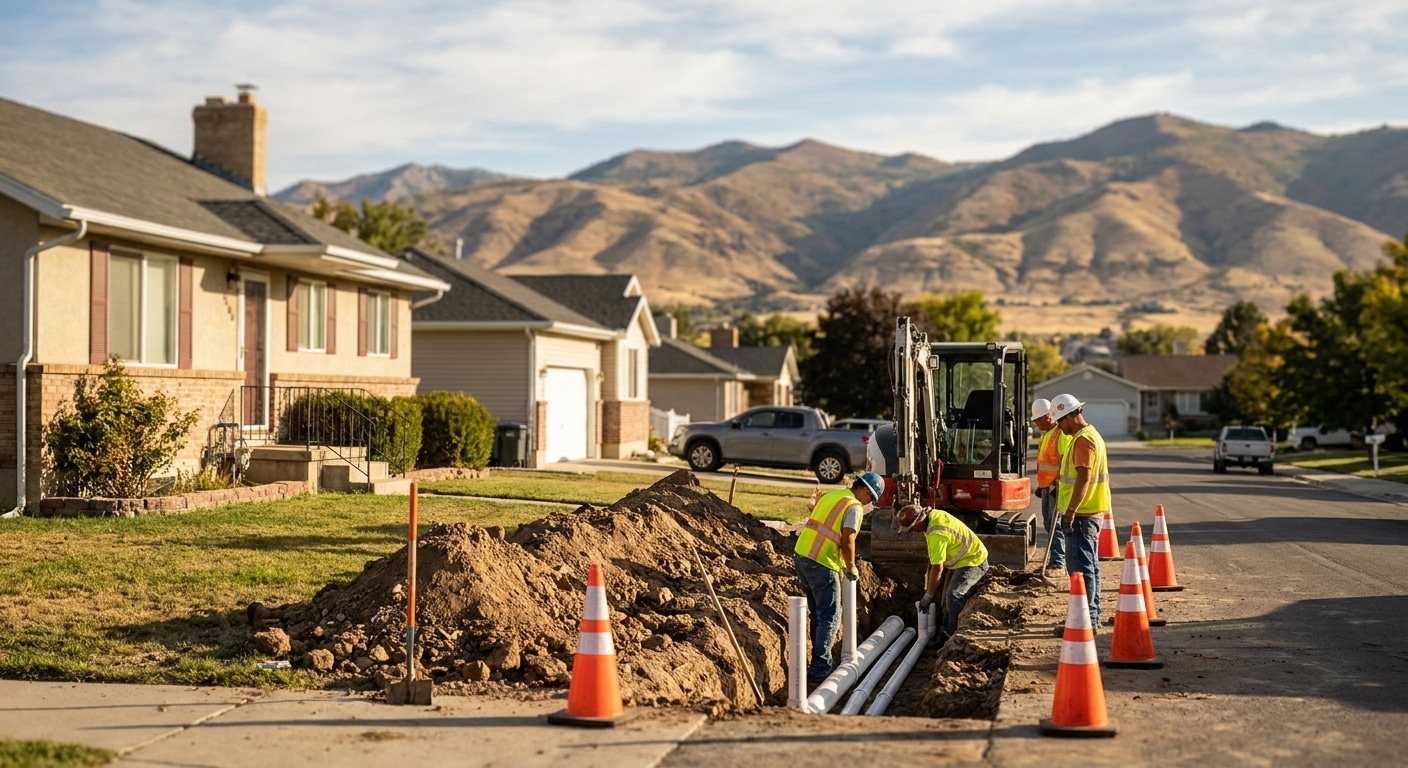
Sewer Line Replacement Cost Guide for Utah (2026)
August 9th, 2026
Replacing a sewer line in Utah in 2026 runs anywhere from $1,000 for a single spot repair to over $20,000 for a full trenchless replacement on a long residential run, and the number that applies to you depends almost entirely on pipe material, length, and access.
- Sewer line replacement cost in Utah ranges from $1,000 for spot repairs to $20,000+ for full trenchless jobs in 2026.
- Trenchless pipe bursting and CIPP lining run $80-$250 per linear foot and skip the yard destruction of open-trench digging.
- Cast iron sewer lines older than 50 years are the top reason Utah homeowners move from repair to full replacement.
- A camera inspection ($150-$500) before any quote is non-negotiable — it tells you if you need a $1,500 spot repair or a $10,000 replacement.
Why this matters
A sewer line failure doesn't announce itself politely. It shows up as a slow drain that turns into standing water in the basement, or a sinkhole forming near the yard's cleanout.
The cost gap between fixing it early and fixing it after a backup is enormous. A $1,500 spot repair on a cracked section becomes an $18,000 emergency dig-and-replace once sewage has saturated the soil under a driveway. Expert Services sees this pattern across Northern Utah homes built before 1980, where original cast iron or clay lines are now 50-70 years old and past their design life.
Knowing the real cost ranges before a contractor shows up puts you in control of the conversation instead of reacting to a scare number.
How this guide was built
The cost ranges here reflect standard 2026 residential sewer line pricing across trenchless and traditional methods, broken down by linear foot and by job type. Ranking criteria: total installed cost, disruption to the property, timeline, and long-term durability for Utah's clay-heavy soil and freeze-thaw cycles.
Each method below gets ranked by where it fits in the decision tree — from cheapest partial fix to full-system replacement — not by which is universally "best." The right pick depends on pipe age, material, and how much of the line has already failed.
Sewer line replacement options, ranked by cost and use case
1. Spot repair — the cheapest fix, if the damage is contained
One memorable detail: spot repairs fix a single failure point, typically 3-8 feet of pipe, without touching the rest of the line.
A contractor excavates or accesses just the damaged section — a cracked joint, a root intrusion point, a collapsed segment — and replaces or relines that piece alone. Cost in 2026 runs $1,000 to $4,000 per section, making it the entry point for anyone with a camera inspection showing one isolated problem area.
This only makes sense when the rest of the line tests clean. If a camera inspection shows scaling, multiple cracks, or bellies (low spots where waste pools) along the run, spot repair is a temporary patch on a line that's going to need full replacement within a few years anyway. Verdict: Buy — but only after a camera inspection confirms the damage is truly isolated.
2. Trenchless pipe lining (CIPP) — best for aging pipes with structural integrity left
Cured-in-place pipe (CIPP) lining threads a resin-saturated liner through the existing pipe and cures it in place, creating a new pipe inside the old one without digging.
This works when the old pipe still holds its shape but has cracks, root intrusion, or corrosion. Cost runs $80 to $200 per linear foot in 2026, and a typical 50-foot residential line lands between $4,000 and $10,000. No yard excavation, no torn-up driveway, and the job usually finishes in a single day. Homes with cast iron pipes that still hold structural shape are the best candidates.
Lining won't work on a pipe that's collapsed, severely bellied, or crushed under a slab shift — the liner needs a host pipe to conform to. Verdict: Buy for structurally sound but deteriorating lines; Skip if the camera shows collapse or major offset joints.
3. Trenchless pipe bursting — best for fully failed pipes without room to dig
Pipe bursting pulls a new HDPE pipe through the old one while a bursting head fractures the original pipe outward into the surrounding soil, replacing the entire line without an open trench.
This is the move when the old pipe is too far gone for lining but the yard, driveway, or landscaping makes open-trench digging expensive or destructive. Cost runs $80 to $250 per linear foot in 2026 — comparable to lining but usable on pipes that have collapsed or lost their shape. A crew can typically finish a 50-60 foot residential line in one to two days versus the week-plus timeline of a full dig.
It does require access pits at both ends of the run, so a line running under a finished patio or an addition may still need spot excavation at the access points. Verdict: Buy for full-line failures where trenching isn't practical.
4. Open-trench replacement — the traditional method, still the right call for shallow or short runs
Open-trench digging removes the entire old pipe and replaces it with new PVC in a dug trench along the same or a new path.
Cost runs $50 to $250 per linear foot, with most Utah residential jobs totaling $4,500 to $12,000 for a 40-60 foot line in 2026, depending on depth, soil, and whether concrete or landscaping needs to be replaced afterward. It's still the most direct method for shallow lines under 6 feet with easy yard access and no obstacles like mature trees or hardscape.
The tradeoff is disruption — a torn-up yard, driveway, or sidewalk section for one to two weeks, plus restoration cost that isn't always included in the initial quote. Verdict: Consider when trenchless methods aren't priced competitively for a short, shallow, obstacle-free run; Hold if landscaping or hardscape restoration would eat the savings.
5. Full system repipe — for homes where the whole line, not one section, has failed
A full repipe replaces the sewer line from the house connection all the way to the municipal main or septic tank, sometimes alongside interior drain line work if cast iron pipes inside the house are also failing.
This is the highest-cost option, running $8,000 to $20,000+ in 2026 depending on total length, depth, and whether trenchless or open-trench methods apply across the run. It's the right call for homes over 50 years old where the camera inspection shows failure at multiple points along the entire line, not just one section.
Skipping this in favor of repeated spot repairs on a failing 60-year-old line usually costs more over 3-5 years than doing the full replacement once. Verdict: Buy for homes with system-wide failure confirmed by inspection; Skip the piecemeal approach once you're past two spot repairs on the same line.
Get a sewer line cost estimate
Camera inspection and written quote before any digging starts.
Cost comparison table
| Method | Cost (2026) | Timeline | Disruption | Best for |
|---|---|---|---|---|
| Spot repair | $1,000-$4,000/section | 1 day | Minimal | Single isolated failure |
| CIPP lining | $80-$200/linear ft | 1 day | None | Aging pipe, still structurally sound |
| Pipe bursting | $80-$250/linear ft | 1-2 days | Access pits only | Fully failed pipe, tight yard |
| Open-trench dig | $50-$250/linear ft | 1-2 weeks | High | Shallow, obstacle-free runs |
| Full repipe | $8,000-$20,000+ | 1-3 weeks | High | System-wide failure, homes 50+ years old |
Where to hire a sewer line contractor in Utah
Three rules before signing any quote in 2026:
- Get a camera inspection first, always. A contractor quoting a price without running a camera down the line is guessing. The $150-$500 inspection cost saves thousands by confirming exactly what's wrong before anyone digs.
- Confirm the permit is pulled, not skipped. Most Utah municipalities require a permit for sewer line work, typically $100-$500. A contractor who suggests skipping it is cutting corners that show up later during a home sale inspection.
- Ask what's included in restoration. Open-trench quotes sometimes exclude landscaping, concrete, or sod replacement — get that itemized separately so the final invoice doesn't surprise you.
“If the camera shows failure at more than one point along the line, stop pricing spot repairs and start pricing full replacement.”
Landlords dealing with a failing line on a rental property face a tighter timeline — a sewer backup in an occupied unit isn't a wait-and-see repair. The same inspection-first approach applies, but rental property landlords should budget for emergency response speed as part of the total cost, not just the pipe work itself.
FAQ
What’s the average sewer line replacement cost in Utah in 2026?
Most Utah homeowners pay between $4,500 and $12,000 for a full sewer line replacement in 2026, with trenchless methods running $80-$250 per linear foot and traditional open-trench digging running $50-$250 per linear foot. Spot repairs on a single damaged section cost $1,000-$4,000.
Is trenchless sewer replacement cheaper than traditional digging?
Trenchless methods often cost about the same or slightly more per linear foot than open-trench digging, but they skip the landscaping, driveway, and hardscape restoration costs that traditional digging adds. For yards with mature trees, patios, or finished landscaping, trenchless usually comes out cheaper overall.
How long does sewer line replacement take?
Trenchless pipe bursting or CIPP lining typically finishes in one to two days. A traditional open-trench replacement takes one to two weeks including restoration of the dug area.
Does homeowners insurance cover sewer line replacement?
Standard homeowners insurance rarely covers sewer line replacement unless the failure results from a covered event like a sudden collapse, and even then many policies exclude wear-and-tear failures. Check your specific policy for a sewer line or service line endorsement, which some insurers offer as an add-on.
How do I know if I need a repair or a full replacement?
A camera inspection is the only reliable way to know. If the damage is limited to one section and the rest of the pipe tests clean, a spot repair or lining job handles it; if there’s failure at multiple points along the run, full replacement is usually cheaper long-term than repeated repairs.
What causes a sewer line to fail?
Root intrusion, pipe age (cast iron and clay lines commonly fail after 50-70 years), soil shifting, and corrosion are the most common causes in Utah. Homes with cast iron pipes are especially prone to internal scaling that narrows the pipe over decades.
Do I need a permit to replace a sewer line in Utah?
Most Utah municipalities require a permit for sewer line replacement, typically costing $100-$500. Skipping the permit can cause problems during a future home sale inspection or insurance claim.
Is trenchless pipe lining as durable as a new pipe?
CIPP lining creates a new structural pipe inside the old one and is rated for decades of service life, comparable to new PVC, as long as the host pipe hasn’t collapsed. It won’t work on pipes that have lost their shape or collapsed sections.
One last thing
The single biggest cost driver isn't the method you pick — it's how long you wait after the first warning sign. A slow drain or gurgling toilet in 2026 is a $150 camera inspection away from an answer; ignored for a year, it's a collapsed line and a five-figure emergency dig. If your sewer line is original to a home built before 1975, get it scoped before it forces the decision for you.
Related guides