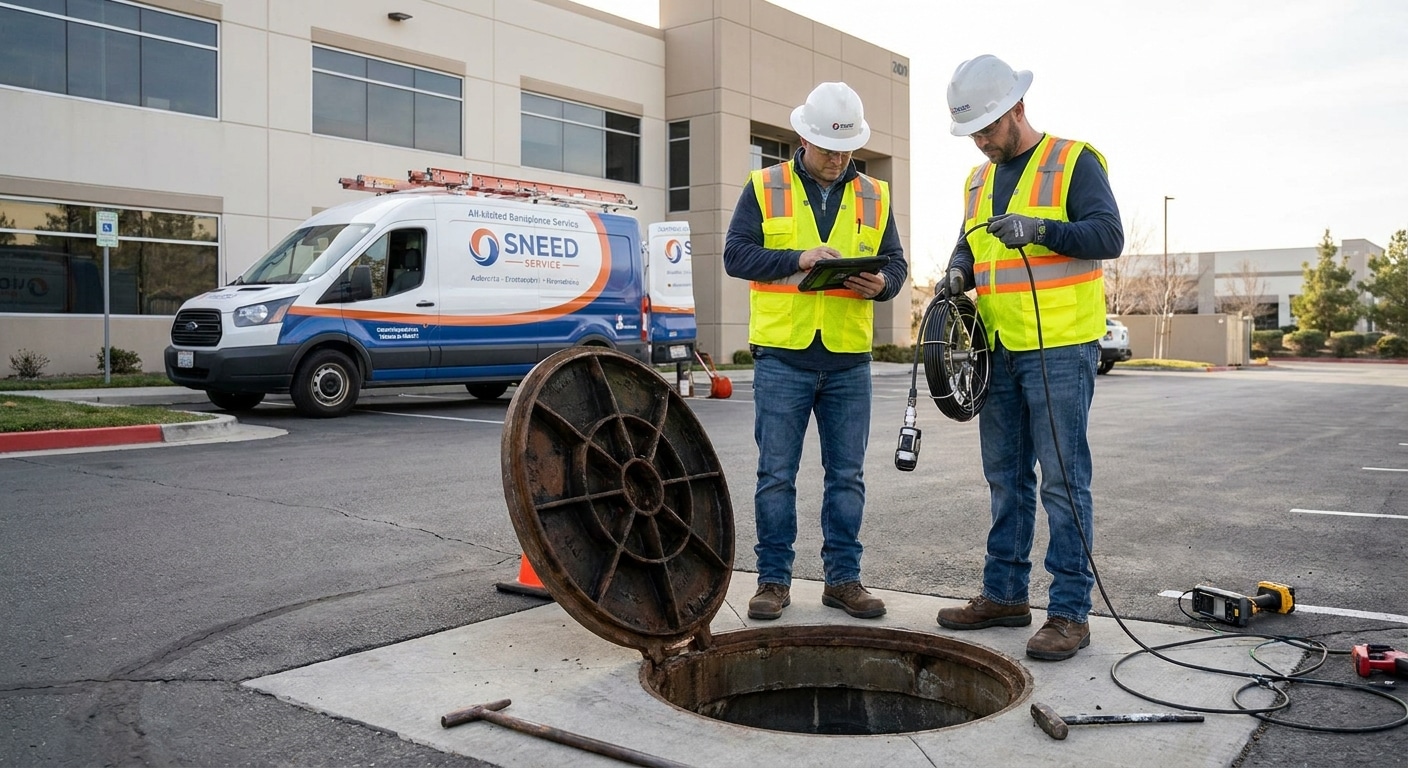
Commercial Sewer Line Maintenance for Managers 2026
August 9th, 2026
Property managers who wait for a sewer backup to schedule maintenance end up paying for tenant relocations, business interruption claims, and emergency dispatch fees — all of which cost more than a maintenance contract ever would. This guide breaks down what commercial sewer line maintenance actually requires in 2026, what to prioritize across a multi-tenant portfolio, and which services deliver the most protection per dollar.
- Camera inspection before hydro jetting saves money by targeting the actual blockage instead of guessing — Buy.
- Hydro jetting clears grease and root intrusion better than mechanical rodding for restaurant and multi-tenant lines — Buy.
- Annual maintenance schedules beat reactive repair calls for properties with 10+ units or food service tenants in 2026.
- Skip generic residential drain cleaners for commercial lines — they lack the jetting pressure and camera equipment commercial sewer lines need.
Why this matters
A single sewer backup in a commercial building doesn't just mean one clogged drain — it means multiple tenants, shared stacks, and potential code violations if the property doesn't have documented maintenance records. Insurance carriers increasingly ask for maintenance logs after a claim, and cities across Northern Utah have tightened grease trap enforcement for food service tenants in recent years. Property managers who treat sewer maintenance as a line item instead of an afterthought avoid the five-figure repair bills that come from a collapsed lateral line nobody caught in time.
Who this is for
This guide is built for property managers and facilities directors overseeing multi-tenant commercial buildings, strip malls with restaurant tenants, office parks, and mixed-use properties across Northern Utah. If you're managing a portfolio where a single sewer backup could shut down three tenants at once, or where a restaurant lease requires documented grease trap service, the criteria below apply directly to your maintenance planning for 2026.
What to look for in commercial sewer line maintenance
Camera inspection capability
A maintenance provider without video inspection equipment is guessing at what's actually happening inside the line. Camera inspection identifies root intrusion, pipe bellies, offset joints, and grease buildup before they become backups, and it gives you documented evidence for insurance and tenant disputes. For buildings with cast iron or clay lateral lines older than 30 years, this isn't optional — it's the baseline.
Hydro jetting equipment and pressure rating
Mechanical snaking punches a hole through a clog; hydro jetting scours the entire pipe wall clean. Commercial lines serving restaurants need jetting pressure in the 3,000-4,000 PSI range to cut through grease buildup that rodding can't touch. A provider running residential-grade equipment on a commercial kitchen line is setting you up for a repeat call within 90 days.
Response time guarantees for multi-tenant buildings
A backed-up main line in a building with eight tenants isn't a same-week problem — it's a same-day problem. Ask any provider what their actual dispatch window looks like for commercial emergencies, not just what's advertised. Properties with restaurant tenants especially need a provider who treats a kitchen backup as the revenue-loss event it is.
Grease trap and FOG (fats, oils, grease) compliance knowledge
If any tenant runs a commercial kitchen, the sewer line maintenance plan has to account for FOG buildup separately from general drain maintenance. Utah municipalities enforce grease trap inspection and pumping schedules, and violations land on the property owner, not just the tenant. A provider who understands commercial kitchen plumbing catches this before code enforcement does.
Licensing and commercial-scale experience
Residential plumbers and commercial sewer specialists are not interchangeable. Commercial lines run larger diameters, deeper trenching, and shared-stack configurations that require different diagnostic approaches. Verify the provider is licensed for commercial work in Utah and has documented experience with multi-tenant or restaurant-anchored properties specifically.
Documentation and maintenance records
Insurance carriers and city inspectors both want a paper trail. A provider who logs every inspection, jetting session, and repair with dates and findings gives you the record you need when a claim or lease dispute comes up. Verbal-only service reports don't hold up when you need proof of preventive maintenance.
Top picks: commercial sewer maintenance services worth scheduling
Camera inspection and line assessment — the diagnostic first move. Video inspection maps root intrusion, cracks, and grease buildup along the full lateral run, typically covering runs up to 200 feet in a single pass. For any commercial building without recent inspection records, this is the starting point before spending on jetting or repairs. Buy — schedule this first on any property without documentation from the last 12 months, and pair the findings with a broader look at commercial drain cleaning for restaurants and offices if the building has food service tenants.
Hydro jetting — the deep clean that actually resets the pipe. Jetting at 3,000+ PSI clears grease, scale, and root hair from the entire pipe wall rather than punching a channel through the middle of a clog. Buildings with restaurant tenants typically need this two to four times a year; general office or retail lines can often run on an annual schedule. Buy for any property with a food service tenant — read more on hydro jetting for stubborn drain clogs before setting the frequency.
Root intrusion treatment — the recurring nuisance fix. Older Northern Utah properties with clay or cast iron laterals near mature trees see root intrusion return every 12-18 months without treatment. Mechanical cutting combined with jetting removes the roots; a foaming root treatment applied after slows regrowth for 6-12 months. Consider this an add-on to your annual jetting schedule rather than a standalone fix — root cutting alone without addressing the crack that let roots in will just repeat the cycle.
Grease trap and kitchen line service — the restaurant-specific pick. Commercial kitchens generate FOG buildup that regular jetting elsewhere in the building doesn't touch. A dedicated grease trap pumping and kitchen line service schedule keeps you compliant and keeps the shared stack from backing up into neighboring units. Buy for any building with a restaurant, cafe, or food service tenant — see the 24-hour plumber for restaurants and commercial kitchens guide for what emergency coverage should include on top of scheduled service.
Emergency response retainer — the safety net for multi-tenant risk. A standing service agreement with guaranteed dispatch times protects you from the scramble of finding an available commercial plumber during a Friday night backup. Properties running six or more tenant units see the fastest payback on this because the cost of a single after-hours emergency call often exceeds a quarter of an annual retainer. Consider this if your portfolio has had more than one emergency dispatch in the past 12 months — otherwise a strong scheduled maintenance plan may cover the risk on its own.
Get a commercial sewer maintenance plan
Camera inspection, hydro jetting, and scheduled service for Northern Utah properties.
What to avoid
- Snake-only service with no camera work. Rodding clears the immediate symptom but leaves the actual damage — cracked pipe, offset joints, grease coating — undocumented and untreated, which means you're paying for the same call again in a few months.
- Annual-only schedules for restaurant tenants. A once-a-year jetting plan is fine for an office building's lateral line but is not enough for a shared stack feeding a commercial kitchen; FOG buildup accumulates faster than that.
- Residential-grade equipment on commercial lines. A provider quoting a flat low rate for a commercial sewer job is often running equipment sized for a single-family home, which won't reach the pressure or diameter commercial lines require.
Verdict comparison
| Service | Best for | Frequency | Verdict |
|---|---|---|---|
| Camera inspection | Buildings with no recent records | 1x/year minimum | Buy |
| Hydro jetting | Restaurant tenants, grease buildup | 2-4x/year | Buy |
| Root treatment | Older clay/cast iron laterals | Every 12-18 months | Consider |
| Grease trap service | Food service tenants | Per municipal code | Buy |
| Emergency retainer | 6+ tenant properties, prior emergencies | Standing agreement | Consider |
Properties managing older infrastructure alongside sewer maintenance should also look at how cast iron pipe condition affects drain performance — the same root intrusion and scale issues that hit lateral lines show up inside the building, covered in drain cleaning for homes with cast iron pipes.
"A snake clears the symptom; a camera and a jetter fix the actual pipe."
FAQ
How often should commercial sewer lines be maintained?
Commercial sewer lines need camera inspection at least once a year and hydro jetting two to four times a year if a restaurant or food service tenant is on the shared stack. Office and retail-only buildings can often run on an annual jetting schedule with inspection findings guiding the exact timing.
What’s the difference between snaking and hydro jetting for commercial lines?
Snaking punches a hole through a clog with a mechanical cable, while hydro jetting uses 3,000-4,000 PSI water pressure to scour the entire pipe wall clean. Commercial kitchen lines with grease buildup need jetting because snaking leaves the coating that caused the clog in place.
Is camera inspection worth it for commercial properties?
Yes, camera inspection is worth it because it identifies root intrusion, cracks, and grease buildup before they cause a backup, and it creates documentation insurance carriers and city inspectors ask for. Skipping it means paying for jetting or repairs without knowing what’s actually wrong.
How much does commercial sewer line maintenance cost in 2026?
Cost depends on line length, diameter, and how many services are bundled, so get a site-specific quote rather than relying on a flat estimate. Multi-tenant buildings with restaurant tenants typically need more frequent service, which affects the annual maintenance budget more than the per-visit rate.
Who is responsible for sewer line maintenance in a commercial lease?
Responsibility depends on the lease terms, but property owners are generally on the hook for the shared lateral line while tenants may be responsible for fixtures and grease trap maintenance inside their unit. Review the lease language and document maintenance schedules clearly to avoid disputes.
Do grease traps need separate maintenance from the sewer line?
Yes, grease traps need their own pumping and inspection schedule set by municipal code, separate from general sewer line jetting. Skipping grease trap maintenance is one of the fastest ways a restaurant tenant causes a shared-stack backup that affects the whole building.
What causes most commercial sewer backups?
Grease buildup from food service tenants and root intrusion in older clay or cast iron laterals cause most commercial sewer backups. Both are preventable with scheduled camera inspection and hydro jetting rather than waiting for a backup to call for emergency service.
One last thing
The properties that avoid emergency sewer calls almost always have one thing in common: a camera inspection on file from within the last 12 months. It costs a fraction of an emergency dispatch and turns every future maintenance decision from a guess into a documented plan — start there before anything else on this list.
Related guides
- Commercial drain cleaning for restaurants and offices
- Hydro jetting for stubborn drain clogs
- 24-hour plumber for restaurants and commercial kitchens
- Emergency plumbing for rental property landlords
- Drain cleaning for homes with cast iron pipes